
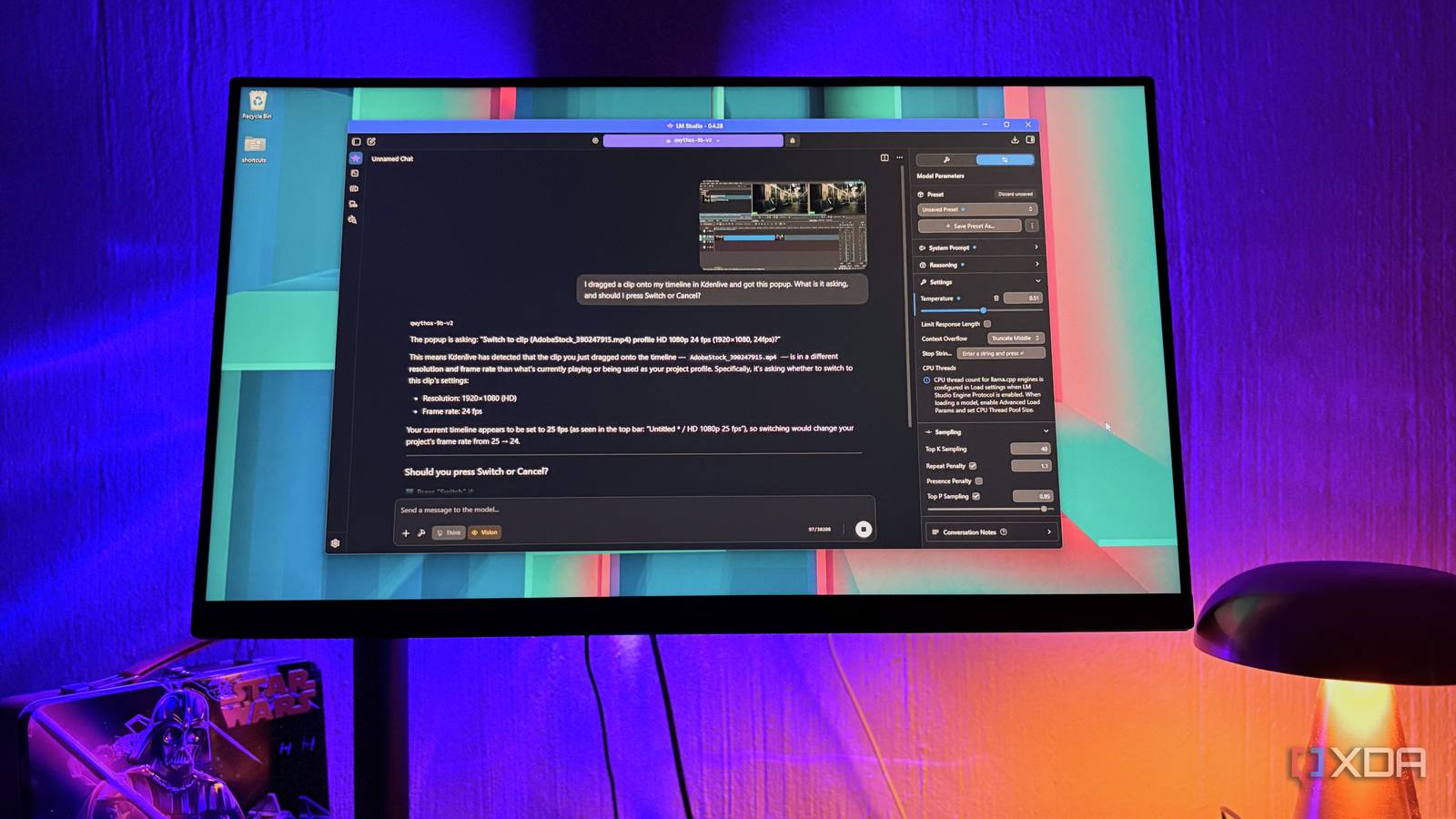
Published Nov 19, 2026, 10:30 AM EST Nolen began their writing career in 2019, with three years dedicated to editing the Creative section at MakeUseOf. Their expertise lies at the crossroads of technology and creativity, covering areas like photography, video editing, and graphic design. Outside of work, you'll often find Nolen diving into a good book, writing their own stories, or playing video games. Screenshots are one of the most common things people hand to a chatbot. It really is one of the most convenient ways to quickly get your information in without spending minutes typing out what you see on the screen. And so, image understanding has become one of the bigger reasons to pay for flagships like Claude or Gemini. Smaller local models tended to be weak in comparison on the vision front, especially when you only have an 8GB GPU and can't really run anything over 9B or set the context higher than 30k. Well, it seems local models have caught up, at least on paper they have. So I gave a 9B on my RTX 3070 the same screenshots and photos I'd normally pop over to Claude and Gemini to see if it really stands a chance. The 9B I use, and where its eyes come from It punches above its size Given how limited I am in testing new open-weights, I was excited to find Qwythos 9B because it's a little powerhouse that actually runs smoothly on my card. It's a community fine-tune from Empero AI, which is a small lab that takes existing open models and retrains them, and Qwythos 9B v2 is their take on Alibaba's Qwen 3.5 9B, using a technique called FTPO to reduce looping while preserving its reasoning. What I didn't know at first is that none of that training actually touched how it sees. According to Empero's model card only the text side was trained, while the vision part stayed frozen. So at first, it didn't seem to be the strongest with images. However, it still inherited Qwen's vision tower, so I knew it had to be good for something, and turns out it is, depending on what you send it. Qwen's own model card puts the 9B at 89.2 on OCRBench, a test of reading text inside images, and 65.2 on ScreenSpot Pro, which checks whether a model can find specific buttons on busy software screens. Those are Alibaba's numbers so I'd treat them as a rough guide. But this pretty much lines up with my experience with Qwythos - not the best for UI, but actually pretty good for text in images. Vision needs a second, smaller file called a vision projector, which converts the image into something the language model can work with. LM Studio's built-in downloader grabs it for you. The Q4_K_M version of Qwythos is 5.74GB, and the roughly 0.9GB projector on top still leaves room on my 8GB card. Putting a small, free model up against Gemini and Claude It depends on what's in the image I've been working with images in Claude, Gemini, and my local models for different tasks for about a year now. So they've all had their place in my stack, and there wasn't really a way to standardize this other than giving them some of the same images and prompts. I did not expect Qwythos to come out on top because it's going against some major workhorses (Opus 5.5, and Flash 3.8). But the point was to see if it could keep up. On screenshots that are mostly text, it kept up really well. Here, I asked it to pull a single chatbot reply out of a busy desktop screenshot; Qwythos copied it out line for line and matched Opus almost word for word, while Gemini actually ended up pulling the wrong part of the image. File and folder screenshots went well too, since file browsers and settings panels are mostly labels and numbers, and it even caught a file whose listed type didn't match its extension. I think it's safe to say that if you mainly send screenshots so you don't have to retype something, then a 9B on an 8GB card will probably have your back. But it got a little shakier when an image needed a decision among more complex visuals. On a video editor popup about changing the project's frame rate, Qwythos read everything correctly, then explained when you'd press each button without picking one. Opus picked the issue immediately, said why, and flagged that the file name in the popup didn't match the clip on the timeline. Qwythos read both names correctly too, but it didn't treat the mismatch as something worth checking. Its answers also run long, though at around 20 tokens per second on my card the wait is short, and this is something you can reel in with the settings that Claude and Gemini don't expose, anyway. The images that stay on my PC now The photos I don't want to send to the cloud are the easiest ones to read Of course, most of this use case is going to be for private screenshots, not buttons or app windows, but I'm obviously not showing those here. A photo of my medication is the clearest example, or a screenshot that happens to show my personal file names, logins, statements, contracts, or anything identifiable. These are the types of shots that are easy for Qwythos to read and where it's least likely to trip up - I don't need a full breakdown of a UI layout, I just need it to be able to extract information. And with Qwythos, I don't have to worry about reading up on retention policies or opting out of model training. Not every screenshot needs a frontier model The funny part is that I picked Qwythos for its Claude-style thinking, and it did its best work on the jobs where that thinking probably matters least. I haven't actually renewed my Gemini subscription yet this month, and am contemplating whether it's worth it at this point since Claude gets all my heavy work and Qwythos gets all my private work, so there's not much left beyond that. That reading side also covers most of what I send any model, private or not, which is when the subscription math started to not add up anymore.
I ran a local vision model on my 8GB GPU against Claude and Gemini, and it made me rethink paying for either
Full Article
Original Source
Read the full article at Xda-developers →KhanList aggregates and links to publicly available news content. We do not host full articles from third-party sources. Always verify important information with original sources.