
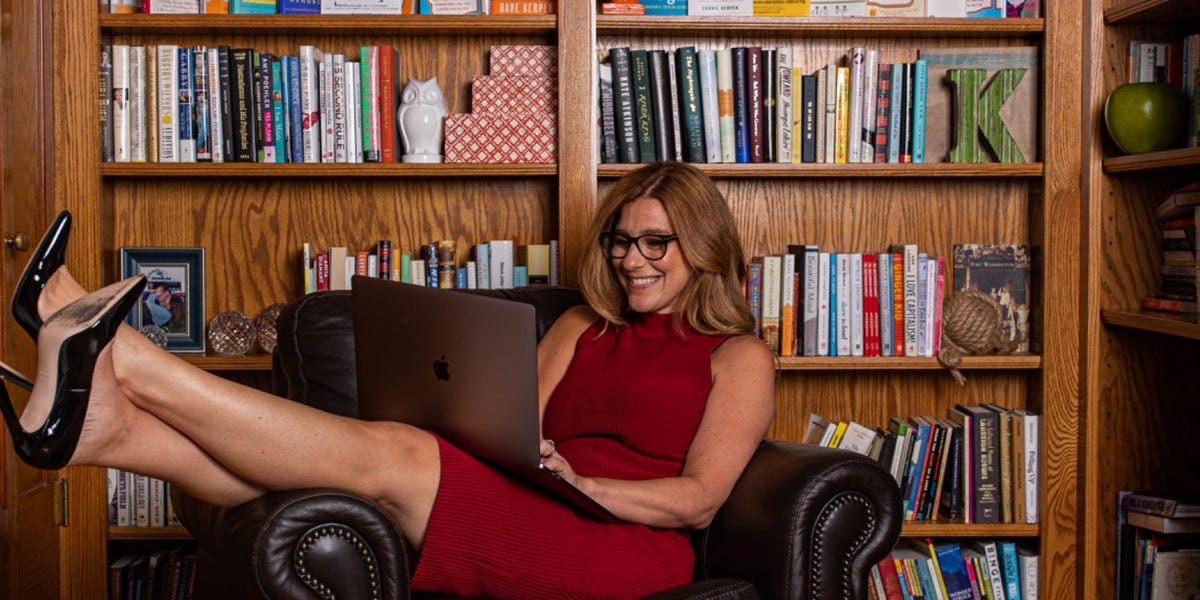
I raised $125,000 in sponsorships for my wedding. It accidentally launched an 8-figure business. Courtesy of Carrie Kerpen This as-told-to essay is based on a conversation with Carrie Kerpen, cofounder and CEO of Whisper Group. It has been edited for length and clarity.My parents wanted me to do something I loved that would bring me joy. But they also emphasized that I should find a secure, steady career.My dad opened a private law practice for a very brief time before leaving to become a law clerk and later a judge. He wanted the security and pension that came with a government job, and he was willing to sacrifice a lot of potential income for that predictability. My mom, a social worker, also had an extremely steady job.They took a similar approach to money and investing. When the stock market crashed in the 1980s, I heard the story on the news and asked my parents if we were OK. I remember my dad saying I shouldn't worry — my parents didn't invest in that, so we were safe.I only took risks when I felt I had toMy family had a very low-risk, simple life. My parents were content with that. At first I was, too. I was only comfortable taking risks once not taking them seemed intolerable.I got married for the first time at 24, and it quickly became clear the marriage wasn't going to work. I didn't have the courage to leave until my daughter was born when I was 26. Suddenly, the risk of being a single mom paled in comparison to the alternative: my daughter being raised in an unhappy home.I took a similar approach at work. I'd been told I would be a great salesperson. Yet I didn't take the leap into sales until the alternative — staying at a lesser-paying job — became too stressful.I leveraged a sponsored wedding into a businessMy biggest risk was my second wedding, which also turned out to be the launch of my business. When my now-husband David proposed, he told me he wanted a larger-than-life wedding. I didn't like that idea: I was holding shame over my first marriage and divorce.Still, I wanted David to have the wedding of his dreams, in a way we could afford. So, I took a huge risk: I contacted a minor-league baseball team about renting out their stadium. Then, we sold about $125,000 in sponsorships. Back in 2006, the idea of a sponsored wedding was totally new and could come across as a little gauche. But our sponsors, friends, and strangers loved it. When sponsors reached out to work with us again, we leveraged it into a media company, Likeable. We scaled the company over time, and sold Likeable in 2020 for eight figures.I teach other entrepreneurs—and my kids—that risk is importantI never would have been able to start my company or grow it as I did without accepting risk. I had to unlearn the lessons my parents had taught me about prioritizing security. At first, that was through necessity — like getting my daughter into a happier home. Carrie Kerpen built her business after her wedding. Courtesy of Carrie Kerpen Later, I learned to calculate the impact of risk. It's a skill I still use today: I reflect on the best-case scenario and the worst-case scenario. As the worst-case scenario is something I can live with, I'm willing to take the risk.I have these conversations every day with the female entrepreneurs I work with. Too often, female founders don't consider selling their companies because they don't know what they'll do next. Or, they don't acquire other companies because they're unsure how that works. Everything in entrepreneurship is risky, and I wish more women could consider calculated risks without fear.I also discuss risk with my kids, who are 23, 29, and 11. I've taught them to consider the worst-case scenario and decide whether it's something they're willing to handle. Right now, they have their whole lives ahead of them, and I would like them to take every risk under the sun. There's enough time to self-correct later. Read next Kelly Burch has been writing about personal finance for more than a decade.She's particularly interested in how finances impact the most intimate parts of a person’s life, from educational and reproductive choices to love, immigration, or estate planning. Kelly has written about these topics personally and explored them with experts, including entrepreneurs, multi-millionaires, financial planners, and more.Kelly is a first-generation college graduate and homeowner who integrates her personal experience creating financial stability into her reporting. She’s a career journalist, with work appearing in “The Washington Post,” “The Chicago Tribune,” “Boston Magazine” and more.Kelly lives in rural New Hampshire with her husband, two children, and two dogs. When she’s not behind her desk, she can be found getting lost in the mountains and lakes around her home.Follow her on Facebook or Twitter, or learn more here. as told to Careers
I raised $125,000 in sponsorships for my wedding. It accidentally launched an 8-figure business.
Full Article
Original Source
Read the full article at Businessinsider →KhanList aggregates and links to publicly available news content. We do not host full articles from third-party sources. Always verify important information with original sources.