
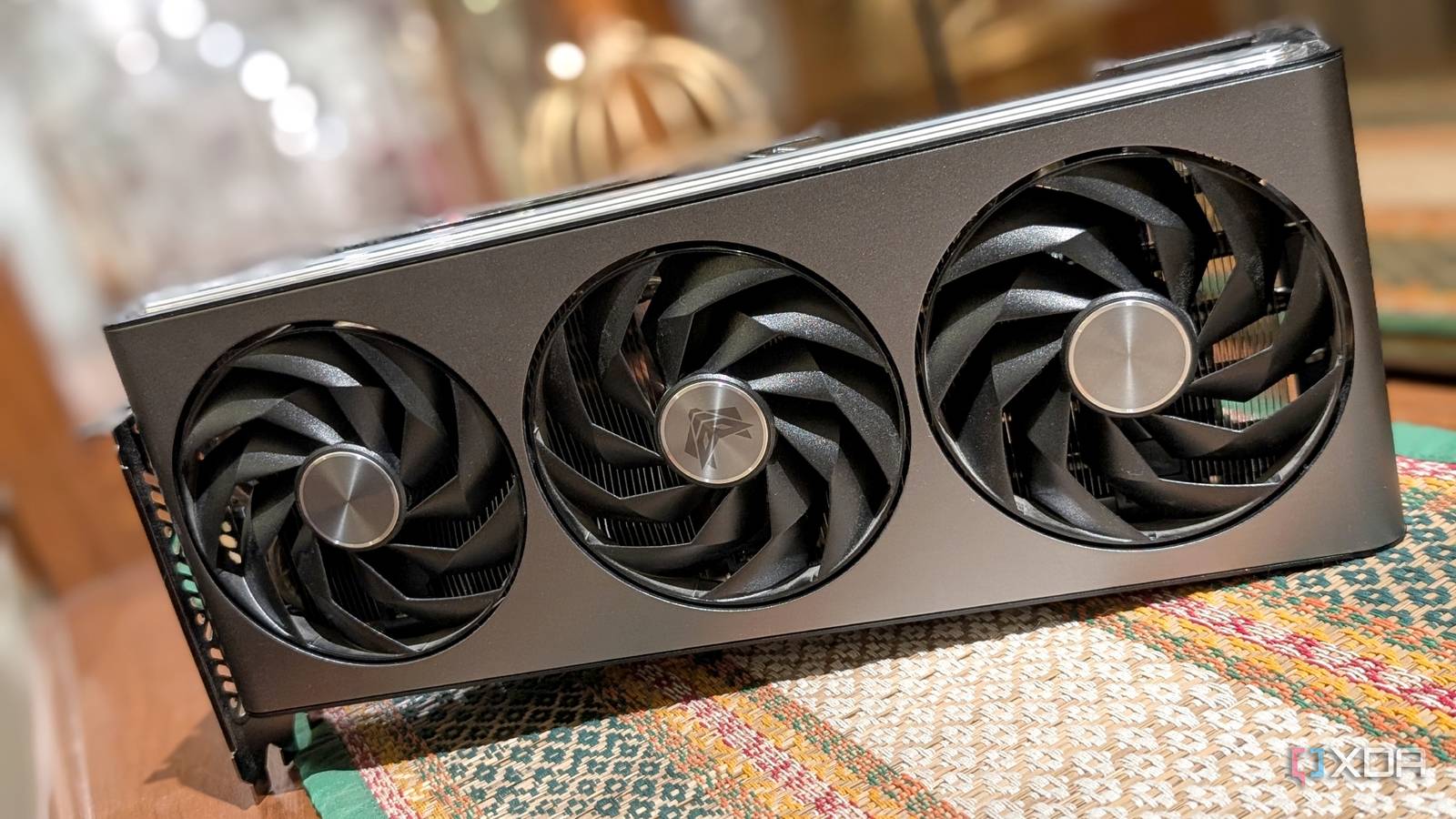
Published Aug 10, 2026, 7:00 AM EDT Abhinav pivoted from a career in banking to pursue his first love in writing. Even while working full-time, he continued contributing as an editor-at-large, a role he has held for more than 7 years. A lifelong tech enthusiast who has built three gaming and productivity powerhouse PCs since 2018, his passion for technology keeps him closely following the semiconductor industry, from NVIDIA and AMD to ARM. His MSc dissertation explored how artificial intelligence will reshape the future of work, reflecting his curiosity about the wider social impact of emerging technologies. Summary AI upscaling is now standard; the question is which implementation wins at extremes. DLSS 4.5 dominates Ultra Performance (720p→4K): high FPS, stable image, few artifacts. FSR 4.1 rivals at Performance (1080p→4K) but shows shimmer and fails at Ultra Performance. There was a time when upscaling existed purely to rescue weak hardware. You enabled it because you had no other choice, accepted the softer image, and enjoyed the extra frames. That era is effectively over. Both AMD and Nvidia have pushed AI-assisted reconstruction harder than ever. As such, the question of whether upscaling is worth using is now obsolete. The real question now is which company is doing it better when you push the tech to its absolute limits. That's exactly what I wanted to find out. Instead of benchmarking every preset across every resolution, I focused on the scenario that exposes an upscaler's strengths and weaknesses faster than anything else: 4K gaming using the most aggressive reconstruction modes available. The results were surprisingly close in some places, and surprisingly one-sided in others. The test had to be on even and justified grounds Both cards and upscalers are fairly remarkable at 1440p There are two ways in which FSR 4.1 and DLSS 4.5 are similar – both are now supported by GPUs a generation old, and both are touted as their respective brand's best attempt yet at 4K upscaling. As such, I could have spent an entire weekend comparing both cards and upscalers at 1440p and 4K, testing Native, Quality, Balanced, Performance, and Ultra Performance presets across multiple games. However, that would have been nothing but redundant – the entire point of comparing the newer versions available on FSR Redstone and DLSS is to push them at 4K, and see where the image starts breaking. As such, I decided to only test at 2160p, and that too, at Performance and Ultra-Performance presets, which internally render the image at 1080p and 720p respectively, before upscaling it to 4K. I also decided to try out two different engines, and thus chose Forza Horizon 6 and Halo: Campaign Evolved for testing. The FSR 4.1 and DLSS 4.5 head-to-head was done on a Radeon RX 7800 XT and GeForce RTX 4070 Ti, respectively. There's a VRAM difference between the two cards (16GB vs 12GB), but the results have been remarkably well-matched in terms of FPS averages and latency. The only difference, of course, was the quality of the final image. Both cards performed as expected at 4K native 60fps 4K native gaming still eludes cards that aren't at the bleeding edge The first order of business was to establish a baseline with native 4K in both games. While the RTX 4070 Ti barely managed to deliver over 40 fps in any of the games, the image quality was undeniably impressive. It even made me slightly regret purchasing a brand new 1440p monitor during Prime Day 2026, but the OLED panel does make up for it. DLSS 4.5 | GeForce RTX 4070 Ti + Ryzen 5 7600X | 2160p 4K Native Avg FPS 1% low Latency (ms) Forza Horizon 6 (High + RT) 44 fps 36.5 fps 78.5 ms Halo: Campaign Evolved (Ultra) 28 fps 18 fps 30.5 ms While both cards ran Forza Horizon 6 and Halo: Campaign Evolved at pretty much the same FPS, it was 007 First Light that surprised me the most. Despite having 4GB more VRAM than the RTX 4070 Ti, at 4K native resolution, the RX 7800 XT performed worse than the Nvidia GPU. Then again, First Light at Ultra settings, and the other two titles, never pushed either card past a 10GB VRAM requirement. Sadly, I couldn't use the James Bond game for the upscaling comparison, since 007 First Light does not support FSR 4 or FSR 4.1. FSR 4.1 | Radeon RX 7800 XT + Ryzen 5 7600X | 2160p 4K Native Avg FPS 1% low Latency (ms) Forza Horizon 6 (High + RT) 48 fps 42.7 fps 62.9 ms Halo: Campaign Evolved (Ultra) 27 fps 24 fps 41 ms By and large, both cards remained neck-and-neck in terms of performance, which is what made me excited about turning on upscaling in both systems. Image quality comparisons came close, but performance certainly didn't For the best image quality with DLSS 4.5, Nvidia recommends using Preset M, which is specifically tuned and optimized for the Performance upscaling path. In order to use it, simply head to the Nvidia App, click on Graphics, and select the Global Settings tab. Here, under DLSS Override, pick Model Presets, and choose Preset M. DLSS 4.5 | GeForce RTX 4070 Ti + Ryzen 5 7600X | 2160p 4K DLSS Performance (1080p internal) Avg FPS 1% Low Latency (ms) Forza Horizon 6 (High + RT) 60 fps 55.7 fps 58.2 ms Halo: Campaign Evolved (Ultra) 68 fps 56 fps 22 ms Preset M delivers the ideal balance of sharpness, temporal stability, and frame pacing for DLSS Performance, which internally renders the game at 1920x1080 before upscaling it to 2160p. On its own merits, DLSS Performance with DLSS 4.5 Preset M absolutely blew me away. I was already pushing each game, and DLSS Performance's doubling of the internal resolution was nothing short of impressive – the image quality held up, the stability left no room for complaints, and I genuinely couldn't believe that this same tech was a blurry mess just a few years ago. Over on the AMD card, FSR 4.1 delivered nearly the same performance, but it did give away the fact that an upscaler was working in real time. The overall sharpness dropped immediately, with fire effects in Halo and rain drops against foliage being the first culprits. FSSR 4.1 | Radeon RX 7800 XT + Ryzen 5 7600X | 2160p FSR Performance (1080p internal) Avg FPS 1% Low Latency (ms) Forza Horizon 6 (High + RT) 60 fps 55.7 fps 58.2 ms Halo: Campaign Evolved (Ultra) 68 fps 56 fps 22 ms Regardless, FSR 4.1 on the RX 7800 XT, at FSR Performance delivered impressive image quality. Sadly, much like the RTX 4070 Ti, it remained unable to push the frame rate to the 60fps mark. While DLSS Performance definitely impressed me on the image quality front, it was clear that I needed the upscaler to do more if I wanted smoother performance. Ultra Performance is where one upscaler remained supreme 33% internal resolution makes things broke down for one team It was clear that in order to get past the 60 fps-mark, both GPUs needed to go down to Ultra Performance, lowering the game's internal resolution to 720p before delivering an upscaled 4K resolution. DLSS 4.5, of course, requires Preset L in the Nvidia App to work best. DLSS 4.5 | GeForce RTX 4070 Ti + Ryzen 5 7600X | 2160p 4K DLSS Ultra Performance (720p internal) Avg FPS 1% Low Latency (ms) Forza Horizon 6 (High + RT) 95 fps 92.3 fps 42.7 ms Halo: Campaign Evolved (Ultra) 89 fps 75 fps 20 ms Preset L with DLSS 4.5 never ceases to amaze, with the image quality holding up ludicrously well. For high refresh rate 4K gaming, Ultra Performance has genuinely proved itself to be a solid and reliable option, which is a lot more than what could be said for DLSS 4 alone. Even at a 720p internal resolution, the image quality stayed stable, with only a few menu and UI elements threatening to break the immersion with a shimmer here or there. FSSR 4.1 | Radeon RX 7800 XT + Ryzen 5 7600X | 2160p FSR Ultra Performance (720p internal) Avg FPS 1% Low Latency (ms) Forza Horizon 6 (High + RT) 82 fps 71.8 fps 36.6 ms Halo: Campaign Evolved (Ultra) 82 fps 63 fps 21 ms FSR 4.1, sadly, didn't impress me nearly as much as its DLSS counterpart. The shimmeriness on every surface, especially any darkly lit textures, was jarring, to say the very least. While AMD has made remarkable progress over the past couple of years, Ultra Performance still feels like it's asking too much of the algorithm, and the compromises become obvious almost immediately. DLSS 4.5, on the other hand, crossed a line I honestly didn't expect it to. For the first time, I found myself playing at a 720p internal resolution without constantly thinking about the fact that an upscaler was doing all the heavy lifting. That's a milestone Nvidia deserves full credit for. DLSS 4.5 has genuinely moved the goalposts The one thing that's absolutely obvious is that neither AMD nor Nvidia is building graphics cards the way they used to five years ago. Instead of brute-forcing native rendering forever, both companies have clearly bet on AI reconstruction, and changed the face of the rendering pipeline forever. Spending a weekend comparing the latest versions of both technologies has made it clear beyond measure that this truly is the direction PC gaming has decidedly taken. Both AMD and Nvidia have changed the graphics rendering pipeline forever. It's even more encouraging to see that this isn't a victory reserved just for flagship hardware anymore. Both of these cards are a generation old, yet they're capable of delivering genuinely enjoyable 4K experiences with the right software behind them. Of course, the hardware is still pretty important, but for the first time in a long time, it feels like the smarter algorithm instead of the faster GPU is deciding who crosses the finish line first.
I pushed FSR 4.1 and DLSS 4.5 to their limits on older hardware, and one changed my mind about 4K gaming
Full Article
Original Source
Read the full article at Xda-developers →KhanList aggregates and links to publicly available news content. We do not host full articles from third-party sources. Always verify important information with original sources.