
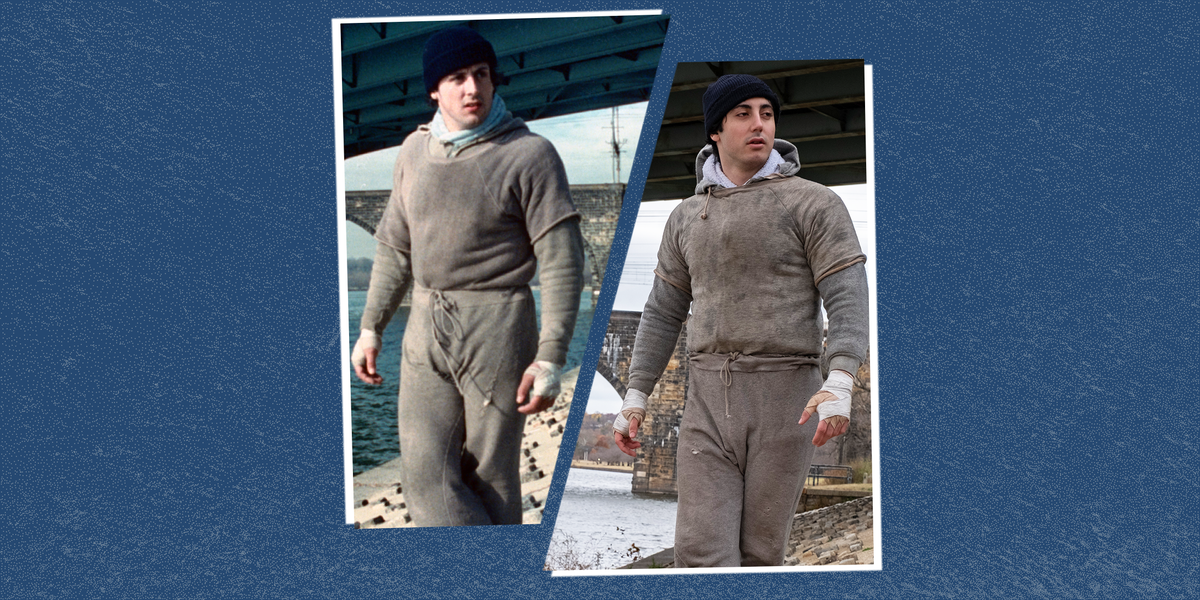
Our product picks are editor-tested, expert-approved. We may earn a commission through links on our site. Why Trust Us?United Artists/Amazon-MGM7 min readROCKY IS A work of fiction, but it’s fair to say Sylvester Stallone threw his heart and suffering onto the page. The then-29-year-old actor-turned-screenwriter was a Hollywood nobody when the boxing movie to end all boxing movies was filmed in early 1976 (with a release later that year). The now-80-year-old had done minor work in largely forgotten films (oh, and don’t forget the porno!) when he wrote himself his dream leading role and convinced studio United Artists to both make the film and take a chance on the hardscrabble, sometimes literally hard-to-understand Sly as the star.This story is recounted in I Play Rocky, the acclaimed biopic about the making and myth behind both Rocky and Stallone, played by Anthony Ippolito. Sly is, alas, “all but indivisible” from his creation, as The Guardian wrote in a review of his new memoir The Steps, “each an extension of the other.” Sly has his own version of his ascension, though it’s laced with frustration toward family and a certain producer on Rocky who he feels fleeced him (more on that below).But what’s real in I Play Rocky, what’s Hollywood-ified, and what’s Stallone’s own hard-won truth? Here we dig into the facts behind Rocky’s development, production, and eventual gangbusters box office reception. But we also get into Stallone’s life and career, where the two merge with Rocky “The Italian Stallion” Balboa, and how well I Play Rocky streamlines it all into popcorn fun.Buy I Play Rocky Tickets HereWhat was Sylvester Stallone’s early life like?Sylvester Stallone was born on July 6, 1946, in Hell’s Kitchen, then a rough neighborhood of Manhattan, according to History. As Sly tells it in a (fascinating) 1976 profile in The New York Times, he was raised by a “bickering Italian couple” who put him in foster care while they worked. (His hairdresser father, Francesco “Frank” Stallone Sr., who had a tiny part in Rocky as the timekeeper in the climax fight, is embodied by a curmudgeonly Matt Dillon in I Play Rocky. Stallone’s mother, Jacqueline “Jackie” Stallone, is not depicted, but had a wild career as an astrologer, trapeze artist, chorus girl, women’s-only gym owner, and boxing promoter.)Stallone became a juvenile delinquent who “attended 12 schools by the time he was 15, and was kicked out of most of them.” More promisingly, the native New Yorker went to high school in Philadelphia, aka Rocky town, and threw himself into sports, being a star fullback and discus thrower. In an unexpected move, he then attended university at American College in Leysin, Switzerland, where he picked up a part-time job chasing men away from female dorms, except he found it was more lucrative to “look the other way” for two francs an hour (money that scored him flights back home).Studying drama came next at the University of Miami for two years before he moved back to New York with the loftiest thespian ambitions. Instead, he found work as an usher at a movie theater and cleaning cages at a zoo. I Play Rocky starts with a very broke Stallone as a theater usher, though there’s no zoo action, and the story cuts the very funny fact that he was fired from said theater when he tried scalping a M*A*S*H ticket to the theater’s owner, Walter Reade. (Also absent from I Play Rocky: Among Sly’s ambitions was a fully autobiographical film that he planned to call From Roaches to Riches.)How did he get to Rocky?Sly took what scraps he could in his New York days, appearing in the low-budget greaser comedy The Lords of Flatbush (contrary to I Play Rocky, he was a co-lead actor, and even wrote additional dialogue). He had an uncredited bit part in Robert Altman’s 1970 touchstone M*A*S*H (yes, the same film for which he tried to scalp a ticket) and acted in Capone (1975) as well as the Roger Corman-produced cult B-movie Death Race 2000 (1975), playing Machine Gun Joe Viterbo.That’s not all. In desperate need of money, the real-life Italian Stallion took a part in the 1970 softcore porn film The Party at Kitty and Stud's, in which he lets it all hang out—without hardcore sex. He thought the movie was garbage, but he was paid $200 for two days of work. “It was either do that movie or rob someone because I was at the end—at the very end—of my rope,” Stallone told Playboy in 1978, according to Far Out.New World PicturesStallone in Death Race 2000. California came calling. With the tiniest bit of fame to his name, he moved to Los Angeles with his first wife Sasha Czack (AnnaSophia Robb in I Play Rocky), where they lived in a one-and-a-half-bedroom apartment ''in the pancreas of Hollywood,” he told the Times, for $215 a month.“Things weren’t going so well there,” Stallone said in an archival interview quoted by Forbes. “As a matter of fact, I actually had to go out and try to sell my dog because it was either that or he wasn’t going to be very well fed around the house.” In I Play Rocky, you see Stallone actually sell his bull mastiff Butkus—then locate and buy back Butkus, who would go on to be the dog in Rocky—though it’s hard to verify if things unfolded exactly this way.Inspiration came when he watched the championship fight in 1975 between Chuck Wepner, a club fighter known as ''The Bayonne Bleeder,'' and world champion Muhammad Ali. “And for one brief moment, this supposed stumblebum turned out to be magnificent,” Stallone later mused, according to Forbes. “I thought if this isn’t a metaphor for life.”The lore is that based on this brief moment, Stallone went on a tear, writing the script for Rocky in just three and a half days. This becomes a crucial montage in I Play Rocky, with Sly putting pen to paper, then snoozing while his wife types it out. In reality, Stallone told the Times that he had the fight in his mind for a month, “my inspiration stage. Then I let it incubate for 10 months, the incubation stage.” Finally, writing the screenplay in a mad dash was merely “the verification stage.” Stallone loves stages.What happened during the making and release of Rocky?Much of the tension in I Play Rocky actually takes place before a frame of Rocky is shot. Stallone gets a meeting with two producers, Irwin Winkler (P.J. Byrne) and Robert Chartoff (Toby Kebbell). When he turns out not to be right for a part, on his way out of the office, he sneaks his Rocky script onto the secretary’s desk. In reality, Stallone had already sold several scripts, mostly to television, and he simply brought up the Rocky idea to the producers, who asked to see the script.Winkler and Chartoff, playing up much of the comedic antics and sarcasm in I Play Rocky, loved Stallone’s screenplay. They just didn’t want him to play the title role. The producers were contracted with United Artists. The top brass threw out star names like Burt Reynolds, James Caan, and Ryan O’Neal. But Sly refused to sell the script unless he took the lead role. And refused again. Despite the fact that he had no car and $106 in the bank.MovieStillsDBStallone as Rocky Balboa in Rocky. In I Play Rocky, the figure offered to buy the script on the condition that Stallone will not play Rocky goes up to an astronomical $360,000 (which in today’s money would be $2.1 million); however, the 1976 Times profile reports that bidding went up to $265,000. Either way, a beautiful heap of money. Finally, the producers and studio greenlit Rocky with a $1 million budget and paid Stallone $35,000 plus his acting fee. Stallone was Rocky Balboa. The entire production lasted 28 days, ''the gestation time for a water bug,'' Sly quipped to the Times.Here’s the more important part of the contract that’s left out of I Play Rocky: Stallone sold the rights to Rocky and its characters in accepting the deal. Those rights went to Winkler—which has given Winkler a fortune plus power over the Rocky franchise, and fueled an ongoing feud between the 95-year-old producer and Stallone, who’s not shy about badmouthing Winkler. Stallone is adamant that he was swindled. Per Collider, he has called Winkler “nefarious” and “the remarkably untalented and parasitical producer of Rocky and Creed.”Axel Koester//Getty ImagesWinkler, Stallone, and Chartoff accepted Rocky’s Oscar for Best PictureDespite this supposed crooked deal, Stallone came out more than fine. What’s also not in I Play Rocky is that the then-unknown received 10 percent of the net profits (known as net points in the industry) of Rocky off the backend. Given that Rocky earned roughly $200 million at the box office, becoming the top hit of 1976—on top of picking up 10 Oscar nominations and an illustrious run in ancillary business—Stallone easily made millions off the original movie. (He claims $2.5 million, Winkler claims much higher.) He is leaps and leaps richer now.Many forget that upon release, the critical response to Rocky was mixed, split between pans and raves. But it energized the masses, and its classic status is unquestionable now. In real life and I Play Rocky, Stallone comes out with a smile on his face, aware that his and his character’s rise from forgotten bum to underdog sensation is complete.Should I see I Play Rocky?Are you a fan of Rocky? (If you’re not, how the hell are you reading this article?) How about Rocky II, Rocky III, the Creed movies? If so, yes, yes, yes, and again yes. On the other hand, if you don’t like Hollywood behind-the-scenes tales, boxing, or Rocky, sit this one out.Though it fudges some turns of events and details, smoothing out the messiness and politics of a young star making his way in Hollywood, its insights can be revelatory—for example, the incredible contribution of Steadicam inventor Garrett Brown (played by real-life camera operator Michael Fuchs), whose experimental invention not only made the original Rocky possible on its shoestring budget and tight schedule, but brought a distinctive graceful movement to Rocky’s training and fighting scenes. The cast is all-around captivating; Ippolito finds soul in Stallone while managing a difficult and eccentric accent.Perhaps unsurprisingly, as directed by Peter Farrelly (Green Book), I Play Rocky is also on the schmaltzy side. But when Sly, or Ippolito, sprints up those Philadelphia Art Museum steps determined to change history, your heart will do a little jump for him.Paul Schrodt is a freelance writer and editor covering pop culture and the entertainment industry. He has contributed to The New York Times, The Wall Street Journal, GQ, Men's Health, The Hollywood Reporter, Los Angeles magazine, and others.
I Play Rocky Tells Sylvester Stallone’s Underdog Story. Here’s What Really Happened.
Full Article
Original Source
Read the full article at Menshealth →KhanList aggregates and links to publicly available news content. We do not host full articles from third-party sources. Always verify important information with original sources.