
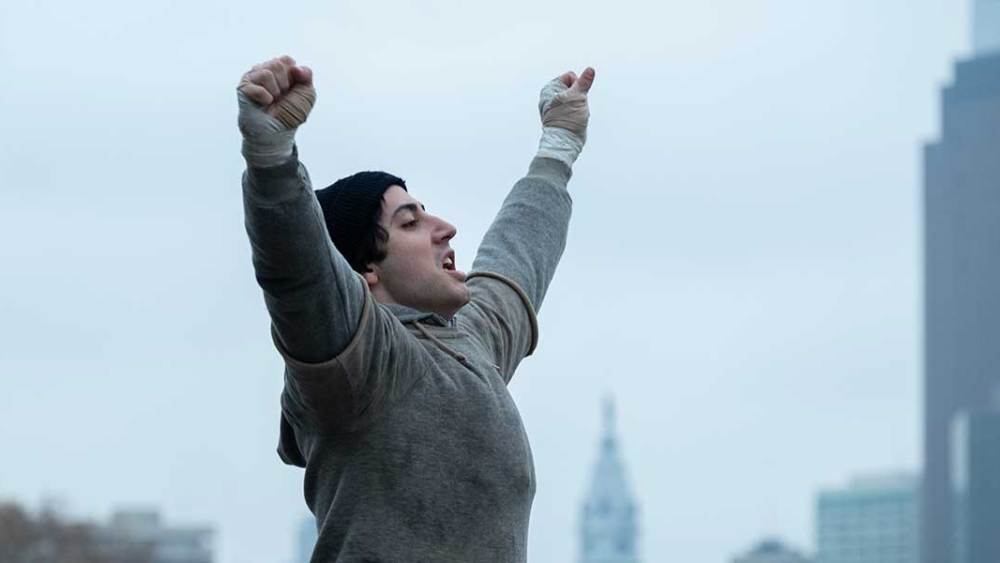
For a biographical drama to work, it’s not required that the central actor do a pinpoint uncanny, so-close-to- the-real-thing-you-might-think-it’s-the-real-thing impersonation of the person he’s playing. But Peter Farrelly’s “I Play Rocky” may be a special case. It’s a movie about the making of “Rocky” — about how Sylvester Stallone, then a two-bit actor in his late 20s, dreamed it, wrote it, sold it, and insisted he play the lead role in it. Since “Rocky” is one of the most popular and beloved movies ever made, and Stallone one of the most famous stars in the history of Hollywood, it’s actually essential for the actor playing him to get it right. If not, we would just be in cheesy-tacky TV-movie land. Anthony Ippolito, who plays Sylvester Stallone in “I Play Rocky,” gets it just right. He looks startlingly like Stallone: the droopy dark eyes, the slightly jutting lips with the delicate dip at the center, even the skin tone — that sort of peach-ivory pallor. And Ippolito’s impersonation of Stallone’s voice is a miraculous act of channeling. He gets that super-low back-of-the-throat growl, the mush-mouth intonation, the words dripping out like molasses, the sense that his whole personality is a slow-motion amiable grumble. Watching and listening to Anthony Ippolito, we can believe that Sylvester Stallone is standing right in front of us, though the performance is more than just an awesome impersonation. He’s truly playing Stallone — the sweetly stubborn and dogged person he was at the time. Popular on Variety “I Play Rocky” is a cleverly crafted crowd-pleaser, all designed to tap into the love of “Rocky” that has never gone away (this November it will be 50 years since “Rocky” was released). But in a funny way I found the film to have a surprising spirit in common with “Nouvelle Vague,” Richard Linklater’s 2025 drama about the making of Jean-Luc Godard’s “Breathless.” Linklater’s film was also a rich piece of nostalgia (the high-end black-and-white cinephile version), and what made it work, apart from the sheer meticulous authenticity with which Linklater recreated the shooting of “Breathless” in the streets of hotels and cafés of Paris, was that Linklater captured the revolutionary form-follows-function dimension of what made “Breathless” a great movie — the fact that Godard made it up as he went along, and how that radical spontaneity worked its way into the DNA of the film. The story told by “I Play Rocky” isn’t nearly as different from that as you might imagine. As written by Peter Gamble, the film opens in New York City in 1974, when Stallone is living in a Times Square fleabag, doing all he can to get acting jobs, though it’s not going anywhere. All he gets offered are roles like “Thug #2” (which he tries out for in the opening scene). He has no money and gets kicked out of the flophouse, where he meets a homeless pug who becomes his pet. He’s so down-and-out he’s reduced to trying out for a soft-core porn film (Stallone was actually in one, though that was back in 1970). The first thing that saves him is meeting Sasha, the ticket-seller at the movie theater he gets a job at. They become a couple, and she’s the one who tells him that if he isn’t getting the parts he wants, maybe he should write a script that features the kind of role he’d like to do. Sasha is played by AnnaSophia Robb, who makes her supportive in a spiky way that had me thinking of another ’70s icon — in a strange way, she sounds like she’s channeling Karen Lynn Gorney from “Saturday Night Fever.” (Could the making of that one be the sequel?) Sly and Sasha get married and move out to Los Angeles, where Stallone gets work as a parking attendant, and he keeps writing scripts. But lightning doesn’t strike until March 24, 1975, when he settles into a bar to have a beer and, on television, starts to watch the championship match between Muhammad Ali and the aging underdog Chuck Wepner. The match is a set-up — the chance for Ali to knock out his opponent in two or three rounds. But instead, Wepner goes the distance, and even gets in a few major licks. He’s standing, against all odds, after 15 rounds, and that triggers something in Stallone. (Stallone has claimed that he was not inspired to make “Rocky” by that match. But clearly the filmmakers decided to ignore him.) Stallone has already met with the producing team of Irwin Winkler (P.J. Byrne) and Robert Chartoff (Tony Kebbell), who constitute a major eruption of ugly geek clothing and bad ’70 hair, and they like his script for “Paradise Alley.” But then he sneaks the script for “Rocky” into their “To read” pile. They read it and love it; it’s got something. They want to make the film, and after meeting with Sandy Maddox (Tracy Letts), an amusingly blustery-for-the-time-but-now-rather-quaint-seeming studio suit (he’s a fictional composite of several movie executives of the era), they agree to pay Stallone $50,000 for his script, which means that he’ll be off and running. There’s just one problem. As Stallone puts it, “I play Rocky.” That, for him, is the dream and the deal. It’s the only option. For a while, “I Play Rocky” is a high comedy of negotiation, as Winkler and Chartoff, who have secured a relatively low budget of $2 million to make “Rocky,” keep offering Stallone more and more money for his script, and he keeps turning them down. They go as high as $350,000 (a lot of money for 1975). But Stallone’s need to play Rocky is non-negotiable, and the essence of that whim of iron is that it’s the true-life version of Rocky Balboa’s need to be a contender. The pleasure of “I Play Rocky” is that it understands the karmic way in which the story of Rocky — the underdog who triumphs against all odds — was echoed in the saga of how Stallone got the movie off the ground. The making of “Rocky,” which was compellingly chronicled in the 2023 documentary “Sly,” has an epic irony built into it: the fact that Stallone created one of the most iconic characters in movie history, but you can totally see why the powers that be at the time didn’t want him to star in the movie. He was a total unknown (they wanted a movie star), but more than that he was an actor who looked half-asleep and sounded like he had a dozen frogs in his throat. Who in his right mind would greenlight that? But that’s where the story becomes rich. Stallone has Winkler and Chartoff over a barrel; they can’t make the movie without him. And so, worn down at last, they agree to let him star in “Rocky,” but they only have the contractual right to do so if they reduce the budget to $1 million. Which is peanuts. But that becomes integral to how “Rocky” turned into a great movie. The director they hire, John G. Avildsen (played with hackish exuberance by Jay Duplass), is known for working fast and cheap, but the budget for “Rocky” is so low that he’s going to have to outdo himself. They decide to set the movie in Philadelphia, so that they can shoot it without unions. They’ll use the newly developed Steadicam to glide up the steps of the Philadelphia Art Museum. Stallone will pull tendons and bust knuckles punching the overly frozen meat slabs in the lockers, but he won’t be allowed to heal for even one day, because if they fall behind then Sandy Maddox has the right to fire Stallone (which is what he wants to do). Did I mention that neither Stallone nor his co-star Carl Weathers (Stephan James) have the slightest idea of how to box? The production hires a legendary Hollywood boxing choreographer (Trevor St. John), who has staged 14 classic fight movies, but Stallone thinks they all look the same. He wants his own version of realism. And so he and Weathers will figure out how to punch each other. All of this makes “I Play Rocky” into a high comedy of Hollywood creativity. It’s about the making of one of the biggest mainstream hits of all time, but what it captures is that “Rocky” wasn’t just a ’70s movie; it was a catch-as-catch-can shoestring fluke, where necessity became the mother of invention. (When the producers first play a tape of Bill Conte’s famous theme music, Winkler thinks it’s way too “grandiose.”) And Stallone really did bring himself into it. The scene where he rages away at Burgess Meredith’s Mickey, retro-fitting Marlon Brando’s “I coulda been a contender” speech, is pure Hollywood magic, because Stallone draws it out of himself. (He’s really railing at his a-hole father, played in the film by Matt Dillon.) Almost every aspect of how “Rocky” was made taps into our desire to see movies echo reality. “I Play Rocky” has some of the slyness of movies-about-real-moviemaking like “Nouvelle Vague” and “Baadasssss!” and — the “Citizen Kane” of the genre — “Ed Wood.” But as infectious as the film is, there’s one thing “I Play Rocky” takes so much for granted that it doesn’t quite dramatize it: the way that “Rocky” wasn’t just a great movie — a Frank Capra fable dusted in ’70s grit — but a movie that changed America. The New Hollywood was desolate and dark. “Star Wars” is the film that’s generally credited for remaking movie culture, but it was actually “Rocky,” with its new-style old-school optimism, that did that. More than any other film, it kicked open the door to the Reagan revolution by rekindling our primal need for happy endings. Stallone played Rocky. But he really played all of our desire to return to belief. Wherever that might lead.
‘I Play Rocky’ Review: Anthony Ippolito Channels Sylvester Stallone in Peter Farrelly’s Cleverly Crafted Crowd-Pleaser About the Making of ‘Rocky’
Full Article
Original Source
Read the full article at Variety →KhanList aggregates and links to publicly available news content. We do not host full articles from third-party sources. Always verify important information with original sources.