
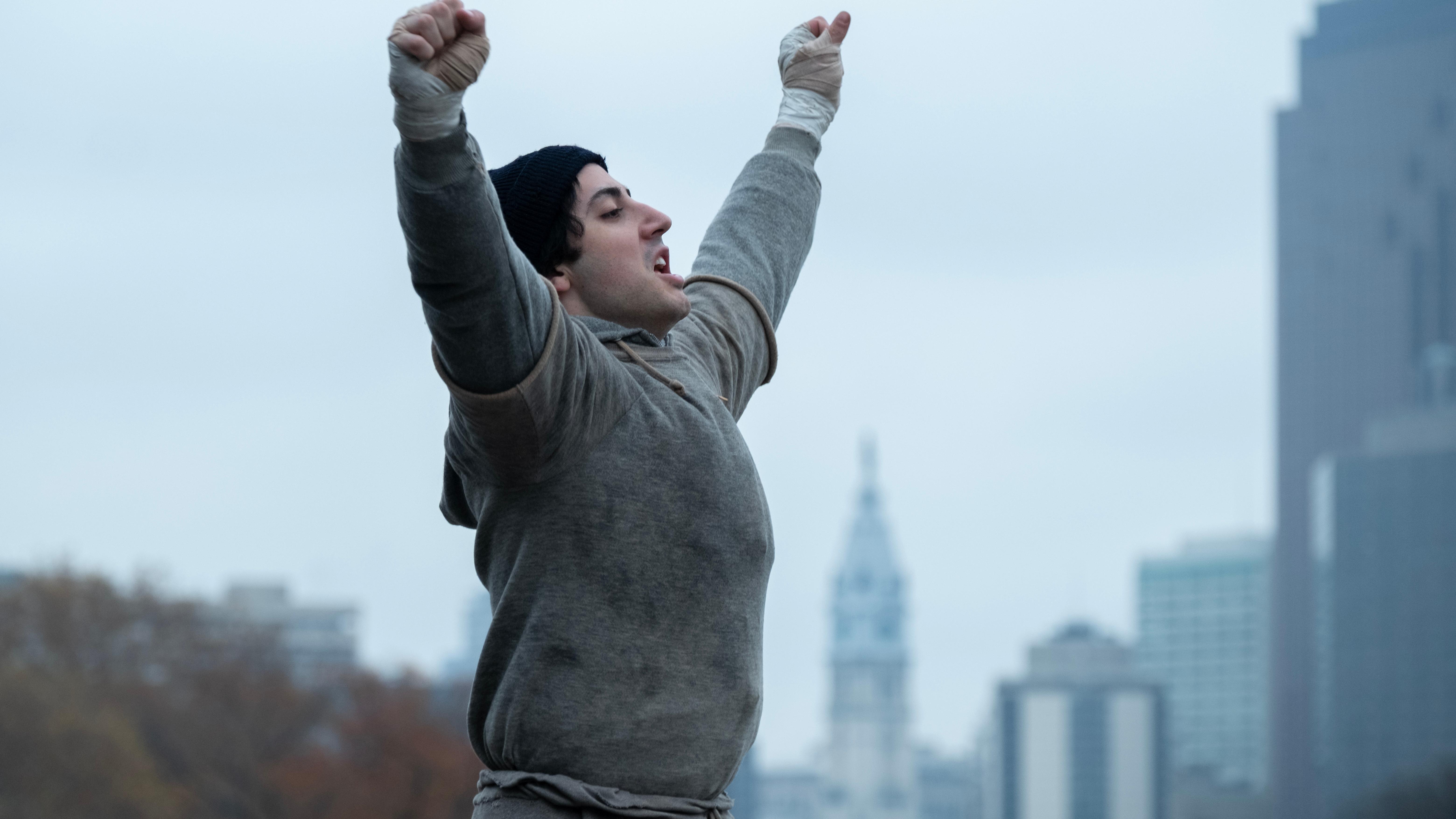
If you saw Rocky in theaters in 1976, you were witnessing, without realizing it, a movie that wasn’t supposed to exist. It was cheap-looking, for good reason: It had been made for just a little over a million dollars which, even in the mid-1970s, was almost nothing. Yet its cheap vibe was part of the excitement. You felt that this somewhat elementary story—of a scrappy small-time boxer who goes against the reigning heavyweight champ and almost wins—was letting you in on a little secret: You weren’t immune to stories that you thought you’d seen a hundred times before. If anything, you were as susceptible as ever, and a movie’s budget had nothing to do with it. Kids went to see Rocky with their parents. Teenagers trekked out in small packs, and grownups turned it into a date night. The ultimate underdog movie, set in the ultimate underdog city of Philadelphia, it became the film everyone talked about. And its star—a guy who mumbled his lines and whose heavy-lidded eyes conjured the spirit of the goodnight poem "Wynken, Blynken, and Nod"—seemed to have come out of nowhere. That he’d also written the movie seemed slightly miraculous, the opposite of business-as-usual in Hollywood.The story of Rocky and its writer-star Sylvester Stallone is so simultaneously out-there and relatable, you’d think it would have long ago been told in movie form. But better late than never: I Play Rocky, directed by Peter Farrelly and written by Peter Gamble, is a crowd-pleaser that fills in the background of one of the greatest crowd-pleasers of its era. Anthony Ippolito—who has come almost out of nowhere, though he previously played Al Pacino on The Offer—stars as the very young, very broke Sylvester Stallone who, when the movie opens, in early 1970s New York, is going by the made-up first name Mike: He thinks it will increase his chances of becoming a star, though the smart, winsome girl he meets, AnnaSophia Robb’s Sasha, persuades him that his given name is actually better. Mike, soon to once again be Sylvester, reads for parts but doesn’t get them. He runs out of money and has to live on the street. He finds a puppy, also in somewhat dire straits, which he names Butkus (after football star Dick). He lands a role in a softcore film, and later gets a job taking tickets at a movie theater. It’s there that he meets Sasha, who will later become his wife. Like so many guys in so many movies before him, he tells her his dreams: He wants very badly to be an actor, and if he has to write his own roles to get there, that’s what he’ll do.Rocky isn’t the first screenplay Stallone will write, but it’s the fastest: he races through it in a feverish three days, and seems a little surprised when the producers he shows it to, Robert Chartoff and Irwin Winkler (played, with vibrant, wheeler-dealer energy, by Toby Kebbell and P.J. Byrne), tell him it’s got something. They want to buy it—but for another star, possibly Burt Reynolds or Ryan O’Neal. Stallone sticks to his guns: He will not sell this screenplay unless he can also star in the movie, and his plainspoken insistence on this fact gives the film its title.AnnaSophia Robb as Sasha and Anthony Ippolito as Sylvester, taking in the product of their labor Courtesy of Amazon MGMAs a director, Farrelly knows what will appeal to audiences, and that’s a pro, not a con. With his brother, Bobby, he made some of the signature comedies of the ‘90s, among them Dumb & Dumber and There’s Something About Mary. These were ridiculous movies, but also openhearted ones, motivated by an essential sweetness of spirit. Farrelly’s 2018 Green Book—in which Mahershala Ali plays jazz pianist Don Shirley, who hires Viggo Mortensen’s Tony “Lip” Vallelonga as a driver before embarking on a tour of the deep South—won three Academy Awards, including Best Picture, though it faced fierce backlash for what critics saw as its obsession with “white savior” tropes. Those criticisms had some validity, but they also had the less-positive effect of diminishing Ali’s terrific performance. And audiences who’d loved the movie as a story of friendship were made to feel they’d been racially insensitive, or had somehow simply taken the wrong ideas from the picture. The Green Book story shows how a filmmaker’s essentially good intentions can’t protect him from the ways in which his movie might be received. But there’s nothing about I Play Rocky that could be perceived as controversial, which means that Farrelly is free to do what he does best: to both entertain people and move them, though not in obvious, treacly ways. Ippolito plays the young, hungry Stallone as a figure driven by both ambition and need. He knows what his liabilities are: In a half-funny, half heartrending scene, he explains to Sasha why certain parts of his face are immobile. He doesn’t yet know if this is going to dash his career hopes or be one of the essential qualities that differentiates him from everybody else. In an earlier scene, he reads Walt Whitman’s “I Sing the Body Electric” into a tape recorder, using the playback to help him overcome his garbled diction. It doesn’t help that his father, played with sharklike good humor by Matt Dillon, does nothing but insult him, though Stallone is so used to this treatment that it barely registers. He pushes right through his insecurities into a golden territory that borders on arrogance. But then, that’s what believing in yourself really means. Ippolito as Stallone as Rocky, in the meat locker scene Courtesy of Amazon MGMIppolito looks and sounds so much like the young Stallone—with the same glottal drawl, the same sleepy, sad-sack eyes—that he may as well be transporting us back in time, to an era when a little movie could make it big against all odds. Farrelly has populated I Play Rocky with terrific supporting players, including Stephan James as Carl Weathers, the flashy actor who would bring Rocky’s opponent Apollo Creed to life, and Jay Duplass as John G. Avildsen, the no-bull director Chartoff and Winkler bring in to helm the project. (He can deliver a film on time and within budget. He’s also, as he himself says, “known to be something of a dick.”) A million things will go wrong before Rocky eventually plays to, and thrills, audiences. I Play Rocky chronicles those mishaps, those thorny negotiations, those times when Stallone was so intent on giving the performance of a lifetime that he hurt himself physically. When Rocky Balboa punches those carcasses in the meat locker, they’re frozen solid, the equivalent of driving your first into a slab of granite. Ippolito makes you feel how much it hurts, which is also part of what makes his character’s eventual, unexpected victory—a runaway hit film—so sweet. Farrelly, like Stallone before him, knows what audiences like to see. I Play Rocky hits all the right beats—and sometimes, isn’t that just what we want? Every day, algorithms tell us what we ought to like. A human who knows what works has come to feel like a rarity.
I Play Rocky Is an Unapologetic Crowd-Pleaser, Just Like the Movie Whose Story It Chronicles
Full Article
Original Source
Read the full article at Time →KhanList aggregates and links to publicly available news content. We do not host full articles from third-party sources. Always verify important information with original sources.