
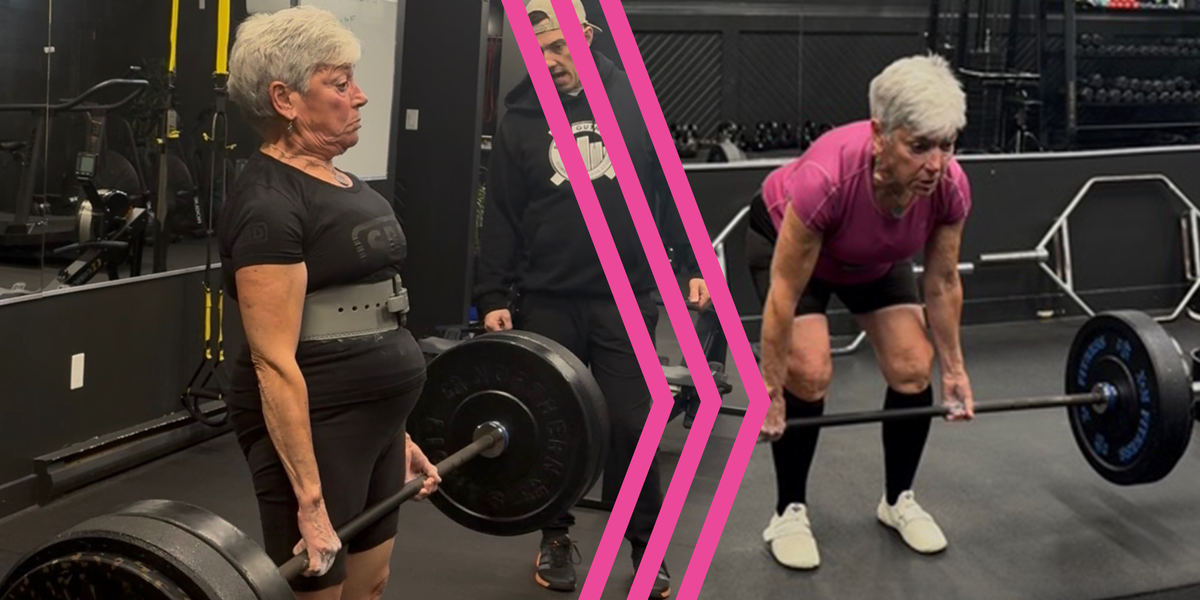
6 min readIf I’ve learned anything over the past few years, it’s to just say yes. Saying the word was simple, but ended up changing my relationship with fitness—and transforming my whole life.I’ve always loved being physically active and moving my body; I ran track and field in high school, played field hockey in both high school and college, and enjoyed horseback riding as a young adult. But shortly after graduating, I had my first of seven children at 23. From that point on, I went straight into parenting mode: My family became my priority, and with so much to juggle, exercise took a back seat for the next few decades.But at 55, I wanted to feel strong in my body again. My kids were grown and I had more free time, so I signed up for a gym membership. I even started working with a personal trainer to make sure I was doing the right moves safely. Over the next 15 years, I exercised with several trainers, lifting light weights once or twice a week with dumbbells and weight machines. I enjoyed the workouts and saw improvements to my overall fitness, but I wasn’t particularly passionate about going to the gym, so I wasn’t always consistent and never set any real goals.Then, at 70, everything changed. My trainer who I had come to enjoy working with and trust moved away, and without that connection, I stopped going to the gym. But after about a year away, the fitness manager at my gym, Nate Fleming, reached out to me, and I began working with him twice a week.He immediately changed up my programming and introduced me to the idea of progressive overload. I learned that gradually increasing the weight I lifted each week could help me build muscle, get stronger, and see real results. He also added new movements to my routine, like farmer’s carries, deadlifts, and squat variations. Deadlifts, in particular, became one of my favorite exercises—I loved that the move required so much technique. There was something so satisfying about picking up a heavy weight and realizing I could lift more than I thought.Nearly overnight, my attitude toward fitness changed: I enjoyed being challenged and discovering how much stronger I could become when I pushed myself. Over the next year, I began to see visible muscle definition in my arms and legs and felt more energized throughout the day. More importantly, though, my confidence skyrocketed because I had developed a greater trust in my own abilities.About a year into training, I was ready for a challenge, so I signed up for a powerlifting competition.I had grown to love lifting heavy, and wanted to step outside my comfort zone and discover what I could accomplish in my 70s. I casually asked Nate if there were deadlifting competitions for older women, and he said there were. So, I took a leap of faith and started a seven-month training process for a powerlifting competition (which took place this past March). I upped my training to three days a week, continuing to progressively increase the weights, and worked on refining my technique to move more efficiently.The day of the competition was one of the best days of my life. I decided to compete in all three lifts: I squatted 132 pounds, bench-pressed 71.5 pounds, and deadlifted 242 pounds, setting records in all three lifts for my age and weight category in Nova Scotia, Canada, where I live. I was so proud of what I’d accomplished and felt incredibly empowered by what my body could do at 71. My kids and grandkids were also there to cheer me on, which made the day even more special. Sharing that moment with my family and showing them what was possible at my age meant so much to me. I walked away feeling stronger, more confident, and excited to do it again.Now, at 72, I’m training to break the national deadlift record in Canada for my age and weight.My next powerlifting competition is this month, and I still lift with Nate three days a week. My training is structured in four-week blocks, and the weight, sets, and reps change each week. For instance, in week one, I might do 3 sets of 5 reps at a moderate weight. Then, I gradually increase the load in weeks two and three while lowering the reps as I get closer to my heaviest lifts. Week four is a deload week, so I reduce the weight and give my body a chance to recover before lifting heavier again.Each workout starts with the main lift (deadlift, squat, or bench press) because that’s when I have the most energy. Then, I move on to three or four accessory exercises, where I use lighter weights to strengthen supporting muscles, address weaknesses, and improve my performance in the main lifts. For example, on deadlift day, I might incorporate exercises like lunges, hamstring curls, and bent-over rows to strengthen my glutes, hamstrings, and back.I’m incredibly proud of my progress over the last six months. I have a lingering shoulder injury, so right now, my bench press has stayed about the same at 71.5 pounds. But I can squat 160 pounds and deadlift 265 pounds, which is only five pounds away from the Canadian deadlift record.While I train hard, I recover even harder in between sessions. I get seven to eight hours of sleep each night and am mindful about nutrition, eating lots of protein, since it’s important for building and maintaining muscle. I aim for around 120 grams a day, with eggs, chicken, and fish as some of my go-to sources. Additionally, during rest days, I focus on stretching and hip and shoulder mobility to improve my range of motion. I don’t count my steps, but I try to walk as much as I can throughout the day to keep my body moving and maintain cardiovascular health.Products I Can’t Train WithoutI love Feetures socks for their snug arch support and gentle compression that keeps them comfortably in place during workouts.Clif Builders are my favorite post-workout snack since they taste great and pack 20 g of protein per bar.These three factors have been crucial for my strength transformation success:1. I wasn’t afraid to ask for help.When I first decided to work with a personal trainer in my 50s, I wanted guidance, accountability, and the confidence that I was exercising safely and effectively—and I got that. My first few trainers helped me build a foundation by teaching me proper form and the fundamental movements that I still rely on today.But working with Nate completely changed my relationship with lifting: He knows how to motivate me, pushing me without going beyond my abilities. When I attempt a new personal record, his belief in me helps me believe in myself, too. Now, I know what I’m capable of and how to challenge myself while lifting safely. The gym has become so much more than a place to work out—it’s where I keep discovering what I can do.2. I understand the power of rest.I’ve learned that getting stronger isn’t just about how hard I work in the gym—it’s also about how well I recover between workouts through getting plenty of sleep, mobility work, stretching, and walking. When I don’t make time for recovery activities or I don’t fuel properly, it makes a difference; I feel more fatigued, have less energy during workouts, and struggle to perform at the same level.For me, progress doesn’t mean pushing myself to the limit every day. It means finding the right balance between challenging my body and giving it the rest and support it needs to keep getting stronger.3. I set big goals and don’t shy away from a challenge. If you’d told me a few years ago that I’d be powerlifting in my 70s and chasing a deadlift record, I never would have believed you. Before I started training with Nate, I had never really set big fitness goals or thought about pushing my limits. But that began to change when I realized how much stronger I could become with the right coaching and encouragement. I was inspired to set goals that challenged me in new ways I never thought possible, and I’ve learned that it’s never too late to surprise myself and try something new. Having a goal to work toward keeps me motivated, and I love seeing how far I can push myself when I have the right support and plan in place.Of course, getting stronger takes patience, consistency, and a willingness to step outside my comfort zone, but the reward is so worth it. I hope my journey encourages other women, especially those in their 60s and 70s, to keep challenging themselves and try new things. They might discover a passion they never knew they had, just as I did.Andi Breitowich is a freelance writer who covers health, fitness, relationships, beauty, and smart living. She is a graduate of Emory University and Northwestern University's Medill School of Journalism. Her work has appeared in Women's Health, POPSUGAR, Food & Wine, What To Expect, Cosmopolitan, Men's Health, and elsewhere. As a former collegiate pole vaulter, she loves all things fitness and has yet to meet a group workout class she doesn't like.
‘I Picked Up Weights for the First Time in My Mid-50s. I Was Powerlifting by My 70s—Here’s How’
Full Article
Original Source
Read the full article at Womenshealthmag →KhanList aggregates and links to publicly available news content. We do not host full articles from third-party sources. Always verify important information with original sources.