
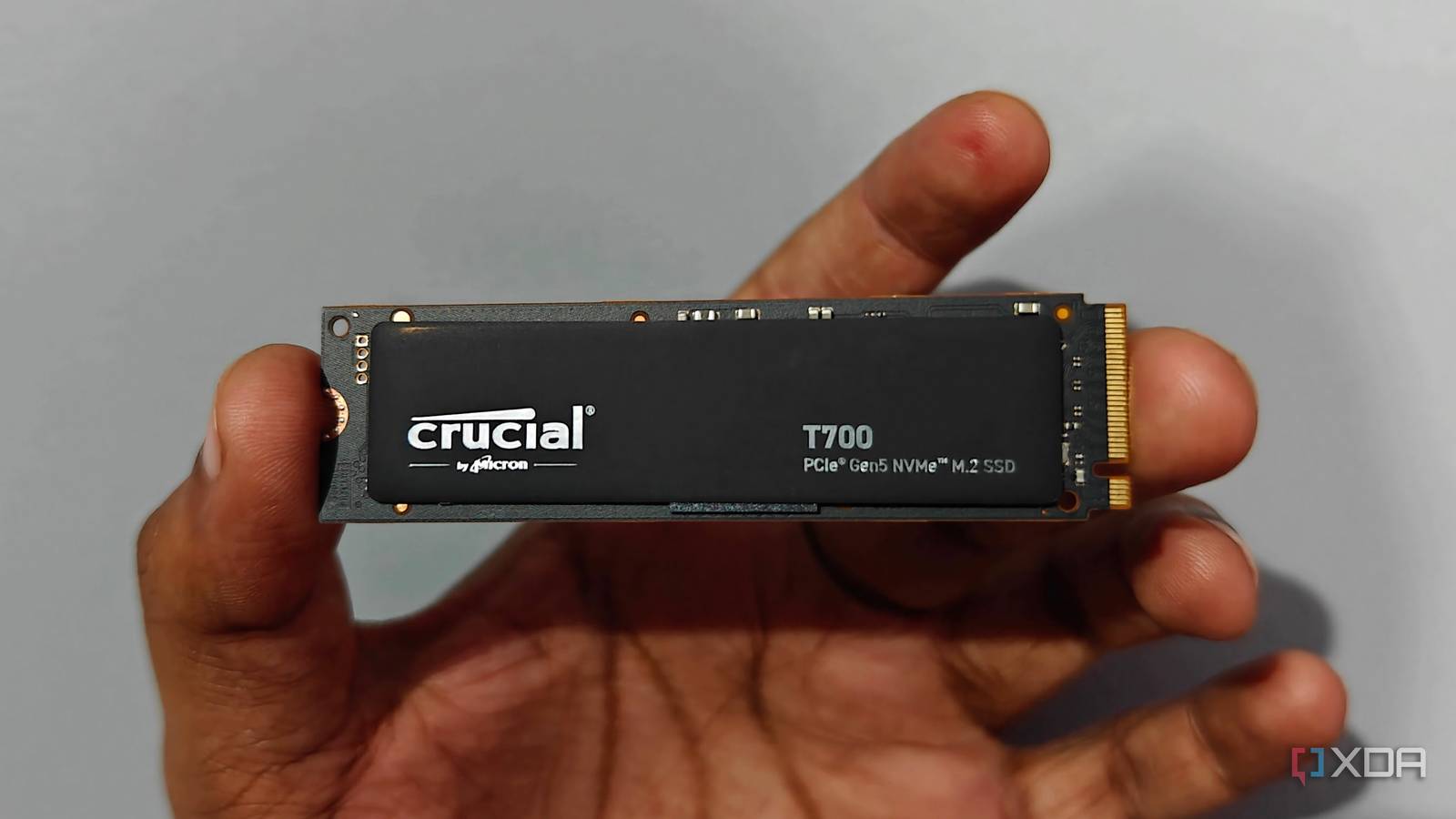
Published Oct 4, 2026, 4:30 PM EDT Hamlin has been in the tech field for over nine years. Since 2017, his work has appeared on MakeUseOf, Android Police, OSXDaily, Beebom, and more. He served as the Senior Editor at Valnet's MakeUseOf for over two years before joining XDA. He uses a high-end gaming rig for desktop use and a MacBook for traveling, but dislikes some of the quirks of macOS. You're more likely to catch him at the gym or on a flight than anywhere else. Earlier this year, when I upgraded to AM5, I bought the Crucial T710 Gen 5 SSD to go along with it, even though I knew my old Corsair MP600 Gen 4 NVMe from 2019 was still no slouch. After all, with my X870E board supporting PCIe 5.0 SSDs, it just made sense to use storage that could actually take advantage of it. The T710, on paper, is about three times faster than my MP600, claiming read speeds of up to 14,900 MB/s. Of course, I wasn't expecting all of that to translate to real-world performance, but I was still curious. Well, now that I've spent half the year actually using one, I can confidently say the speed difference looks more impressive in storage benchmarks than anywhere else. When gaming, I just don't see the difference at all, no matter what title I play. Fast travel in open-world games and loading saves feel just about the same as they did on my Gen 4 drive. I'm not saying these faster drives don't have their place, but if you're planning to get one just for gaming, you're just paying more for almost nothing in return. Games really don't need the speeds Gen 5 SSDs offer Those speeds look good for a CrystalDiskMark screenshot, not gaming When you load up CrystalDiskMark and see your Gen 5 NVMe hitting the speeds advertised on the box, it's hard not to be impressed and think it was worth your money. But the vast majority of games don't access storage the way CrystalDiskMark does. Games mostly rely on random reads rather than sequential reads, which are what SSD makers love to brag about. They also typically operate at relatively low queue depths, so your SSD isn't getting enough simultaneous requests to push anywhere close to its maximum throughput. That's why I'm comfortable saying that even older PCIe 3.0 NVMe drives are still more than enough for most games, let alone Gen 4 ones. My MP600 was already fast enough that I was barely waiting on loading screens anyway, so tripling the sequential read speed wasn't going to make them disappear. Sure, I might be saving a fraction of a second here and there, but is that really even worth mentioning when I can't notice it without a stopwatch? To me, that's nowhere near enough to justify the premium. Your SSD isn't the only loading bottleneck There's a lot more happening during a loading screen than reading data When you're waiting on a loading screen, the game isn't just pulling files off your SSD. Your CPU may still have to decompress and process assets, the game has to prepare data in RAM and VRAM, and the engine itself could have plenty of work to do before you can actually start playing. And depending on the game, you could also be waiting on shader compilation or online services. A faster SSD is only going to address a portion of that loading process. If the game is waiting on other factors rather than storage, how is tripling the read speed going to help? Sure, if you're on an HDD or even a SATA SSD, storage speed can still be a bottleneck. But once you're on a decent NVMe drive, you're already at the point of diminishing returns. That's exactly what I've experienced since upgrading to the Crucial T710. Coming from Gen 4, I was already well past the point where storage speed was making a meaningful difference to my loading times. DirectStorage could make Gen 5 SSDs more useful But even with DirectStorage, we're not close to needing PCIe 5.0 yet One of the reasons why I didn't think twice about getting a PCIe 5.0 SSD during my AM5 upgrade was DirectStorage. Microsoft introduced this feature years ago, and even though adoption has been pretty slow, I still think it has huge potential down the line. That's because DirectStorage was designed to take advantage of NVMe SSDs. It handles storage I/O with less CPU overhead and even offloads asset decompression to the GPU. As games continue to take advantage of it, I can see faster SSDs becoming a lot more important. However, we're just not there yet. DirectStorage works just fine with a PCIe 3.0 NVMe SSD, which should tell you how far we are from actually needing Gen 5 speeds. In fact, I haven't noticed DirectStorage games that I also played last year, like Marvel's Spider-Man 2 and Ratchet & Clank: Rift Apart, loading any faster on my T710 either. So if even DirectStorage isn't giving me a noticeable difference, I have a hard time believing we're going to need PCIe 5.0 NVMe drives anytime soon. You're better off paying more for capacity I still don't regret getting a Gen 5 drive because I strongly believe these speeds will eventually matter once storage demands catch up. And it's not like I just game on my PC 24/7. I also run VMs occasionally, and running multiple instances simultaneously can put that extra I/O performance to good use. But if you're buying an SSD just for gaming, I'd just get a Gen 4 NVMe and use that $100 toward more capacity instead. Storage prices are already out of hand due to AI demand, and with plenty of AAA titles taking well over 100GB these days, you'll be glad you prioritized capacity over speed you don't even notice outside of CrystalDiskMark.
I paid for a PCIe 5.0 SSD, and my games load exactly as fast as they did on my old drive
Full Article
Original Source
Read the full article at Xda-developers →KhanList aggregates and links to publicly available news content. We do not host full articles from third-party sources. Always verify important information with original sources.