
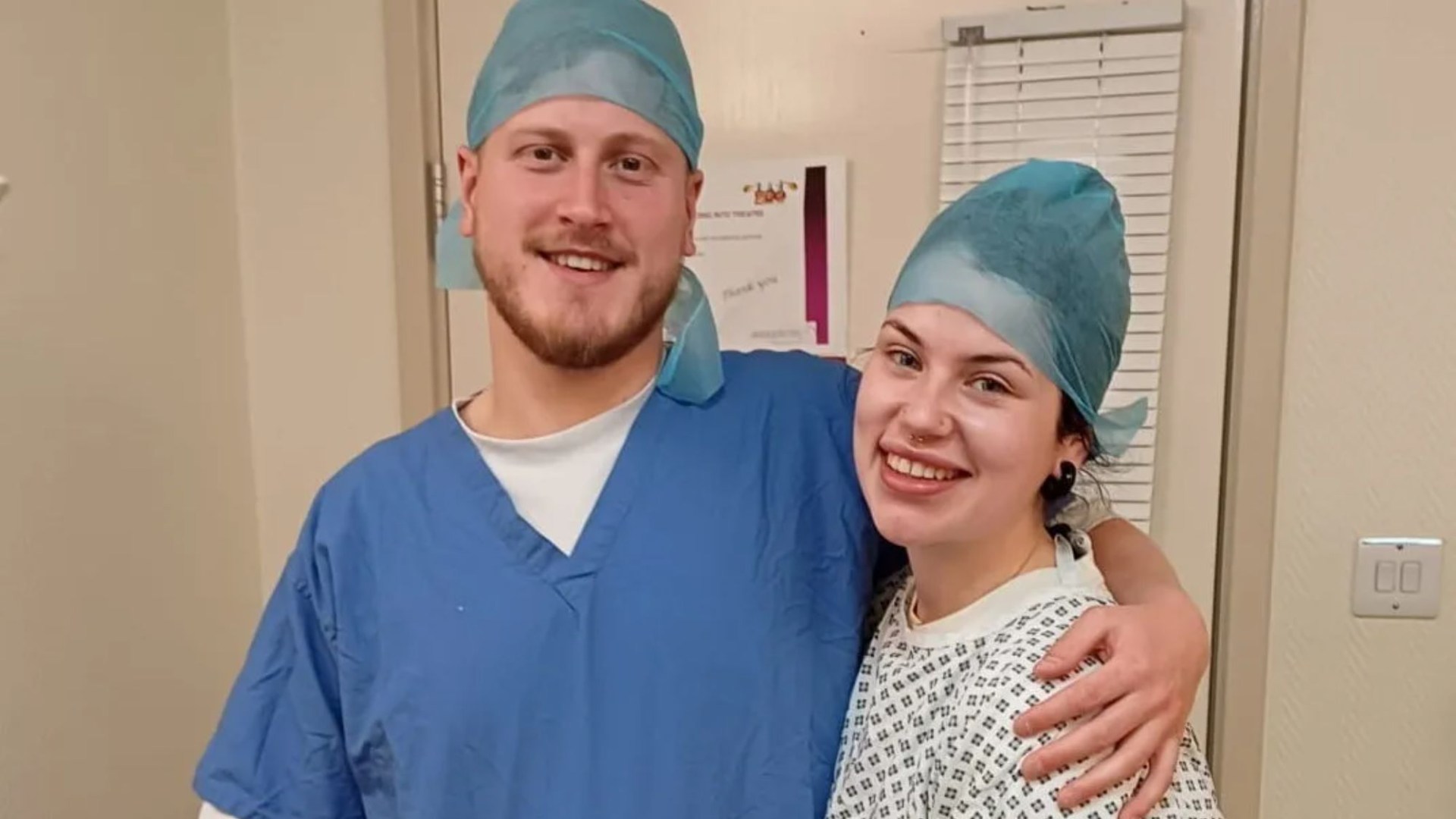
A WOMAN born without a womb is raising £20,000 for a life-changing uterus transplant in a bid to become a mum. Molly Eagles, 28, was diagnosed with Mayer Rokitansky Küster Hauser (MRKH) syndrome at the age of just 15. Pictured, Molly Eagles with fiancé Matt Crowe Credit: SWNS Molly Eagles, 28, was diagnosed with Mayer Rokitansky Küster Hauser syndrome aged 15 Credit: SWNS The congenital condition – meaning it was present from birth – occurs when the womb does not develop at all or is a fraction of the normal size. Ovaries usually function normally, meaning puberty and hormone development occur as expected, but periods do not start. Sign up for the Health newsletter Thank you! Molly, from Chesterfield in Derbyshire, said she has “always wanted” to be a young mum. After meeting her now fiancé Matt Crowe, 28, the couple paid privately for IVF embryo creation in 2019 – using their savings and help from family. They were paired with a surrogate through a private agency, but Molly says their first round of embryos – using Molly’s eggs and Matt’s sperm “didn’t stick”. After their second round of IVF in June 2024, their surrogate became pregnant in November 2024 but they miscarried just a month into the pregnancy. The couple took some time to “recharge” after their loss and having spent £50,000. Earlier this year in February, however, a baby boy became the first child in the UK to be born using a womb transplanted from a dead donor, offering hope for thousands of women including Molly. Most read in Health Molly and Matt’s next round of embryos would need to be PGT-A tested before she can be added to the list, which could cost up to £12,000. PGT-A (Preimplantation Genetic Testing for Aneuploidy) is an IVF lab procedure used to check embryos for the correct number of chromosomes before transfer. Now, the couple are raising £20,000 for their next round of embryos and for them to be PGTA tested. The money would also help cover surrogacy in the future for the couple, which they plan to use if they do not make the transplant list. Recalling her heartbreaking ordeal, Molly, a barista, says: “I was 15 when I was diagnosed and obviously everything was developing throughout puberty. “But I had a gut feeling something was wrong. Pictured, Molly Eagles with fiancé Matt Crowe during the IVF process Credit: SWNS WHAT IS MRKH? Mayer Rokitansky Küster Hauser (MRKH) syndrome is a congenital (born with) abnormality, characterised by the absence or underdevelopment of the vagina, cervix and the womb, which affects one in every 5,000 women. People with the condition usually discover that they have it during puberty, as although they develop breasts and pubic hair, they do not start having periods. This is because the ovaries produce the female hormones that make normal development occur, but the absence of the vagina and uterus mean that there is no bleed. For the majority of women with MRKH, surgeons are able to create a vagina by stretching the small amount of vaginal tissue already present. This is usually done by using specially designed smooth cylinder-shaped objects called vaginal dilators. Following this, women with MRKH will be able to have sex. Although women with this condition are usually unable to carry a pregnancy, they may be able to have children through assisted reproduction. Individuals with MRKH syndrome may also have abnormalities in other parts of the body. The kidneys may be abnormally formed or positioned, or one kidney may fail to develop (unilateral renal agenesis). Affected individuals commonly develop skeletal abnormalities, particularly of the spinal bones (vertebrae). Females with MRKH syndrome may also have hearing loss or heart defects. For more information, visit the MRKH support group. “I can’t explain it, I had a feeling something was wrong with my body. “So I went to the doctors and was told a few times I was a late bloomer as I had not started my period. “My mum demanded a scan and that was when I found out. “Whilst they were scanning I was looking at my mum and I could see her facial expression and in that moment I knew something was wrong. “It sounds ridiculous but I’ve always wanted to be a young mum. “Even when I was a baby I used to carry dolls around all the time and roleplay families. “Honestly it felt like my heart had been ripped out. “From that day I’ve had a pain in my heart I carry around daily.” Molly met Matt through friends when they were 13 but they started dating in 2017. “He’s just incredible,” Molly says. “Because when you’ve got a condition like MRKH you sort of feel like people aren’t going to accept or be in a romantic relationship with you as you can’t provide them with a child easily. “But Matt has always been so supportive, positive and just incredible.” Just two years into their relationship they started IVF. Molly did not meet the eligibility criteria for a free round through the NHS. But their attempts were not successful. “From then we took a break just to recharge mentally, physically and financially,” Molly says. “Now, we’ve started a GoFundMe because we’ve seen that uterus transplants are actually being trialled. In February, Grace Bell became the first British woman to give birth after a womb transplant from a deceased donor Credit: PA “We want to create more embryos but they have to be PGTA tested to actually be eligible to be put on the list for a transplant. “All our family said ‘look, you’ve tried so much yourselves and spent nearly £50,000, do a GoFundMe you never know what will happen. “The kindness of people has been so overwhelming”. To date, their GoFundMe page has raised just over £9,300. Molly and Matt will also need to pay for blood tests, and a uterus will be matched to Molly dependant on blood type. If successfully paired, Molly’s transplant will take place in Oxford, and she will need to be based close by for eight weeks after surgery for monitoring. The couple got engaged in March 2026 at Barmston beach, Driffield. Molly says: “We’d like to elope next year on our 10 year anniversary, just us and our dog as a big wedding isn’t on the cards for us as our financial focus is our baby. “We won’t give up fighting for our baby. We are beyond grateful to people for donating. “We’re just excited and it restores hope – I just don’t feel like we’re alone anymore. “Obviously don’t get me wrong we are putting it out there raise funds and move financially forward in our journey but at the same time spreading awareness of MRKH is a really important thing to me because I think everything I spoke to someone about it they don’t have a clue what it is. “When I was diagnosed I would have loved to have had more information about it. “It’s empowering to people who do have MRKH to know they are not alone and they should feel proud of who they are”. An estimated 15,000 women of childbearing age in the UK live without a functioning uterus, with roughly 5,000 born without a womb. Comment now
I need £20k to join womb transplant waiting list after being born without a uterus & £50k IVF heartache
Full Article
Original Source
Read the full article at Thesun →KhanList aggregates and links to publicly available news content. We do not host full articles from third-party sources. Always verify important information with original sources.