
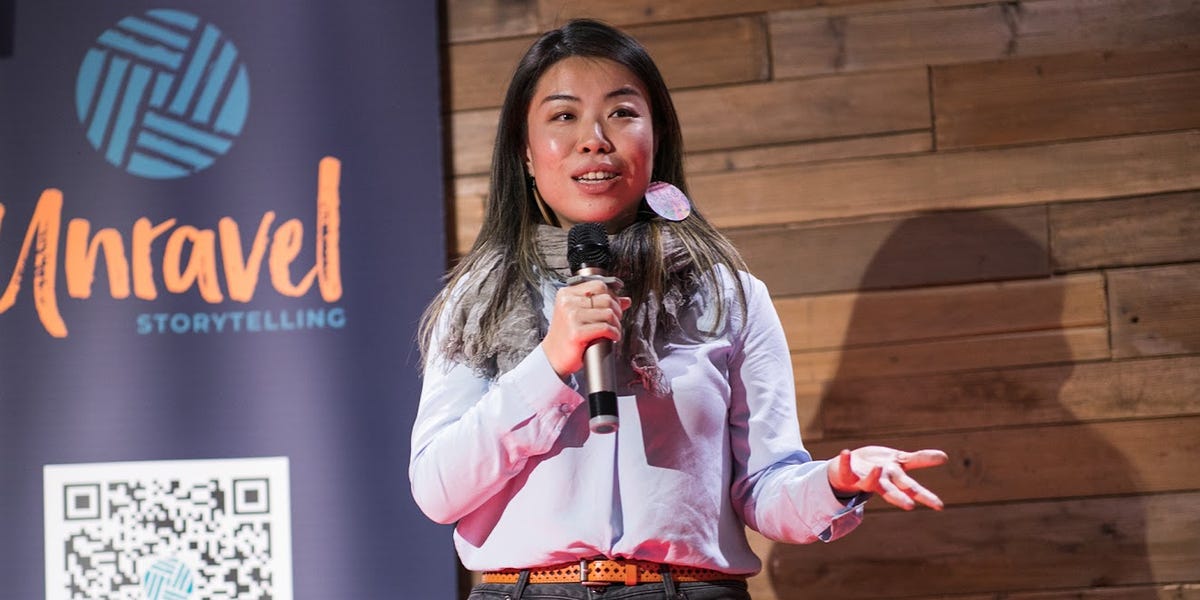
I moved back to Beijing after studying in New York and Boston. I found my creative outlet in China. Alex Shi earned two master's degrees, first in Boston and then in New York City. When she couldn't secure visa sponsorship, she moved back to Beijing. Provided by Alex Shi This as-told-to essay is based on a conversation with Alex Shi, a 37-year-old freelancer who moved back to Beijing. She worked as a freelance director and stand-up comic. It has been edited for length and clarity.When I graduated from college in Beijing, I wanted to start work right away. My mom had other plans.Her views had swung wildly. When I was in high school, my English teacher told me to leave China and study in the US, where she said I'd thrive. My mom said only kids who couldn't get good grades went overseas. A couple of years later, studying abroad became hugely popular, and suddenly my mom thought I needed to go too. We fought for 2 months.In the end, I went to Boston University and got a master's in broadcast journalism. At 25, I moved to Charlotte, North Carolina, for a boyfriend. We broke up, and I'd wasted most of my OPT year in a city where I knew no one. But I wasn't ready to go home, so I did a second master's in media studies at The New School in New York.My plan was to stay in New York, but a teaching offer from a film school fell through when they found out I needed visa sponsorship. I left the US in 2018, on the same day my best friend got married. I'd helped him pick the cake and the menu, but missed the wedding.A few years in Big TechBack in Beijing, I freelanced for a few years, taking on corporate projects and producing for international news outlets. I started dancing salsa as well.When the pandemic started, the only entertainment left was comedy open mics. I watched for 2 months before trying. My first time on stage, I got laughs. The comics I knew were encouraging.But freelancing had died down. I wanted a bit more stability, and my family was encouraging me to find a steadier job. In 2021, I was hired by ByteDance as an intercultural communication expert. Two months in, my whole department disappeared, so I moved into product design. We worked with teams in other time zones, so the day never really ended. It was the most stressful 2 years of my life. I stopped doing comedy and dancing. I was the heaviest I've ever been.The office was in an old building in Beijing with low ceilings and turnstiles on every floor that made me feel like I was swiping myself into prison.I went back to freelance, focusing on intercultural communication. I work with corporate clients, including Chinese businesses looking to expand overseas. This time, I drew a line for what projects I'd take on rather than taking on everything I was offered. I knew that I didn't want to be a generic creative. I now have more control.Finding my creative outletI never set out to do comedy. In New York, I was into live storytelling, inspired by the podcast "The Moth." Back in China, I traveled to Shanghai twice to tell stories.What I like most about doing comedy is that when I bomb, I have to tell myself to get over myself.For most of my life, I only chose things I was about 90% sure I'd be good at. I don't play sports I'm bad at because I don't want to look stupid. Comedy is the one thing I told myself I wouldn't give up. I can't blame the audience every time, and I can't blame myself every time.It's still a hobby, but I'd love to tour as a stand-up comedian and turn it into a career. Shi would be happy to turn stand-up comedy from a hobby into a career. Provided by Alex Shi My days in Beijing are flexibleUnless I have a morning meeting, I get out of bed around 10:30 a.m., spend about two hours making coffee and not cleaning my room, and then start work in the afternoon. Last night, I edited a podcast until 3 a.m. with an in-person meeting the next day.Plenty of people assume I was more creative abroad. It's true that in New York, I was surrounded by artists. I shot photography and independent films. I'd see a woman at a restaurant and ask if she wanted to take photos. It was free-wheeling and fun.But in Beijing, I'm a creative professional. I take things more seriously; I don't just do whatever comes to mind.In New York City, I was living with four other roommates. Now I'm in a different stage of life. I live alone. The city is expensive, and more money- and status-oriented than anywhere else I've lived. I'm Chinese, living in my own country's capital, and I feel I have something to prove.I don't want to be a struggling artist here. My parents live in Beijing too, and I hate admitting how much pressure that adds. When an idea hits, I ask where it can go and how to carry it to the next step. I'm happier as a creative person in Beijing, because I finish what I start. Read next Business Insider tells the innovative stories you want to know Business Insider tells the innovative stories you want to know Business Insider tells the innovative stories you want to know Business Insider tells the innovative stories you want to know as told to China
I moved back to Beijing after studying in New York and Boston. I found my creative outlet in China.
Full Article
Original Source
Read the full article at Businessinsider →KhanList aggregates and links to publicly available news content. We do not host full articles from third-party sources. Always verify important information with original sources.