
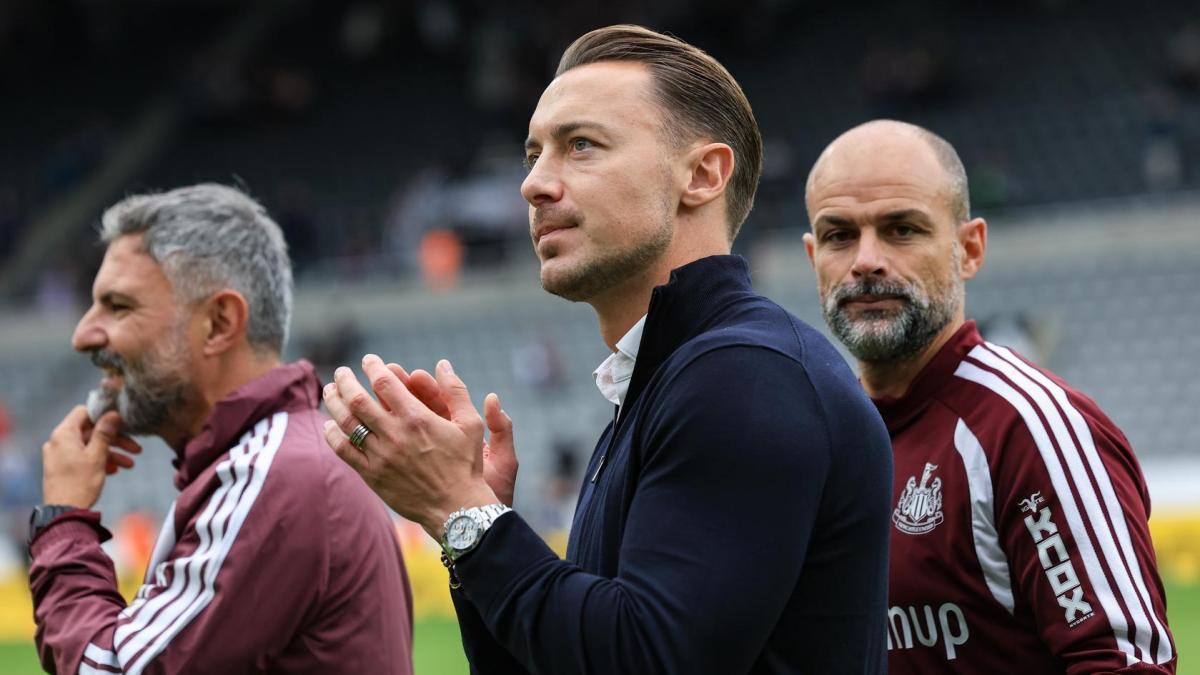
Take a walk through Newcastle United’s Darsley Park training ground and on the screens in the canteen you’ll notice a leaderboard of players who make the most high-intensity sprints. It is intended to introduce a bit of friendly competition. Sitting proudly at the top is Matias Fernandez-Pardo. But the numbers across the board are impressive. Speed is something on everyone’s mind at Newcastle. After a fast start under Matthias Jaissle, progress has slowed and questions are being asked. The next four games – starting on Saturday against league leaders Arsenal and ending against Sunderland in what could be a red letter day for the German next month – feel absolutely crucial. Can a stuttering Newcastle lay down a marker? The i Paper spoke to Jaissle’s three assistant managers – Alexander Hauser, Engin Yanova and Florens Koch – to build a picture of what is really happening on the training ground at Newcastle as they attempt to get the manager’s “vertical football” strategy working. The i Paper got to see behind the curtain of the Jaissle-era (Photo: Supplier) The trio have never spoken to English media before but all are interesting, intelligent characters. Hauser, who could have turned pro as a cross-country skier, is the only one of the three to have enjoyed a successful playing career, starting out at Rangers as a 16-year-old where he lived in digs run by David Moyes’ parents. He began as a striker at Ibrox before converting to a left winger and slowly moving inside “because I lost all of my pace”. A graduate of the Red Bull school of football, he’s been with Jaissle the longest, the pair having first worked together at Austrian outfit FC Leifering in 2020.Koch studied mechanical engineering at university in Munich before being head-hunted by the Red Bull Academy in Salzburg, where he followed the class of 2002 from under-15s to senior level. It was an intake that included Amir Dedic, who he says he acted like a “big brother” to him during his “wild” days as a teenager with bags of potential. His passion is player development. Away from the training pitch he’s desperate to visit Tynemouth and sample a British pub – preferably one when Newcastle have just played. Yanova – whose highly promising youth career was cut short by injury – is the most recent addition to the staff, first joining Jaissle in 2023 at Al-Ahli after working for the German national FA and Bavarian football association developing high potential players. Joshua Kimmich is among his success stories. Like Jaissle, the trio are workaholics. There are 7am starts but laptops are regularly popped open in front of live matches in the evening. Games of padel and runs offer rare respite from the breakneck pace of the Premier League. “This is a really good group of people and we’re obsessed with football. Also obsessed with this way of playing because we know it will work,” Hauser explains. Yanova began his coaching career over 10 years ago (Photo: Supplied) Each coach gets different bits Jaissle is a boots-on-the-grass manager who leads from the front in most sessions but he has assigned his three trusted lieutenants position-specific responsibilities. Koch has responsibility for the midfielders and an over-arching remit to lead on “player development” while Yanova is on the attackers. He is also the link to the academy, in regular dialogue with Steve Harper and Robbie Stockdale about promising players who could train and join the first team squad. Hauser is responsible for the defenders and, with input from Jaissle, plans the day-to-day training sessions. He is also part of a four-man team dedicated to set pieces. Martin Mark leads that department and is on attacking set piece routines while Hauser works on the defensive set plays. Newcastle, he explains, have made changes in that area that have borne fruit. “We have changed the defensive structure from last year. We’ve adjusted a few principles and the set-up a bit and then you need to look game by game how you adjust,” he explains. “Last year they changed quite a lot from man to man to zonal and they conceded too many goals. We have changed the defensive set up to man markers and we’ve only conceded one free-kick and not from any corners but we have Arsenal this weekend so the hard work begins.” How a typical week looks There remains a “total” belief that Jaissle’s favoured style – a high intensity, attack-minded system he calls “vertical football” – can work in the Premier League but time on the training ground is going to be critical making it work. A typical week begins four days before matchday, working in small spaces with small-sided games and open goals. There are plenty of rondos and work on defensive ideas. The idea is to coach the players into making quick, correct decisions. Three days out it is about transition and in-possession principles. The small spaces are gone and the emphasis is on hard work and physical load. The final two days before the game the squad concentrate on specific tactics and shape work for their opponents . It is different to Eddie Howe’s way of working and there has been an adjustment period. Hauser oversaw one session in which passing backwards was banned in the middle third of the pitch. The idea, he explains, was to provoke them into “thinking about going forward every time”. At the end of sessions, Jaissle’s assistants break out and deliver what the team call “snacks” to individual players or groups depending on their positions. These are 15-minute bite-size sessions tailored to improving things like positional awareness, movement or something specific that could be important in the next game. They are big on individual analysis and players are pulled into regular meetings for data-driven analysis. These sessions are not intended to be one-way – coaches want to exchange views and feedback on what is and isn’t working. A recent forum with the midfielders delved into line-breaking passes from the number six position – what worked against Fulham and what didn’t. Newcastle are building for the future but also need to get those most out of their current stars (Photo: Supplied) “Developing players is not just about identifying things they can do better,” Koch explains. “If you don’t have a good relationship with a player, it’s difficult. It’s important that there’s respect and trust, on one side you can be hard to the boy if he’s not working hard enough but also you need to be the nice guy.” With all of the assistants – and Jaissle himself – having a background in youth football from under-11 up to under-21 they are big on player development. One of the reasons they got the job was their ability to work with young players and a week after they got the job Koch began a project aimed at ranking the squad in key areas from one to three. A mark was assigned to them related to Jaissle’s five principles of playing. Some were basic stuff like first touch but it rolled into how good they are in the four phases of playing – in possession, out of possession, transition to attack and transition to defence. The idea was to make it a quick, first impression score and coaches and analysts were all canvassed for their opinion. Each player has a matrix and the exercise will be repeated again in six months time to see how quickly – or if at all – they are progressing. “In the short-term you need results. That is clear. But in the long-term the culture here has to be about developing players,” Koch explains. What is going wrong – and what is going right Theory has collided heavily with reality on a few occasions this season. Newcastle began well but heavy defeats at Leeds and Coventry, and damaging losses at St James’ Park against Aston Villa and Everton, have sapped enthusiasm and belief among some supporters. The feeling in the coaching staff is that Newcastle were over-performing before the first international break and then under-performed significantly before the most recent hiatus. Clearly, coming in less than a fortnight before the season began made things difficult. “It’s been intense. We came in late, starting in La Manga and we tried to work things out really fast but it’s a journey, it’s up and down. It was clear for us that it would be like this,” Hauser says. “There were a lot of changes in the summer and we lost experienced players. As a player you know if you lose the core of the team, not only on the pitch but also in the dressing room, it takes time but of course we don’t have time! We know that’s part of football, we need to deliver results, we need to deliver good performances on a consistent level.” So what are the issues? They don’t score enough, for a start, and their strikers are not providing enough of a cutting edge. “We have the quality in the strikers but we need to get the little details right, knowing the runs each player makes, timing. We need more of a strong conviction to be in the right place in the box at the right time,” Yanova says. “It is not a problem of opportunities, we had 28 shots against Everton, but we need to work on these details.” Newcastle’s new coaching staff are still implementing the new philosophy (Photo: Supplied) He predicts more to come from Fernandez-Pardo, who he has worked with intensively since his return from a virus. “He’s very gifted. He has so much talent. He’s very powerful with his deep runs, I believe he can hurt every back four in the Premier League but we all need to know each other in terms of timing,” he explains. “Everything is detail now. The timing of deep runs has to be right and the other side is if he runs, the other players need to know when and how he runs. Sometimes he doesn’t need to be on the edge of the offside line because he’s so fast he can reach the ball. This is the development we need with him.” Just as important is a midfield mix that Koch admits they haven’t got right yet. “It’s very complex,” he admits. “In vertical football the midfielders have to give rhythm to the game. They have to be aware of different situations. At that moment when you get the ball in the centre, the first idea has to be playing forward. The principle is ‘first thought forward’ but it doesn’t mean that we have to play forward if there’s nobody free. Read more Pete Hall: Inside Poch’s Man Utd plans: ‘Murderball’, wall charts and four transfer targets Pete Blackburn: The Nottingham Forest ‘quarterback’ turning into the next Elliot Anderson “Then we don’t play forward. If we play forward you have to organise the rest of the field again, you have to be playable or you have to mark a man and it’s quite complex. You cannot switch off.” Having deployed double sixes against Everton, Newcastle played Nico Gonzalez and Sean Steur at Fulham. Koch is a huge fan of the latter. “The first time I saw him I thought ‘F**k! What a talent’. He’s so smart, a typical smart Ajax player, the way he manipulates the ball,” he says. His enthusiasm is infectious but it has to be grounded in reality. “We know we need those results. We have an incredible, talented group and we can do better,” he says.
I met the trio putting Matthias Jaissle’s philosophy into action at Newcastle
Full Article
Original Source
Read the full article at Inews →KhanList aggregates and links to publicly available news content. We do not host full articles from third-party sources. Always verify important information with original sources.