
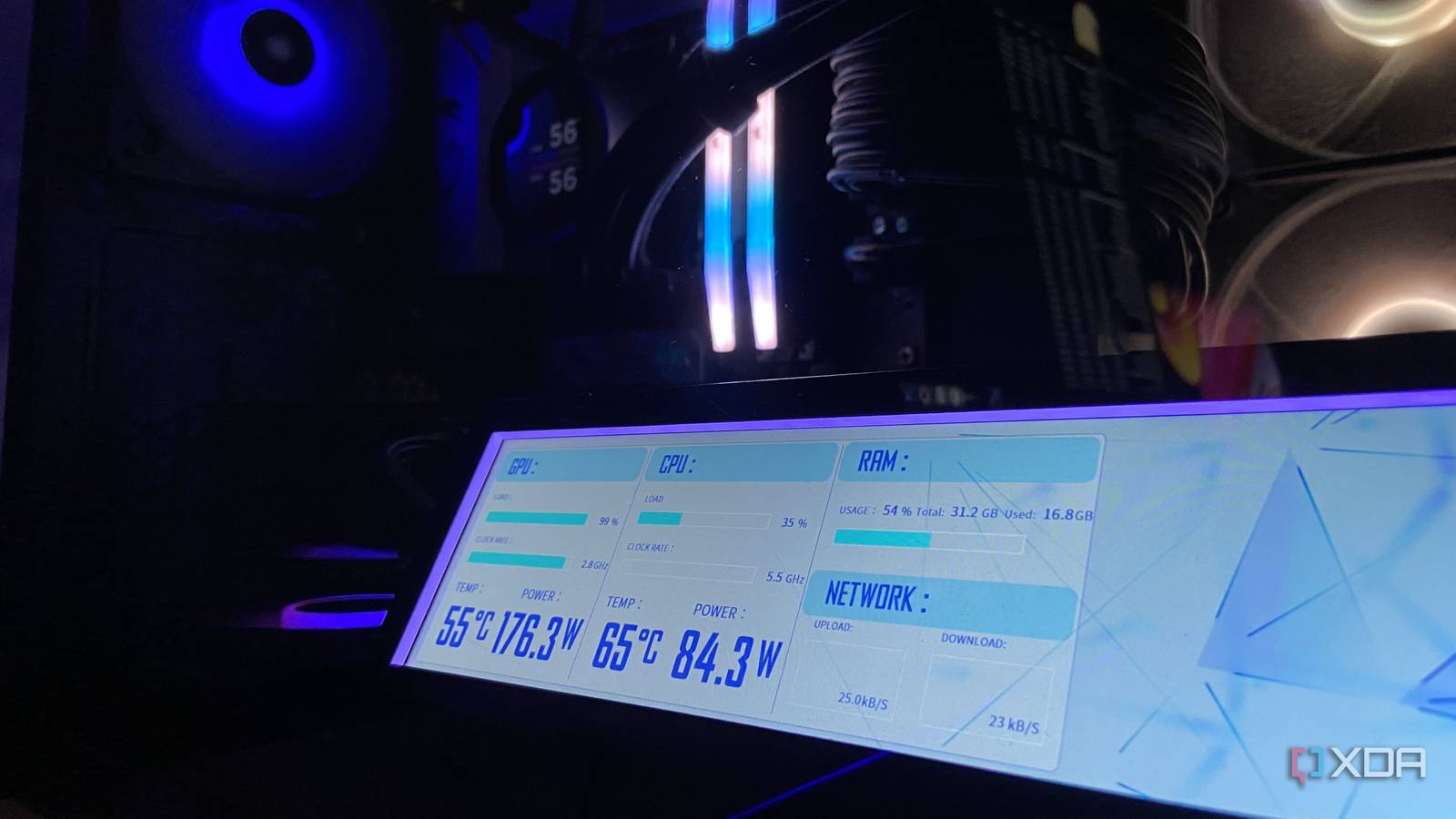
Published Nov 4, 2026, 10:30 AM EST Abhinav pivoted from a career in banking to pursue his first love in writing. Even while working full-time, he continued contributing as an editor-at-large, a role he has held for more than 7 years. A lifelong tech enthusiast who has built three gaming and productivity powerhouse PCs since 2018, his passion for technology keeps him closely following the semiconductor industry, from NVIDIA and AMD to ARM. His MSc dissertation explored how artificial intelligence will reshape the future of work, reflecting his curiosity about the wider social impact of emerging technologies. I've been a staunch proponent of self-hosting AI for a while now, and the points that I usually make are centered around data privacy and the fiscal cost of self-hosting your own models versus paying for a monthly subscription. One of the most frequent comments I get says that whatever I save by self-hosting my models is offset by my power bill, which always felt hyperbolic. To find out exactly how much local AI inference adds to my power bill each month, I benchmarked a model with llama-bench, the benchmark tool built into llama.cpp, logged power draw with HWiNFO and Nvidia's own nvidia-smi on my RTX 4070 Ti Super PC, and found that the cost is nowhere close to what I'd pay for a single AI subscription. Here is what I found, and how I measured it. Measuring only the GPU would've flattered the numbers So every watt the model touched went into the accounting To make the test and an estimation of cost as comprehensive as possible, I picked Qwen3.6-35B-A3B, which is a model that's too big for my RTX 4070 Ti Super's 16GB of GDDR6X memory on its own, and not lacking in capability at any task I throw at it. At 16.5GB in its UD-IQ4_XS quantization, I tend to offload the experts from eight of its layers to my Ryzen 5 7600X with llama.cpp's --n-cpu-moe flag to get a comfortable inference speed. This also puts the CPU to work on every token generated by the model, so measuring the GPU alone would have concealed a big part of the power bill, which is exactly why I accounted for the CPU in the cost accounting as well. I used llama-bench, which is a benchmark test that comes baked into llama.cpp (build b11927) to time the two jobs a model does, which is reading prompts and generating tokens. For this test, I gave the model a 2,048 token prompt to read ten times over and instructed it to generate 512 tokens five times over, both starting from an empty context. I even assumed the worst for every watt Peak draw, no idle draw discount, and a 100W added on top While llama-bench ran, I used HWiNFO to log the CPU's package power and nvidia-smi to log the GPU's board power every half a second. Added together, the two peaked at 237.5W while reading and 251.9W while generating. Then, I took an approach that can be described as hyperbolic in the accounting of costs, which entailed stacking the deck against myself. I priced every token as if my CPU and GPU drew that peak for the entire run, did not subtract their idle draw, and used the U.S. Energy Information Administration's 2026 projected average U.S. residential rate of 18.2 cents per kWh. The rest of the system, including the RAM, the fans, and power supply losses wasn't logged by HWiNFO, so I'll show what another 100W on top does, which is the figure I would use as the true "worst case." Task Speed Peak draw Cost per million tokens (USD) Worst case (+100W) Reading a prompt 2,855 t/s 237.5W 0.42¢ 0.60¢ Generating tokens 85.5 t/s 251.9W 14.9¢ 20.8¢ To put that in context, or more aptly, in subscription terms, $20 buys about 110 kWh at the currently projected U.S. average rate. At my measured peak of 251.9W, my PC would have to generate tokens non-stop for roughly 436 hours to burn through that, which works out to about 14.5 hours a day, every day, for a month. Even with the extra 100W on top, it still comes to around 312 hours, or over 10 hours a day. That's counting generation alone, which is the expensive half of the process, since reading a prompt costs well under a cent per million tokens even if you were to consider the worst case. Cloud tokens cost dozens to hundreds of times more than a local model And that's the rate you pay once your subscription runs out At this point, you would've likely realized that comparing the cost of running a local model versus paying for a cloud-based subscription service is quite a ridiculous practice. However, there's one final bit of accounting left, and that's comparing the two. When you pay for a monthly subscription service, the price of each token remains hidden, but the API rate cards from Anthropic, Google, and OpenAI don't, which makes them the most fitting standard of measure for what a model's output is worth. I compiled their list prices against my measured numbers for a clear comparison. Model Input (per million tokens, USD) Output (per million tokens, USD) Output vs Qwen3.6-35B-A3B on RTX 4070 Ti S PC (Qwen3.6-35B-A3B) 0.42¢ 14.9¢ - Claude Sonnet 5.5 $2 $10 67x Gemini 4 Argon $2 $10 67x (Introductory pricing) Gemini 3.1 Pro $2 $12 81x Claude Opus 5.5 $4 $20 134x ChatGPT (chat-latest) $5 $30 201x Claude Fable 5.1 $10 $50 336x GPT-6 Astra $10 $50 336x My power bill was never the real cost of local AI There are a lot of misconceptions surrounding the cost of running local models on the hardware you own, particularly relating to power draw. Part of what feeds into these misconceptions is the fact that a GPU running close to its rated power looks and feels energy-intensive, so most people assume that a model keeps the GPU pinned to that figure as long as it's running. However, that is rarely ever the case, because token generation leans on memory more than raw compute. My RTX 4070 Ti Super peaked at 144W while generating and 177W while reading a prompt against its 285W rating, and even with the CPU's draw and an extra 100W on top, I'd have to keep the model generating continuously for over 10 hours a day before it could match one $20 AI subscription.
I measured my local LLM’s power bill and it costs less than a single $20 ChatGPT, Claude or Gemini subscription
Full Article
Original Source
Read the full article at Xda-developers →KhanList aggregates and links to publicly available news content. We do not host full articles from third-party sources. Always verify important information with original sources.