
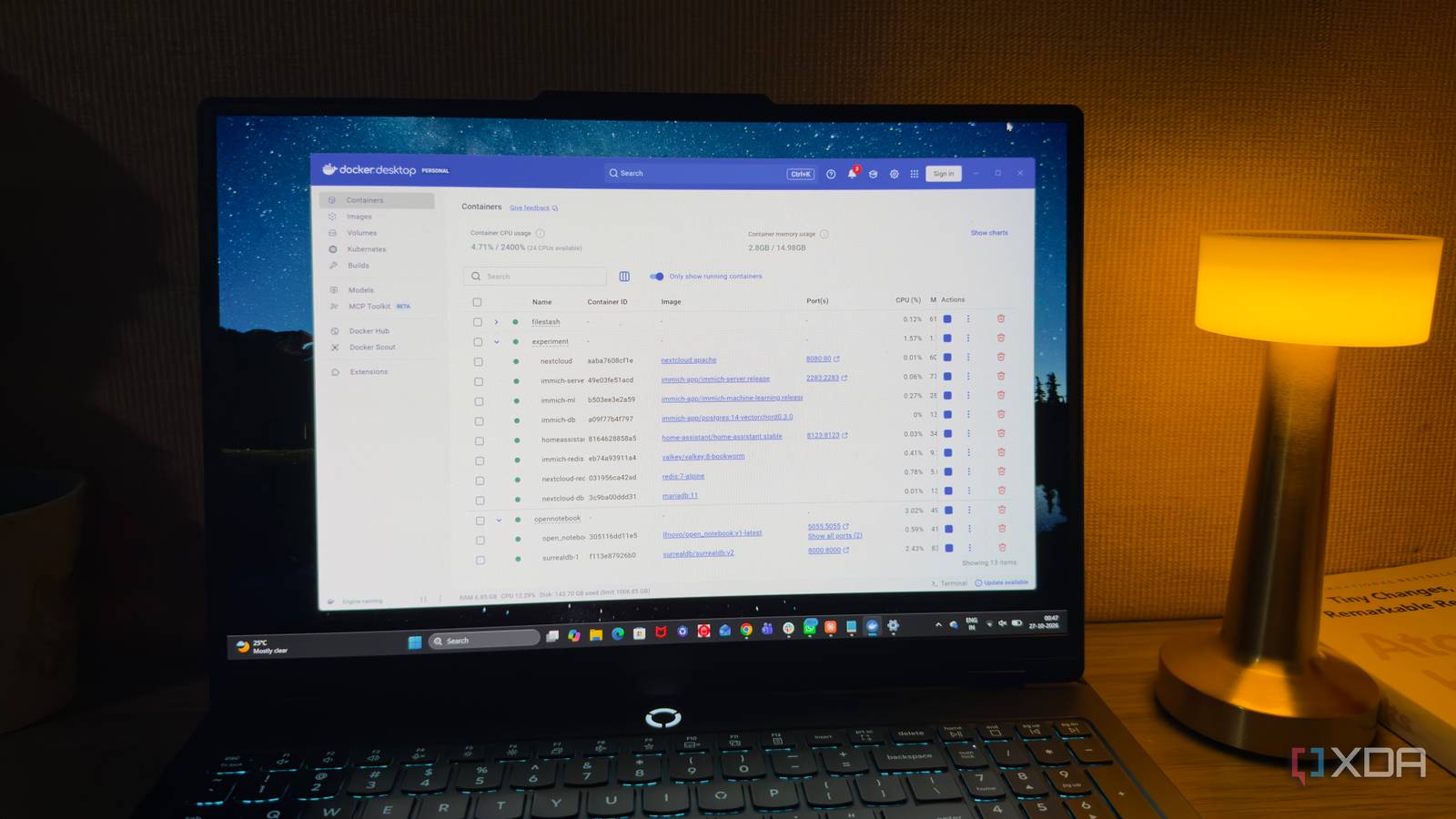
Published Oct 27, 2026, 4:00 PM EDT Beginning his professional journey in the tech industry in 2018, Yash spent over three years as a Software Engineer. After that, he shifted his focus to empowering readers through informative and engaging content on his tech blog – DiGiTAL BiRYANi. He has also published tech articles for MakeTechEasier. He loves to explore new tech gadgets and platforms. When he is not writing, you’ll find him exploring food. He is known as Digital Chef Yash among his readers because of his love for Technology and Food. Self-hosting gives me the freedom to run my own services, explore open-source tools, and keep more control over my data. What started as a fun hobby gradually grew into a bigger project than I expected. I was spending more time configuring my setup than enjoying the applications I hosted. Every weekend seemed to bring a new tweak, and my list of planned changes grew faster than I could work through it. The problem wasn't self-hosting itself. It was my habit of building for every possible scenario, including ones I never ran into. A straightforward setup rarely felt like enough when I could make something more flexible. Looking back, that one mistake made everything harder: I kept over-engineering things instead of focusing on what I needed. I kept adding complexity that I didn't actually need I optimized for problems I hadn't encountered yet The more comfortable I became with self-hosting, the more I wanted to customize everything. I experimented with reverse proxies, custom Docker networks, environment variables, and extra configuration options, even when the default setup worked perfectly well. For example, I could have reached a self-hosted application on my local network using its IP address and port. Instead, I was tempted to set up a reverse proxy, configure domain names, manage SSL certificates, and route traffic through additional services. That approach makes sense when you need remote access to multiple applications, but it's overkill for tools I only use at home. I also found myself adding tools to improve other tools. If an application lacked a feature, I'd look for another service to fill the gap. Each addition felt like progress, but I wasn't always solving a problem I had. Part of the appeal was that complexity looked like competence. Homelab forums and YouTube tours are full of elaborate stacks, and it's easy to treat them as the standard to aim for. But those setups are often built by people with different needs, more free time, or jobs that reward that kind of knowledge. Copying their architecture didn't give me their reasons for building it. The hidden cost of over-engineering was maintenance The real cost showed up after the initial excitement wore off. Running the applications was only part of the job. I also had to keep everything updated, check that services were still working, and figure out what went wrong whenever something broke. Even small changes could turn into time-consuming tasks. Before updating a container, I sometimes had to check its configuration to make sure nothing would break. When something went wrong, I had to dig through logs and check different components to find the cause. The more services depended on each other, the harder it became to pinpoint the problem. Time made it worse. A clever tweak I made one weekend would be a mystery a few months later. When something failed, I often had to reverse-engineer my own decisions before I could fix anything, because I rarely documented why I had set things up that way. My setup was taking far more time than it deserved, and the benefit of each extra layer rarely justified the upkeep. I needed a better way to decide what belonged in my homelab and what didn't. My biggest self-hosting lesson was to stop over-engineering Build for your needs, not possibilities Now I judge my setup by how well it serves me, not by how advanced it looks. If an application runs reliably, I leave its configuration alone, even when another approach seems more interesting. Often, the smarter choice is to change nothing. Before adding anything new, I run through a few quick questions. Does it solve a problem I have today? Will I use it regularly? Am I willing to keep it updated a year from now? If the answer to any of them is no, it stays on my list of things to try someday rather than becoming part of my homelab. I've also gone the other way and removed services I rarely opened, which made the rest of the setup easier to understand. For tools that never leave my home network, I went back to plain IP-and-port access and kept the reverse proxy only for the few services I need from outside. That doesn't mean a complex homelab is a bad idea. Building one purely for the learning experience is a perfectly good reason. What matters is knowing whether the complexity serves a purpose or just creates work. For me, self-hosting is more enjoyable when it stays practical, and my tools run quietly in the background. The best homelab is the one that lets you get on with life I still enjoy discovering new self-hosted tools and experimenting with my setup. But I no longer feel the need to install every interesting application or keep tweaking things just because I can. There's always something new to try, and that's part of the fun. I've simply learned to be more selective about what deserves a place in my homelab. After all, I started self-hosting to make my digital life easier, not to spend all my time managing it.
I made self-hosting harder than it needed to be by making this one mistake
Full Article
Original Source
Read the full article at Xda-developers →KhanList aggregates and links to publicly available news content. We do not host full articles from third-party sources. Always verify important information with original sources.