
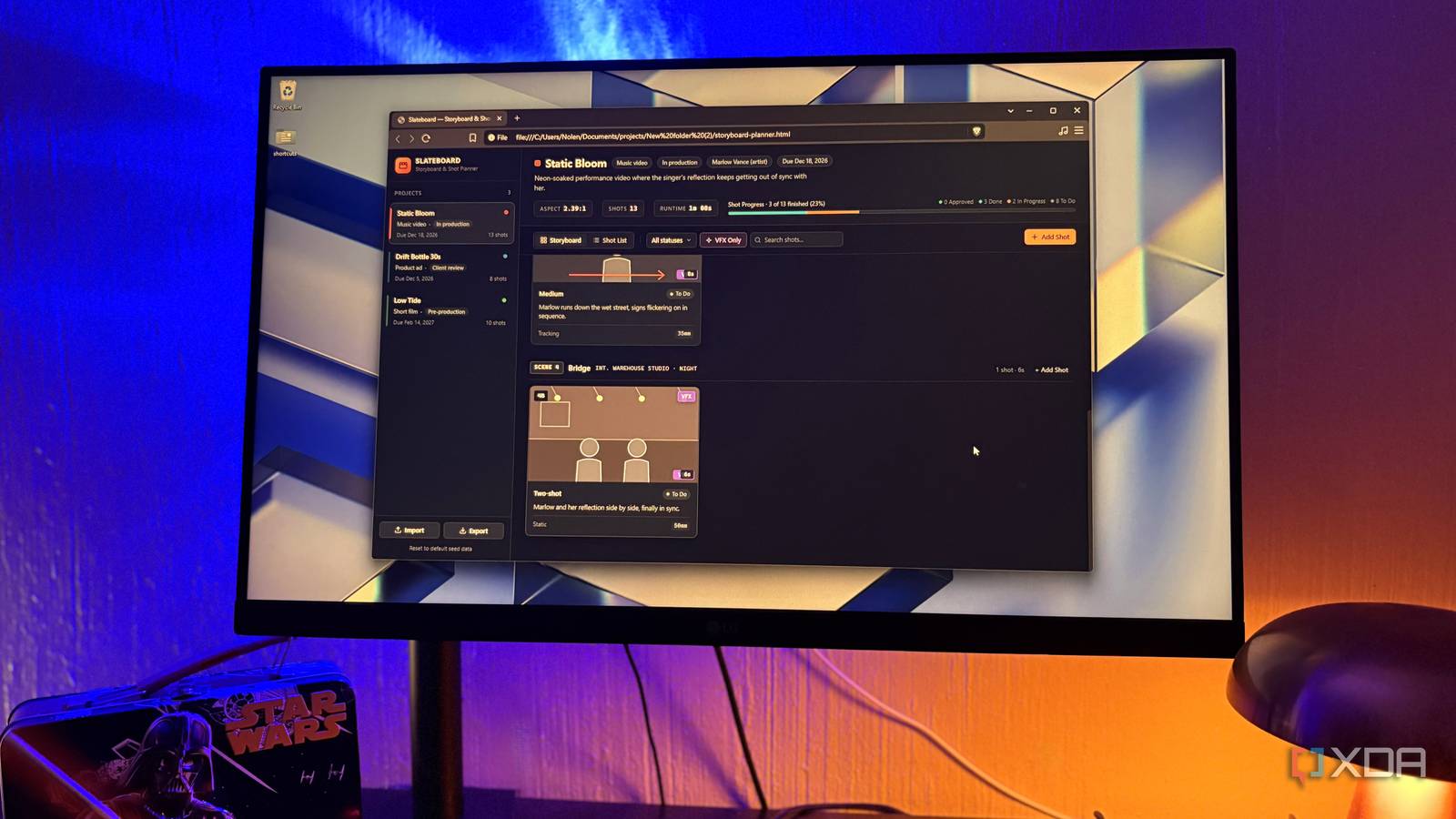
Published Nov 27, 2026, 12:31 PM EST Nolen began their writing career in 2019, with three years dedicated to editing the Creative section at MakeUseOf. Their expertise lies at the crossroads of technology and creativity, covering areas like photography, video editing, and graphic design. Outside of work, you'll often find Nolen diving into a good book, writing their own stories, or playing video games. Pre-production software is one of those subscriptions that's easy to justify on paper. StudioBinder is one of the go-tos for storyboards and shot lists, and its Starter plan is the cheaper option compared to something like Boords on monthly billing, at least for one person. But that's still $29 a month, and the free plan caps you at a single project (archived ones included), which isn't realistic for client work. This is exactly what vibe-coding is for, in my opinion. You can make apps and tools not just to replace your subscriptions, but to cover only the features you actually need, and that have a much smaller footprint. So, I gave the same prompts to Claude Code, Codex, and Antigravity to see which one could build me the best storyboard planner app that I actually want to open every day. Claude took the long route The slowest build, but the most thorough one I went with my favorite Claude model, Opus 5.5 on Medium, because it strikes the balance of being easy on usage limits while still being powerful. As for my prompt, I normally leave enough to the imagination so I can see how the models fill in the gaps, but I got pretty detailed this time. The app had to be a single HTML file that opens with a double-click, with nothing to install, and it had to load an existing projects file so my storyboards were in there from the start. For features, I stuck to the parts of StudioBinder I actually used. This includes a sidebar for switching projects and a storyboard view with frames grouped by scene, plus a shot list table I could flip to and a side panel for editing any shot. I also wanted to filter shots by status. The design brief is where I kept it a little looser on purpose to give it more wiggle room for creativity, as long as it worked like a real product and didn't look like a demo. Claude Code was pretty slow with it. The writing step alone sat for over nine minutes, then it opened the app in a browser and went through it, fixing bugs like a squashed preview and the mobile layout. Claude also tested an export button by popping up a save window. It was a little tedious, not going to lie, but we eventually got there. It delivered everything on my list, and when it exported my projects back out, the files matched the ones I started with so nothing was dropped or rearranged along the way. It also added things I never asked for that someone planning a shoot would want, for example letterbox bars on each frame that match the project's aspect ratio, and an undo after deleting a shot. The edit panel docks next to the board instead of covering it entirely, which I quite like. But the trade-off ended up being a very long report for me to read through. Codex took less than five minutes Fast, distinct, and very literal about the brief In Codex, I used GPT-6.1 Sol at Medium, and it was the fastest of the lot by a mile, finishing the entire build in under five minutes with my app ready to load. It never actually looked at what it made, though. Its preview tools also wouldn't load the files from my computer, so it only checked the code and data without opening the app, which made me the first to see whether the frames actually showed up on the screen. The design is the most distinct of the three. It went with a lime-green accent and a big editorial project title, and there's even a little tagline in the footer, which is a detail I wouldn't have thought to ask for. It's actually the only one here that looks like a product with its own distinct brand, which is exactly what my brief was looking for. Beyond the design, it ticked off all my boxes from the prompt. Some choices make it feel more like a form than an app. Edits only stick once you hit a Save button, rather than saving as you type. The editor also shows an internal shot ID field I'd never actually want to use, and deleting a shot throws up a plain browser popup that looks out of place next to the rest of the design. There's no search or way to edit scenes either, and new shots get numbered in a format that doesn't match the rest of the project. But a search box, editable scene fields, and a fix to the numbering function would sort all of the issues in one follow-up prompt. Antigravity had a solid build It played it safe Last but not least, Google's Antigravity. I've been loving it for my local admin work despite some of its shortcomings, so naturally I was going to include it in this roundup. I ran it on Gemini 4 Hydrogen at Medium, which is a smidge more intelligent than Argon, way faster, plus cheaper and lighter on rate limits. And after just a couple of minutes, it finished with its usual review pane showing every line of the file it wrote. Like Codex, it did only check that the code was valid so it never saw the app. Design-wise, it actually looked extremely similar to Claude's build with a near-identical layout, and it also covered everything in the prompt. The one feature it added was the search bar, which I actually think is more useful than filters. And deleting a shot takes two clicks, meaning it gives you that confirmation before it gets rid of it. The edit panel is where it lost me a little. Edits save as you type and there's no undo, so if I change my mind on something then I have to remember what was there and type it back myself. The fix to this would be cloning the object when the panel opens, which would take a couple of seconds in a follow-up prompt. Only one keeper If I could only keep one, it would be Claude's, and I think that mainly comes down to it checking its own work before giving it to me. It found and fixed the exact type of issues I encountered in the Codex and Antigravity builds. I must say Antigravity actually came close. It looks very similar to Claude's build and also covered the whole prompt. The only issues with it were fixable with follow-up prompting, anyway. I'll also give Codex some credit because it was the fastest and has the most distinct design, but it left me with the longest list of fixes. Honestly all three of them are usable as lightweight tools for the storyboard-planning features I needed, though they don't replace a full StudioBinder subscription. My preference just ended up being Claude's because it didn't require as much back-and-forth. Google Antigravity Codex
I made Claude Code, Codex, and Antigravity build a replacement for an app I paid for, and only one made something worth opening every day
Full Article
Original Source
Read the full article at Xda-developers →KhanList aggregates and links to publicly available news content. We do not host full articles from third-party sources. Always verify important information with original sources.