
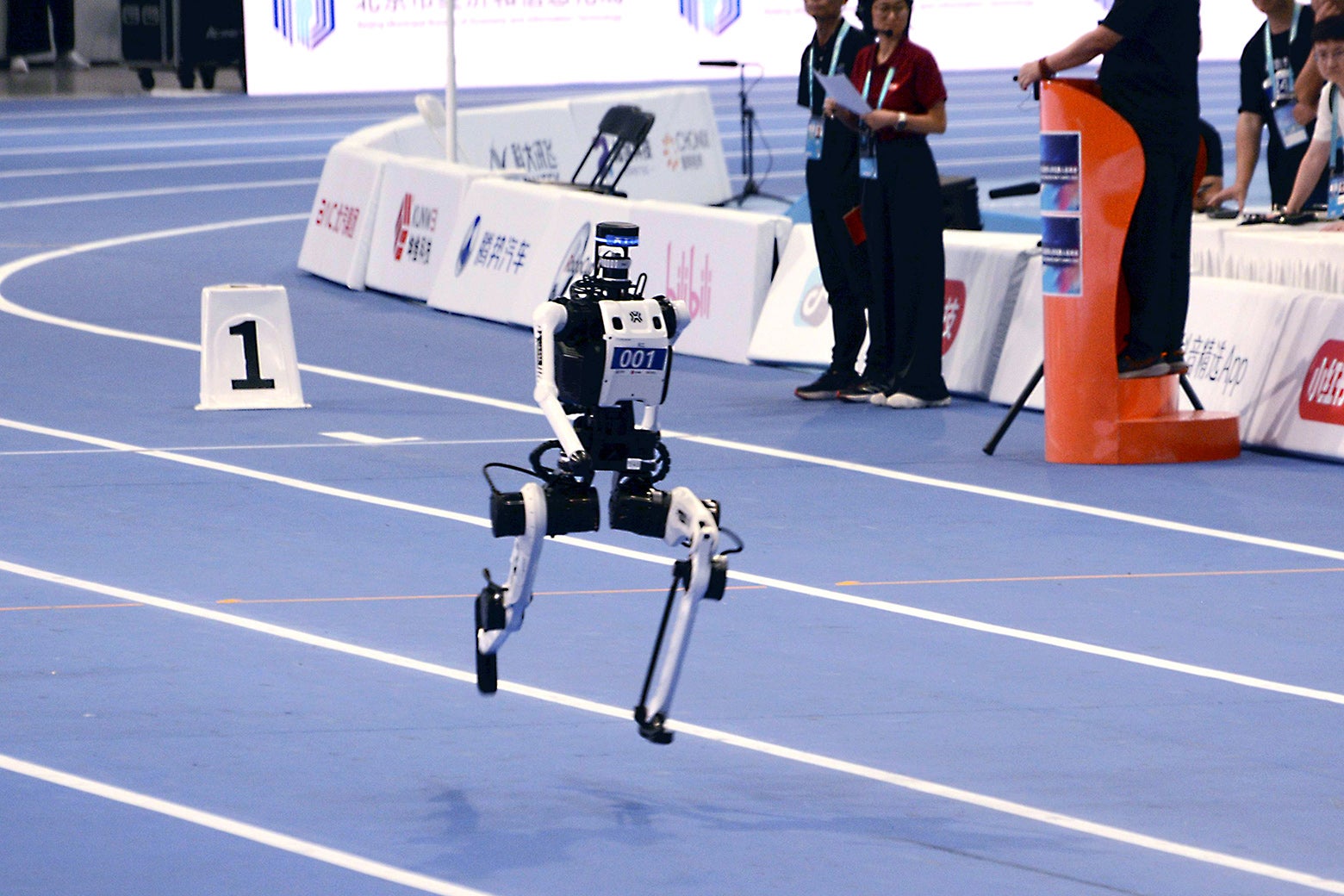
The Industry The Robots Are Winning Us Over by Falling on Their Faces The World Humanoid Games were actually a social experiment in the making. The Yomiuri Shimbun/Reuters Sign up for the Slatest to get the most insightful analysis, criticism, and advice out there, delivered to your inbox daily. The World Humanoid Games, held in late August in Beijing, were meant to demonstrate the supremacy of China’s robotics industry. Humanoids sprinted faster than Usain Bolt and jumped 11 feet in the air from a standing position. Robot breakdancers surpassed the athletic artistry of Raygun. But for millions like me, the robot Olympics burst into our feeds as a glorious cornucopia of slapstick comedy. Sprinting robots hurtled themselves full-speed into a wall like Forrest Gump with a death wish. The event billed as “soccer” was mostly slow-motion pileups of players wearing shirts but no pants. Two contenders for the boxing title were unable to even locate each other in the ring, until one attacked the air and toppled over, prompting the other to pump its arms like it just won the Rumble in the Jungle. Every robot that faceplanted, lost a limb, or disintegrated in a spray of sparks was borne away on a stretcher by human attendants with deadpan solicitude. People love to watch robots fail. It taps into humanity’s most ancient, addictive comedic truth, which is that some dude getting hit in the balls is hilarious. There’s also a vindictive pleasure in seeing that our supposed future overlords are dum-dums who can’t climb stairs. Plus, it’s inherently funny when a body engineered to function with extreme precision behaves ineptly. A humanoid’s frantic attempts to stay upright—arms flailing, legs skittering—bears an uncanny resemblance to the choreographed collapses of Charlie Chaplin or Buster Keaton. But there’s something deeper at work in our brains when we watch a robot trip over its own feet. We’re awash in apocalyptic anxieties about rogue technology. Fully autonomous drones are waging war in Ukraine; A.I. executives keep warning us that their next software update might accidentally delete humanity. Against that dystopian backdrop, goofball mechanical athletes may be doing something far more valuable for their creators than outpacing our greatest sporting achievements: They’re making machines relatable. There’s a term for this: the pratfall effect, named for a 1966 psychological experiment which found that highly accomplished people become more appealing to others when they make minor screwups. (Jennifer Lawrence tumbling up the stairs at the Oscars is the living embodiment of this concept.) In 2017, researchers at the Center for Human-Computer Interaction at the University of Salzburg tested whether the pratfall effect applied to robots. They discovered that people “significantly” preferred interacting with a robot that made non-dangerous mistakes over one that performed flawlessly. It’s not just that a robot becomes less threatening when it stumbles. We also recognize ourselves in its fallibility, which creates a subconscious bond. Carey Morewedge, a psychologist and professor of marketing at Boston University who has studied human-robot interaction, explained the underlying logic to me: “Let’s say a presidential candidate goes and shoots baskets for charity, and they’re not great at basketball. You connect with them more because this person’s very powerful in politics, but they’re willing to show that they’re like us in other ways.” Other studies have reached similar conclusions. People feel empathetic embarrassment for robots in uncomfortable situations. One experiment found people had warmer, more engaged interactions with robots that made social flubs, including “judgmental mistakes, wrong assumptions, expressing tiredness or boredom, or getting overexcited.” (Some researchers theorize that robots could be better caregivers or companions if such flaws were incorporated into their design, which does raise the question of why we need to invent bumbling humanoids when we already have … humans.) We’re also more likely to anthropomorphize robots when they act unpredictably. Confronted with the inexplicable, Morewedge says, we instinctively turn to the “incredible psychological machinery that we have for thinking about how people behave.” And so at the Humanoid Games, when one robot sprinter reacted to the starting gun by sitting down, then lying on its back and gazing at the sky, viewers saw a fellow casualty of burnout. “Are robots having bad days already?” one YouTube commenter wondered. I didn’t feel any affinity with the humanoid that smashed Bolt’s 100-meter record, but found the robot weightlifter that crumpled under a 15kg barbell and staggered into a table very relatable. One of the Games’ most popular characters was the “shy robot,” which went viral for a running style that makes absolutely no sense if you have a human body. The Tiangong Omni swivels its torso wildly from side to side while waving its bent arms in front of its face. Viewers found this endearing, speculating that the robot was “bashful” or suffering from social anxiety. But its weird gait was a physical coping mechanism rather than an emotional one: Waving its arms stopped its shoulder joints from overheating, while twisting at the waist helped it maintain balance around corners, which remain a gnarly challenge for humanoids. I asked Morewedge if viral robot fails were, counterintuitively, good PR for the industry. “Well, there’s two audiences for these things,” he said. “If I’m trying to pitch DARPA on my killer robot, I don’t want to show it failing to pick up a letter. But seeing failures of these kinds of systems assuages the public in general. Doing this in a very public way is certainly targeting an audience with a message of reassurance.” Xenia Bulatov is putting that concept into practice. She’s the co-founder of Ultimate Bots, which started as an underground robot fight club in San Francisco and aims to be a major humanoid sports league. “Humanoid robots are an amazing technology. Done well, the impact will be positive for society. That’s the future I want to live in,” Bulatov told me. “So it’s important for people to see that robots are not foes, but friends.” Whereas most American robotics companies only show their products in obsessively stage-managed demos, at an Ultimate Bots fight, “failure is the show,” Bulatov says. “Laughter is something we engage in to soothe us,” she explained. “If we show that robots are kind of clumsy and a little stupid right now, it puts people at ease.” Retrieving busted bots on stretchers, one of the Humanoid Games’ best visual gags, may actually have originated with her league. Dragging a human-like body offstage by the arm or stuffing it in a bag just didn’t look right, Bulatov said. They came up with the stretchers as yet another way to humanize robots for a wide audience. “Trust in an unfamiliar technology—one shaped like a person, with a century of hostile fiction attached to it—does not get built by a product launch,” she wrote in an essay on X. “It gets built by years of positive, repeated, emotionally legible exposure.” By laughing at robots, am I unwittingly participating in that effort? The humanoids that competed in Beijing are being developed to replace people in multiple industries, from healthcare to service work to retail to manufacturing; some may also have military applications. By the next robot Olympics, they’ll probably have figured out how to run around corners. Getting people to accept them is a much greater hurdle, one that requires a different kind of engineering. When we start to see ourselves in the machines, we may be doing some of that work for the industry without even realizing it. The robots might be the butt of the joke. But perhaps we’re their useful idiots. Artificial Intelligence China Robots Silicon Valley Sports
I Loved Laughing at Videos of Robots Falling on Their Faces. Then I Realized That’s Exactly What They Want.
Full Article
Original Source
Read the full article at Slate →KhanList aggregates and links to publicly available news content. We do not host full articles from third-party sources. Always verify important information with original sources.