
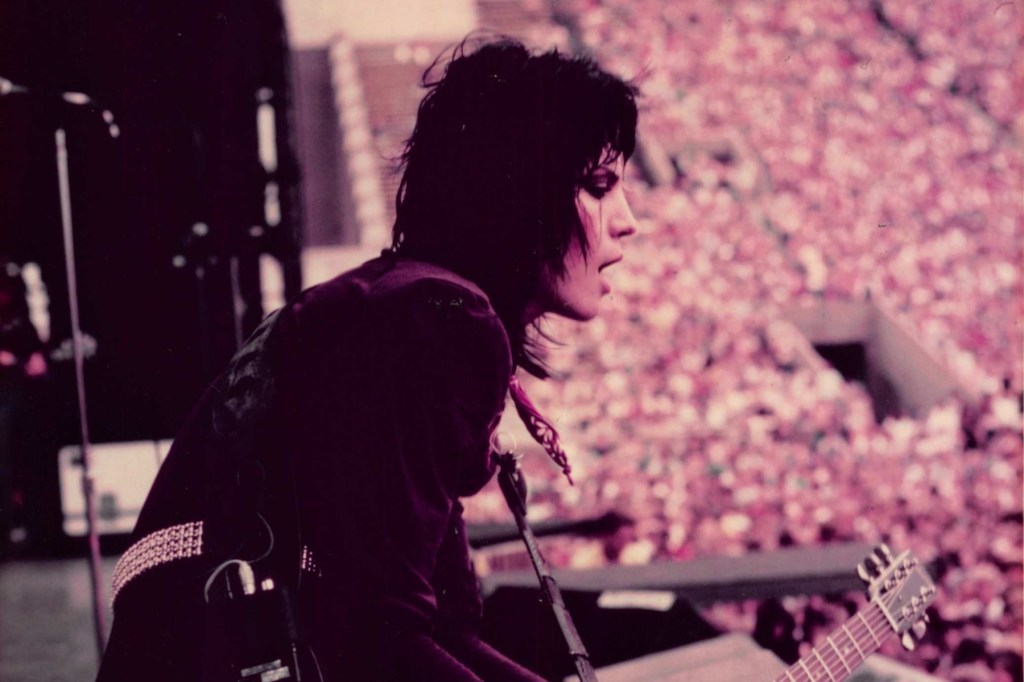
Joan Jett loved rock ‘n’ roll from the time she was an adolescent and swore to play it — especially after her first guitar teacher told her that “girls don’t play rock ‘n’ roll” and taught her “On Top of Old Smokey” instead. Explore See latest videos, charts and news She certainly made good on that ambition. Born Joan Larkin in suburban Philadelphia, she started playing guitar in Rockville, Md., and really pursued her passion after her family moved to Los Angeles County. She began haunting Rodney Bingenheimer’s English Disco and co-founded The Runaways with drummer Sandy West and producer/impresario Kim Fowley in 1975. “She was a Suzi Quatro fan,” remembers latter-day Runaways and Jett manager Toby Mamis, now of Alive Enterprises, who met Jett when he was working with Quatro. “She planted herself in the hotel lobby, too shy to introduce herself or ask for an autograph. But we looked at her, this girl that dressed like Suzi … and I would encourage her. I thought that a great outlet for her devotion to Suzi was playing rock ‘n’ roll the way Suzi did, being inspired by Elvis.” The Runaways lasted four studio albums, charting a couple of singles (“Cherry Bomb,” “Heartbeat”) on the Bubbling Under Hot 100 chart and making more noise in Japan than anywhere else. (The sordid story, including Foley’s abuse, is chronicled in the 2004 documentary Edgeplay: A Film About the Runaways and in the 2010 biopic The Runaways.) The band’s dissolution during the spring 1979 left Jett moribund for a time, but after dealing with some health issues, she launched a solo career. Mamis recruited pop writer-producers Kenny Laguna and Ritchie Cordell, who first worked with Jett on We’re All Crazee Now! (a never-finished film based on the Runaways), and then on her first album in 1980, known as Joan Jett in Europe and Bad Reputation the following year, after Jett signed with Neil Bogart’s Boardwalk Records in the U.S. Produced by Laguna and Cordell, with two tracks by Sex Pistols’ Steve Jones and Paul Cook, the album was an auspicious start for Jett — who herself had produced albums for several bands, including the Germs, around that time. Combining originals and covers, Bad Reputation reached No. 51 on the Billboard 200, while the title track and a rendition of Gary Glitter’s “Do You Wanna Touch Me (Oh Yeah)” and Lesley Gore’s “You Don’t Own Me” received a modicum of radio attention. But the big breakthrough was on the near horizon. I Love Rock ‘n Roll was recorded during the summer of 1981 and released on Nov. 18. Featuring Jett’s band the Blackhearts — a leather-clad, meat-and-potatoes rock quartet formed as she toured to support Bad Reputation — it was a defining 10-song collection of strong hooks, muscular arrangements and rocket-fueled energy, part craft, part chin-forward attitude. The troupe pulled out other covers, including the Dave Clark Five’s “Bits and Pieces,” the Halos’ “Nag” and the Runaways’ “You’re Too Possessive,” while Jett turned out four originals, including “Be Straight,” co-written with Laguna and Greg Kihn. The album got off to a sluggish start; the first release included the Christmas staple “Little Drummer Boy,” which didn’t give the album much in the way of shelf life. After the holiday season, it was replaced with a Jett original, “Oh Woe Is Me,” and the title track — a 1975 song by the Arrows that Jett first heard while touring the U.K. with the Runaways — provided liftoff. The thumping alchemy of glam and punk hit No. 1 on the Billboard Hot 100 for seven weeks and Mainstream Rock Airplay for five weeks in 1982, followed by her cover of Tommy James and the Shondells’ “Crimson and Clover,” which went top 10 on the Hot 100. The I Love Rock ‘n Roll album peaked at No. 2 on the Billboard 200 and went platinum — enough to cement Jett’s place as a true queen of rock ‘n’ roll noise, whose reign continues 45 years and a 2015 Rock & Roll Hall of Fame induction later. Jett, now 68, has seemed ageless over the years, clad in black and continuing to sling her guitar on stages around the world. “She’s such a force,” says Jane Wiedlin of the Go-Go’s, which followed the path Jett and the Runaways forged. “You can tell music is in her blood, and she’s always playing. She’s just… amazing. That’s all I can say.” I Love Rock ‘n Roll’s sapphire anniversary, meanwhile, is being feted with a Record Store Black Friday release of I Love Rock ‘n Roll: The Shadow Album, a long-lost version of the set that was recorded during two-hour 1980 session at ODO Studios in New York. Though surprisingly finished-sounding, Jett and the Blackhearts — with Ricky Byrd replacing original guitarist Eric Ambel — opted to re-record the album for its ultimate release; the original recording remained lost, albeit in plain sight, at Laguna’s house until its recent discovery. On Dec. 11, a 45th anniversary deluxe edition will package both the original and The Shadow Album together. To commemorate 45 years of putting another dime in the jukebox, baby, we’ve gathered some of the principals to dance with what they created back then. Mick Rock/Full Coverage PR The Gang of Four Mamis managed the Runaways during the last year or so of their career, through their final album, And Now… The Runaways. He had approached Laguna but found him initially reticent. Jett, meanwhile, recorded three songs with the Sex Pistols’ Jones and Cook, including an early version of “I Love Rock ‘n Roll.” Ultimately, Mamis convinced him to help make the soundtrack for the We’re All Crazee Now! film. Jett: When the Runaways broke up, I was pretty devastated; it was my band and I loved it. Once it broke up, I could feel the whole city of Los Angeles laughing: “We told you girls can’t play guitar! We told you they can’t rock!” It was a very depressing time. I was … not even partying. I was numbing myself. I thought about joining the military, ’cause what am I gonna do? I don’t have a skill. It was a very low period in my life. Mamis: Without her band she was a bit rudderless. She had some health issues; there’s a picture of her playing guitar in a hospital room, playing guitar with these really cool headphones I got her that had built-in amplifiers so she could play loud and nobody else would hear it. I said, “When you get out of here we’re gonna launch your solo career. We’re gonna go to England and we’re gonna make a record.” Jett: We had signed on to write a movie project right before the Runaways broke up. I still had to do this thing; I’d signed a contract and didn’t want to get sued. Toby knew Kenny, knew Kenny was a great producer and could write songs, so he put me together with Kenny to write songs for this movie. Mamis: Kenny had previously turned me down on producing the last Runaways album; he wouldn’t even come see them in England when he was there recording something. Despite that, I just knew he was the right guy. So I called about the film soundtrack thing, and he said, “Could I bring Ritchie Cordell?” Well, absolutely, yeah. So they came out to L.A. and sat down at the Hyatt Hotel on Sunset the first day and came up with a gem of a song they were excited about … so we commenced working with them. The film never came out, but Kenny was determined to continue working with (Jett). Jett: Kenny’s wife Meryl convinced him to come out and write with me; she said, “I think she’s significant.” So he did and we hit it off immediately. It was one of those things where you connected with somebody. The energy was good. I didn’t feel threatened. So we wrote songs for this movie, and then Kenny wanted to help me realize my dreams. I told him I wanted it to be guys; I didn’t need the endless Runaways comparisons that would happen. Laguna: I had five songs on a tape: “Bad Reputation,” “I Love Rock ‘n Roll,” “Crimson and Clover,” “Do You Wanna Touch Me” and “You Don’t Own Me.” All hits, I thought. That tape went to 23 labels, and everybody turned it down. Jett: We still have all the letters; “You need a song search,” “Tell her to lose the guitar,” all insulting stuff. That tells you they don’t listen to the music people send them, ’cause they missed out on all these songs that made a significant dent on the charts. Laguna: Clive Davis wrote us back that, “Joan’s an interesting artist, but she’d need a song search.” I wrote back, “If you signed Cole Porter, you’d probably do a song search!” So he didn’t sign four, five hits. We had a thing with Ariola, which became our label in England and we were going to just put it out ourselves (in the U.S.) until Boardwalk picked it up and changed the name, because Neal Bogart was a genius. Bulking Up the Blackhearts The first album featured a cadre of players, including a “house band” dubbed the Roll-Ups that included Laguna on keyboards and backing vocals. Others contributing included Clem Burke and Frank Infante of Blondie, who Mamis was also working with, as well as future Blackheart Ambel. In its wake, the Jett camp began filling out the band, holding auditions at S.I.R. Rehearsal Studios in Los Angeles after running an ad in music magazines reading “Joan Jett is looking for a few good men. Showoffs need not apply.” Mamis: We had auditions for several days in a row, and John Doe, a friend from the L.A. scene and a bass player, came down and helped us evaluate drummers. We brought a few back the next day to play with a variety of bass players, and John sat down and evaluated the bass players and we narrowed that field down and the guitar players… we put the Blackhearts together. Joan came up with the name and I booked some shows for them in Europe to tie in to the album release and then we booked some shows in L.A. — clubs, residencies — for four weeks in a row, two shows a night, all to break the band in. Chrissie Hynde showed up at the Whisky one night ’cause she came from Ohio as a Suzi Quatro and Runaways fan and wanted to see the show and meet Joan. Jett: I wanted to form a band, but I wanted it to be guys. I didn’t want endless Runaways comparisons that would happen if I did it with (women) again. So we formed a version of the Blackhearts in Los Angeles and we moved everybody back East… ’cause there’s a more robust touring scene. You can hit five states pretty easily and cover more ground than you could back in L.A. So we were writing songs and getting our set together, and we started to gain fans … and were selling the (first) record out of the trunk of our car at gigs. Byrd Takes Flight The I Love Rock ‘n Roll Shadow Album was recorded with original Blackhearts — Ambel and Gary Ryan on bass, with recent recruit Lee Crystal on drums. The addition of New York native Byrd from the band Susan, meanwhile, was a crucial move that brought a tougher element into the mix. He’d stay with Jett for 10 years, recording six more albums with her. Byrd: Carol Kaye, my wife, was a publicist at Leber Krebs, this giant company that managed Aerosmith, Ted Nugent, Humble Pie. Joan and Kenny were friends with Steve Leber, and they didn’t have an office; they were selling the Bad Reputation record basically out of the car. So Steve Leber gave them a closet in the back of Leber Krebs, and Carol became friendly with Joan. I saw the Runaways at CBGB; I remember standing on the side of the stage. The band Susan had done our thing and I was trying to figure out what was next. Then Carol said, “Would you be interested in going down and jamming with (Jett)?” I said, “Of course.” It was as simple as that. Mamis: Ricky had a different kind of approach to the guitar than Eric did. Eric played great guitar, but he’s not as assertive of rock player. Ricky was more of an AOR, radio-friendly rock guitarist, more of a lead guitar player. Joan was de-emphasizing showoffs and lead guitar, but I think that Kenny, as a producer, saw that the recordings needed more lead guitar and lead guitar attracted fans. That’s the difference from the Bad Reputation album; the I Love Rock ‘n Roll album is more guitar-heavy in terms of the leads. Byrd: There was no pressure. I joined a band, and we started doing gigs, so we got to know each other and I weaved in and out of her rhythms. Ritchie and Kenny knew what the guitar sound was they wanted, and I just played the way I play. That black (Gibson) Les Paul I used on the whole record is in the Rock & Roll Hall of Fame now. Jett: We were just feeling our way; the band had to fit around me. I don’t think I was specifically after (a sound). I didn’t hear something that I wanted to make. I just wanted to make those sounds I heard in my head when I started to play guitar — Marc Bolan and T. Rex, (David) Bowie, a dirty, strong rhythm guitar (like) Keith Richards. I wasn’t sure, but I knew it when I had it and I would know if I didn’t like it. There wasn’t a lot of experimentation; everyone did what they did, and it came together naturally. Loving Rock ‘n Roll The glammy “I Love Rock ‘n Roll Song” was written by Alan Merrill and Jake Hooker of the British band Arrows, released as a single in 1975 as, Merrill told Songfacts, “a knee-jerk response” to the Rolling Stones’ “It’s Only Rock ‘n Roll (But I Like It).” Produced by Mickie Most, it started out as a B-side but was eventually flipped to the A-side and the group performed the song on its self-titled ITV television series the following year. Jett: I was in England and watching this TV show and this band called the Arrows was on and they were playing the B-side of whatever their single was at the time. The B-side was “I Love Rock ‘n Roll,” and I thought, “Wow, I like that song. It sounds like a hit.” It just really grabbed me. So I went to a record store and bought the 45 and said, “I want the Runaways to do this, maybe.” But we had done a (Velvet Underground) song, “Rock & Roll,” on the first album and everyone was like, “We don’t want to do another song with rock and roll in the title,” which I understood. Laguna: Joan told the Runaways it could be a hit, and they didn’t think so. They were thinking very small — no vision, in my opinion. Jett: So I thought, “I’m gonna hang onto this,” ’cause you never know. I knew the Runaways wouldn’t last forever. And after the Runaways broke up, I knew I wanted to try the song. Mamis: One day, after (the Runaways) made their first album and were getting to work on their second, (Jett) was at my apartment in West Hollywood. I played her some records I thought would be pretty cool for the Runaways to cover, and I played “I Love Rock ‘n Roll’ by Arrows. She looked at me: “I know this song! It’s great!” So I made a cassette and Joan brought it to Kim. He was interested, but when Mickie Most wouldn’t give him a share of the American publishing rights, he refused to record it with the Runaways. So the Runaways didn’t cover it at the time, but Joan kept it in her pocket. When we started working on her solo career, I said, “We still have to do this song” and she said, “We absolutely have to do this song.” She knew it was a great song. Jett: I think Toby had connections with the Sex Pistols management in England. It may have been a matter of the Sex Pistols had broken up, and I went in and did the song with Steve and Paul in England (during March 1979). Mamis: Kenny felt the version we did with Steve Jones and Paul Cook wasn’t strong enough, wasn’t mainstream enough. He knew it was a good song, worth re-recording. Laguna: When we did Bad Reputation I said, “This is very commercial, this song, but we should wait until we have our ducks in a row. We’re just too small now. Let’s save it ’til the next record.” Byrd: The first time I heard (“I Love Rock ‘n Roll”) was when I joined the band. It was a very simplistic song. I remember going to Leslie West, who was a friend of mine and a huge influence on my guitar playing when I was a kid, and asked him, “What kind of solo should I play on this?” He goes, “Just play the melody,” so that’s what I tried to do. I think it’s a pretty good simple guitar solo that’s still played by everybody, all the cover bands that do “I Love Rock ‘n Roll.” Jane Wiedlin: I knew the song before, from the (Arrows) version of it. Her version is so amazing; she has the whole glam rock element to her sound, which I love because I was a glam rocker before I became a punk rocker. It’s a powerful song. It never gets old, and everyone loves it. There’s nothing not to love about it. Byrd: Did we know it was gonna be a huge song? I don’t know if anybody knows anything; you put stuff out there and it either hits a nerve or it doesn’t. I’ll tell you one thing: all these many years later you can walk into any Stop & Shop or any store anywhere and it’ll come on the sound system to this day. And if I’m with my kid she just looks at me and rolls her eyes. Shadow Casting The session captured on The Shadow Album was recorded after weeks of rehearsing and gigging before settling in at ODO Studios in New York. That version of the Blackhearts — Ambel, Ryan and Crystal — was in fighting form and, playing live, laid down initial recordings of the 10 album tracks. Laguna: Electric Lady offered us a few hours to do an album, ’cause we had a great buzz on the street and they wanted us to try their studio. They gave us two bottles of champagne, and while we were laying down tracks and not watching Joan, being one of a crazy scene of punk rockers, she drank the two bottles. When it came time to sing, she couldn’t sing and the session was scrapped. Jett: I thought I could sing! Laguna: We did the 10 or 12 songs and got them down and really tight. We went into it like a demo; Joan remembers two hours, I remember one hour, but we went in and recorded with Joan singing in an (isolation) booth and her amp outside the booth and that live vocal. When we listened to it we said, “Boy, this is really good. Maybe this is the album.” Jett: We just ran it like a set, just recorded everything and it sounded really awesome. It’s just fun and raw. We had one more song we didn’t do in that session, “Run Away,” so we went to another studio (Kingdom Sound on Long Island) and played the song and it was head and shoulders above what we had just recorded with The Shadow Album. So we decided to do the whole thing again; we knew we could get everything sounding a little better but still be raw, the way we wanted it to sound. Laguna: We had a better engineer (Glen Kolotkin) and a better studio … It was just superior. So I called Ritchie and said, “I think we’re not looking at the truth; we both know we should record the album over.” “Oh no, we can’t do that! That’s insane!” So we had six days left and we recorded the whole album, and that was the I Love Rock ‘n Roll album. Jett: I’m glad we found (The Shadow Album) because it really gives a view into what we sounded like in those really early days. We just ran it like a set, just recorded everything and it sounded really awesome. It’s just fun and raw. When I listen to it I find it really interesting, the sort of rhythmic ways that I sang the songs and phrase things … but it’s very similar to what we are now. Laguna: It’s a miracle we found this (tape). We own this house together on Long Island and Joan used to live with us there. There’s a guest room, and on the shelves was the (original) “Crimson and Clover” tape and I think they found The Shadow Album in the basement of my house. We said, “It can’t be this simple that I was sleeping 10 feet from it for 25 years!” It’s such a miracle. Over and Over Richie Cordell had been a principal songwriter, along with Bo Gentry, for Tommy James and the Shondells, penning hits such as “I Think We’re Alone Now” and “Mony Mony.” “Crimson and Clover,” however, marked a sea change, with James getting complete creative control from Roulette Records and writing on his own — albeit still with Gentry for this. James’ version was released in 1968 and hit No. 1 on the Hot 100 for two weeks in 1969. Jett’s version hit No. 7 in 1982, and she caused a bit of a controversy by not changing the pronouns from James’ version, which referenced romantic intentions toward a woman. Jett: Kenny played in Tommy James’ band on a lot of the hits. I heard Tommy’s version and said, “I’d really like to try and do that (song), and just keep it the same.” Laguna: You found it in my record collection, and we talked about it. Jett: I asked you what it was about. You said Tommy said it was about, like, an acid trip, it wasn’t necessarily about a girl. Laguna: I didn’t know what Tommy meant by the song. It wasn’t a love song, per se, as much as it was, like, an acid trip. It was just a psychedelic song and a gorgeous melody; it doesn’t really mean anything except what you want it to mean. Tommy had a vision in his head that those words would go together. Jett: It’s just a song I was a fan of and I thought it would be good to do, and people loved it. Laguna: Joan just did it fooling around at a sound check, and the people cleaning up the place and getting ready for the gigs put down the mops and started clapping — maybe only 30 people there, but that was significant. They were reacting to what she just did. So we saw that happen and we put it in the set and people loved it. It got a much bigger reaction than “I Love Rock ‘n Roll.” Jett: I didn’t change the (gender) in the lyrics because … why? It would be stupid to change it to a “him.” I related to it, if you understand what I mean. What are you afraid of? I get a lot of women and girls telling me how important that song was, just because I didn’t change the words. For some reason, it meant a lot to a lot of people that I had the courage to do it, but I really didn’t think about it. It’s an instinct thing. If I feel something’s right, I just do it and deal with the consequences later. Laguna: Both Joan and I said, “You’ve got to keep it the way it was — ‘I hardly know her but I think I could love her.’” It felt right to us that Joan, a woman artist, would sing the pronouns feminine. Some of the people who heard that thought it was not doable, but in the end it turned out to be a really cool thing. The kids liked it. Kathleen Hanna said in the documentary Bad Reputation that as a kid listening to it, it blew her mind; who was this girl who didn’t change the pronouns? For Kathleen, that was a major thing and Joan was not afraid of keeping the gender the way she thought the song should be. Byrd: They had already cut that with Eric, so I just kind of jumped on what Eric did and added my two cents. It’s pretty similar to Tommy James’; it just rocks a little harder. Playin’ My Favorite Song Among the more intriguing covers on the album was “You’re Too Possessive,” a Jett composition that closed the Runaways’ third album, Waitin’ For the Night, which was the group’s first as a quartet after the departure of singer Cherie Currie. Laguna: It was part of a conscious thing we did. We thought we could reintroduce those songs by the Runaways that were way underrated — as good as any of the guy groups. If (Jett) had been a boy, it would be perceived differently. Jett: The lyrics still totally speak to what goes on either in my life or other people’s lives, where they can attach to situations they’re in. I try to write as many songs as I can to reflect on my life or people who I know’s lives, things I can actually speak to. Laguna: Our concept for the Blackhearts being the solo comeback for Joan was we were going to try to do a Runaways song on every album, with the Blackhearts, ’cause they had been overlooked by the industry and radio. But these songs she was writing, at 16 years old, were just fantastic … and we wanted to get more respect for them. Laguna: (Bogart) thought the hit was “Little Drummer Boy.” I was old school; you can’t have a hit anymore at Christmastime because it takes three weeks to make it a hit, and so you’ve got to put it out in November. By the end of three weeks (the industry) took a break at the end of the year; the last two weeks of the year there was no radio, there was no adding things. The whole industry closes down. You have two weeks to make a hit. So we argued about that; I wanted “Crimson and Clover” and “Victim of Circumstance,” and Neal wanted “Little Drummer Boy.” Then, all of a sudden, “I Love Rock ‘n Roll” started crawling up in January, crawling up in February and went on radio as the No. 1 most requested. Dime Meets Jukebox Boardwalk finally released “I Love Rock ‘n Roll” as a single on Jan. 20, 1982, along with a black-and-white music video featuring Jett and the Blackhearts playing in a dive bar (the Privates in Manhattan’s Upper East Side) that was embraced by a fledgling MTV. The single, meanwhile, quickly swelled on radio playlists. Laguna: We saw the writing on the wall. I was in Florida, driving on (Interstate) 95 and “I Love Rock ‘n Roll” was on the radio. I pressed the button after it was over and there’s “I Love Rock ‘n Roll” again. And then it happened a third time, and when it finished, the DJ said, “There you have it; our No. 1 record this week.” That wasn’t for the country, just for Florida, but I was so overcome with emotion I couldn’t drive. I had to pull over on the side of the shoulder to get my breath, ’cause I couldn’t believe it. That was the first time the universe was saying, “Something is happening for you guys.” Jett: I’ll never forget; when it hit No. 1, the first thing I wanted to see was Billboard. I wanted to look at those charts and see the song up there. I get chills thinking about it even now …’cause it was so unlikely in the scheme of things, the way everything was stacked against us. We were just this little band, struggling to make it and then…. Byrd: Did we know it was gonna be a huge song? I don’t know if anybody knows anything; you put stuff out there and it either hits a nerve or it doesn’t. When you’re in the middle of it, when you’re young and you’re riding through it, you don’t realize what’s going on. We do the record, it comes out, we hit the road and we’re playing clubs. Everybody’s piled into this Winnebago, crew and band and management. We don’t know what the hell is going on. What we do see is the venues start getting more crowded and the venues start getting bigger and now we’re starting to open for these giant bands. Then all of a sudden we’re getting a tour bus. Once a week or something, Kenny Laguna or Meryl would come on the bus, “Look at Billboard!” and you see it climbing up the charts. But we were in the middle of it. We’re just a rock ‘n’ roll band, bro. We just want to go out there and get sweaty. Reputation Vindicated Besides establishing Jett’s enduring career, “I Love Rock ‘n Roll” has enjoyed a robust afterlife. “Weird Al” Yankovic and LadBaby both parodied it as “I Love Rocky Road” and “I Love Sausage Rolls,” respectively — the latter a Christmas No. 1 in the U.K. in 2019. Britney Spears had a worldwide hit with her version from the 2002 film Crossroads. In 2016, Jett’s recording was inducted into the Grammy Hall of Fame. Jett: It was definitely a vindication. “I’m not going away” was the message, “I love this and the audience seems to love it and I’m gonna keep it up.” It was very satisfying to hear your songs on the radio and turn it all the way up and roll your windows down in the car. That was the fantasy you had when you were a kid about being in a band and making it — it wasn’t as much about being famous, it was more to be in communion with other people and be in a space and look them in the eye and share that connection. Mamis: I felt really vindicated when she broke through. Really vindicated. Joan is a great artist. I never lost faith in her, even when I stopped working with her. I always wanted her to succeed, so when she did it really justified my belief in her and the contributions I made. And I still think she’s great. Laguna: In the meantime, I still didn’t believe the Bad Reputation record was done. I always thought “Do You Wanna Touch Me” could be a hit. It just showed like a hit — when we played it live, and people were requesting on the radio. [Re-released as a single in 1982, it peaked at No. 20 on the Hot 100.] Jett: I also felt the whole industry saying, “OK, you did it yourself. Do it again,” in a way. I might be reading into it a degree, but I felt people felt dissed or something ’cause we were able to do it ourselves. So we did it (again). Sometimes it feels like 45 minutes, sometimes it feels like 45 years. I’ve been really lucky in my life, and blessed that I’ve been able to do what I wanted to do and have so many things happen in my life.
‘I Love Rock ‘n Roll’ Turns 45: An Oral History From Joan Jett, Kenny Laguna & More
Full Article
Original Source
Read the full article at Billboard →KhanList aggregates and links to publicly available news content. We do not host full articles from third-party sources. Always verify important information with original sources.