
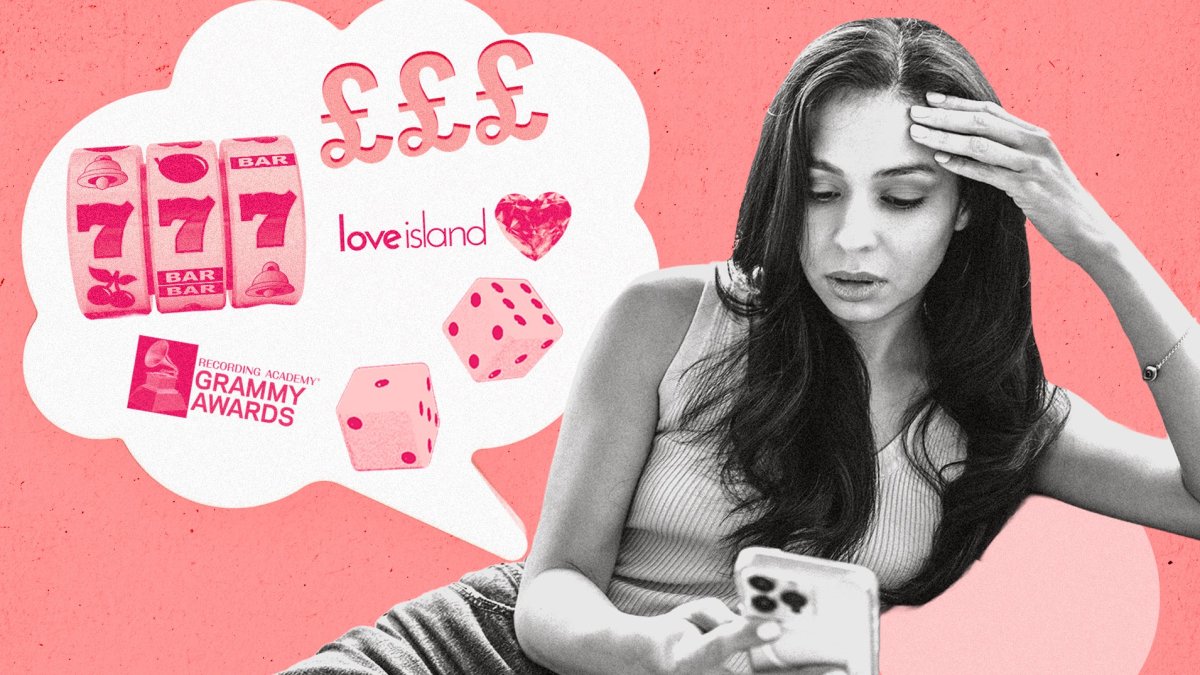
When Rachel Stanley, 38, downloaded a betting app in 2024 to place a bet on Taylor Swift winning at the Grammys, she had no idea that a year later she’d have spiralled into an all-consuming obsession, spending almost a quarter of her annual salary on gambling. “A £20 bet on Taylor to win two awards netted me an £80 profit, but winning was probably the worst outcome because immediately I thought, ‘I’m good at this.’” Suddenly, awards season became thrilling in a completely different way for the self-confessed pop culture addict: “I’d bet on the Grammys, the BRITs, the Oscars and the Emmys. I was generally good at predicting winners, and I’d think, ‘Why not make money from being right?'” Except £20 bets became £50 bets, then £100. The business development manager from Bristol started receiving emails from betting sites about online slots, offering her free spins, and she began depositing more and more money, high on the dopamine hit she got when she hit the jackpot. Shorts Rachel never kept track of what she was spending at the time, but says: “I never bet beyond my means, so I don’t think I had a problem.” Then, after a year, she downloaded her transaction history and discovered she’d spent £10,000 in 12 months. “I couldn’t believe it. That’s enough to buy a car, or go on the holiday of a lifetime. I felt disgusted with myself because I didn’t withdraw money if I won; I just kept betting my winnings and depositing more money.” Her partner was shocked when she told him how much she’d spent. “He asked me whether I thought I was addicted. I said absolutely not. To me, addiction means not being able to stop. I can go weeks or months without betting,” says Rachel. Rachel says escapism is one of the reasons she spends so much time on gambling sites: “My job is stressful, and I find researching an award show and looking at odds quite relaxing. And the dopamine hit I get from a win is exhilarating; it’s a high I can’t help but chase.” And while Rachel doesn’t consider herself hooked, she’s taken steps to limit her betting activity. “When I realised how much I’d spent in the first year, I set myself a monthly limit of £100. I was previously spending that on a single bet, but that was the equivalent to my electricity bill, or a fortnightly food shop.” The digital age has changed gambling habits, as a lot of gambling that used to take place in betting shops now happens at home. Gross gambling yield (GGY) for the industry was £16.8bn in the year to March 2025, which represents an increase of 7.3 per cent on the previous year. This rise has largely been driven by GGY generated from online gambling, which has gone up by more than £900m to an annual figure of £7.8bn. For decades, gambling companies have built businesses around football, horse racing and poker betting and largely targeted men. When women gambled, it tended to be on the lottery and bingo, which continues to be one form of gambling where women outnumber men. But there’s been a real push since the early noughties for “novelty” betting, where people can predict anything from the Best Picture at the Academy Awards to the first contestant to be knocked out of Big Brother. A recent study from Australia’s Deakin University found that gambling promotions linked to women’s lifestyle content increased the normalisation and social acceptability of gambling among women aged 18 to 40, but some participants were concerned that the framing of gambling as harmless, empowering and socially beneficial may lead to an addiction. As therapist Alison Cooper says: “Women who wouldn’t have wanted to go into a bingo hall or arcade are now gambling on things that interest them. We see more professional women doing it, and for some, it’s becoming less of a habit and more of an addiction as they use gambling as escapism, to ease boredom or to boost their household income.” Susan, 57, never expected that when she discovered online casinos, it would lead to her losing her life savings: “I started gambling after my marriage ended in 2020. My daughter had left home, and the evenings alone were the worst. I’d spent years coming home to somebody, and suddenly there was silence. One evening, I saw an advert for an online casino on Facebook and deposited £20, and won £50 that first night. I felt a rush of pleasure for the first time in months.” “It sounds ridiculous now, but gambling was exciting. There were flashing lights, little celebrations when I won and the constant anticipation of what might happen next,” says Susan. Within months, a £20 deposit had become £200. “I had savings, so initially there were no consequences. I could lose £1,000 and nobody knew.” Then Susan began chasing losses: “If I’d lost £500, stopping felt impossible because that meant accepting the money had gone. I’d tell myself I’d play until I got back to even. Instead, I’d lose another £500. Over the next year, I burned through savings I’d spent decades accumulating. Nobody had the faintest idea.” Her adult daughter eventually discovered what was happening after Susan asked to borrow money. “She knew immediately something wasn’t right because I’ve always been financially independent. I finally admitted I’d lost almost £30,000. My daughter was shocked and angry, but she also helped me understand that secrecy was keeping the addiction alive.” Andy Kalli, centre manager at Rehab Today, who specialises in the psychology of substance use, says: “Gambling addiction can be much harder to spot than a drug or alcohol problem; that’s because there’s rarely any physical signs to notice. It’s especially true for women, who are still less likely than men to seek support even when they’re struggling. GambleAware figures show only 27 per cent of women experiencing gambling problems have sought help, compared to 33 per cent of men, and in our experience, that gap often comes down to stigma and the sense that gambling isn’t seen as a serious enough problem to ask for help with.” Susan registered with GamStop, an organisation that banned her from using gambling sites for five years (the maximum term). “I also spoke to a therapist and changed my routines. Evenings were my danger zone, so I deliberately filled them – walking, seeing friends, exercising, anything that stopped me sitting alone with my phone,” says Susan, who has now been gambling-free for almost four years. Of course, many people can gamble occasionally and have fun with it, like Jade, 29, a recruitment consultant from Newcastle. As she says: “I’ve been obsessed with Love Island from the beginning, and am great at predicting winners. I follow fan accounts and online polls. So, it doesn’t feel like randomly picking a horse.” There is also a social side Jade enjoys. “I am in multiple group chats with other women who gamble on entertainment. During something like Love Island, we’re messaging constantly about changing odds and who we think will win. It makes the whole experience more fun.” During a series of Love Island, Jade might bet £50 a week, and at the end of every series, she usually has a profit of around £200. She says: “My salary is good, and I don’t have children. Other women I know spend hundreds on clothes, beauty treatments or weekends away. Gambling is what I choose to spend my disposable income on. It’s not hurting me, or anyone else, so why would I stop?” Rachel is happy to continue betting under her agreed limit, and says she hopes she would know if her gambling was getting out of hand: “Realising I’d spent £10,000 with nothing to show for it was a real wake-up call. I recently won a cash prize at a raffle, and I briefly considered using it for betting, then I stopped myself. Because sidestepping my agreed limit by walking into a betting shop with cash feels less like a hobby and more like a compulsion.”
‘I lost £10,000 betting on Taylor Swift’: How gambling got women hooked
Full Article
Original Source
Read the full article at Inews →KhanList aggregates and links to publicly available news content. We do not host full articles from third-party sources. Always verify important information with original sources.