
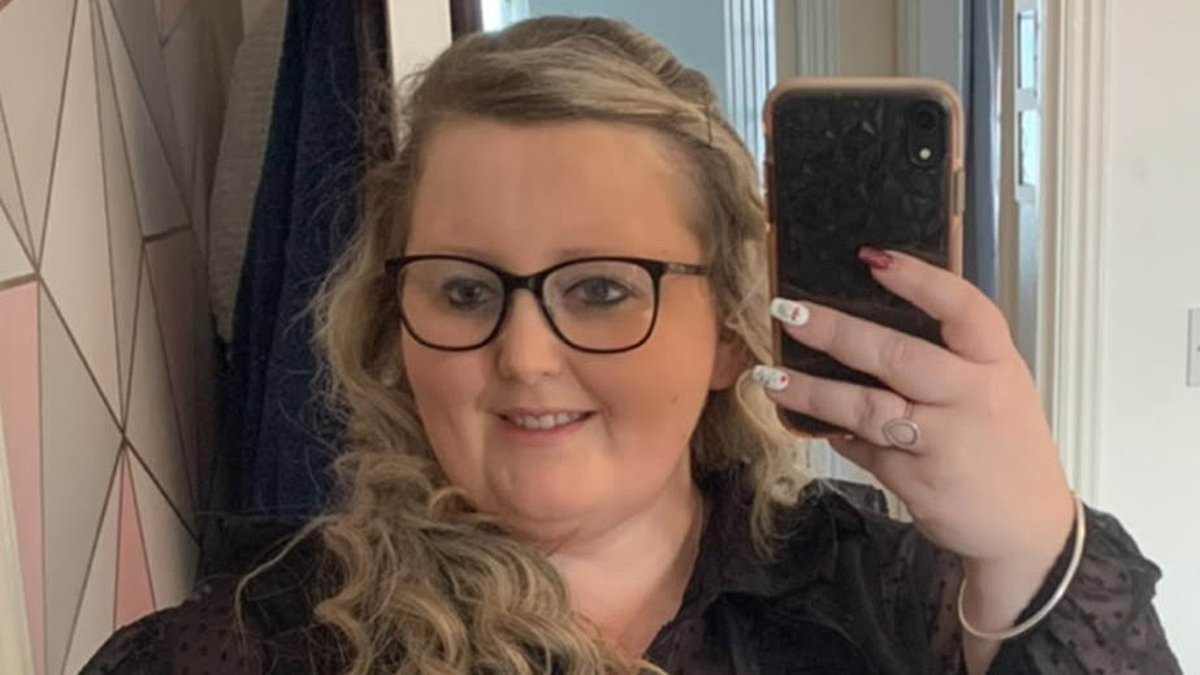
Like many young couples, Lauren Smith and her husband Kenneth had imagined a future filled with family life and children of their own.But after almost two years of trying for a baby, they were dealt a devastating blow – they both had fertility problems that meant conceiving naturally would be extremely difficult.Doctors told them that in vitro fertilisation (IVF) offered their best chance of having a child. But there was another obstacle: at almost 20 stone and a dress size 24, Lauren was told she would need to lose a substantial amount of weight before she could qualify for treatment on the NHS.What followed was an extraordinary transformation – not once, but twice.Determined to become a mother, Lauren shed nine-and-a-half stone over two years, swapping convenience foods for home-cooked meals and gradually becoming more active.After undergoing private IVF treatment, she and Kenneth welcomed their daughter Ella Grace in March 2020.But when Lauren regained much of the weight during lockdown and the early years of motherhood, she faced the prospect of having to lose it all again to have a second child.This time, she shed a further ten-and-a-half stone – bringing her combined weight loss to an astonishing 20 stone. At almost 20 stone and a dress size 24, Lauren was told she would need to lose a substantial amount of weight before she could qualify for IVF treatment on the NHS. Determined to become a mother, Lauren shed nine-and-a-half stone over two years, swapping convenience foods for home-cooked meals and gradually becoming more activeAnd in March this year, the couple welcomed their second child, a son named Reuben.Remarkably, Lauren achieved both transformations without weight-loss injections or surgery. Instead, she credits a series of simple changes to her eating habits and daily routine – from cooking meals from scratch to taking regular walks and attending weekly diet club meetings.'For me, a lot of it was diet – chocolate was my downfall,' says Lauren, 32, a nursery manager from Barnstaple, Devon.'Once I lost a few stone, I started being more active. I was going on walks every day – even if it was just for ten minutes.'Her first weight-loss journey began in September 2017, after she and Kenneth, now 35, had undergone NHS fertility tests.Lauren was diagnosed with polyendocrine metabolic ovarian syndrome (PMOS), formerly known as polycystic ovary syndrome (PCOS), a hormonal and metabolic condition that can interfere with ovulation and make it harder to conceive.Kenneth, a sales consultant, was also found to have a low sperm count. The double diagnosis was particularly difficult for the couple to come to terms with. 'We found it harder because it's usually one or the other – a problem with the woman or male-factor infertility,' Lauren says. 'For us, it was both.'After a six-month course of the fertility drug Clomid failed to help Lauren conceive, doctors advised the couple to consider IVF.However, Lauren's weight meant she did not meet the NHS eligibility criteria for treatment.She joined Slimming World, the commercial weight-loss programme founded in 1969, which combines dietary advice with regular group meetings, weigh-ins and support from other members.Its eating plan, called Food Optimising, encourages people to fill up on foods that are relatively low in calories but satisfying, such as vegetables, fruit, lean meat, eggs, potatoes and pasta.Members can eat these so-called 'Free Foods' without weighing or counting every portion, while foods that are more calorie-dense, including chocolate, biscuits and other treats, are allocated a daily allowance.The idea is to reduce overall calorie intake without leaving dieters feeling constantly hungry.Slimming World is not the only commercial programme built around this approach. WeightWatchers, for example, uses a points system to guide food choices, while digital programmes such as Noom combine food tracking with behavioural coaching designed to help people change their eating habits. Lauren and Kenneth welcomed daughter Ella Grace in March 2020. And in March this year, the couple welcomed their second child, a son named ReubenResearch suggests structured weight-loss programmes can be effective, particularly when they provide regular support and accountability.But they are not without drawbacks. Membership costs money, their rules and tracking systems can feel restrictive, and some people find it difficult to maintain their new habits once they stop attending meetings or following the programme.Nor is losing weight necessarily the hardest part. Research has consistently shown that weight regain is common after dieting, particularly without continued support.Lauren's experience would eventually illustrate that problem.At first, however, she found the structure of weekly meetings helped her make relatively straightforward changes to her diet.Instead of relying on ready-made meals and sauces, she began cooking more of her food from scratch.'Before, when I made a bolognese, I'd buy the premade sauce,' she says. 'I started making it from scratch using tinned tomatoes and herbs instead.'I stopped eating as many convenience foods.' She also gradually increased her activity levels, starting with short daily walks.Over the next two years, she lost nine-and-a-half stone – an achievement she had hoped would finally make her eligible for NHS-funded IVF.But despite her dramatic weight loss, she says she was still unable to meet the required body mass index (BMI) threshold.BMI is a measure calculated using a person's height and weight, and is commonly used by NHS fertility services when determining eligibility for treatment.Lauren says that, even after losing so much weight, she was left with substantial amounts of excess skin and her BMI remained around 33, above the threshold of approximately 30 she had been given.'It got to the end and I didn't have a lot of fat left to lose,' she says. 'It was all just loose skin.'Unable to access NHS-funded treatment, the couple decided to pay privately, turning to Bristol Centre for Reproductive Medicine (BCRM), around two hours from their home.They ultimately spent approximately £14,500 on fertility treatment. In May 2019, Lauren underwent her first IVF cycle using intracytoplasmic sperm injection (ICSI), a technique in which a single sperm is injected directly into an egg to help fertilisation.Doctors collected 16 eggs, from which three embryos were created.One was transferred to Lauren's womb, while the remaining two were frozen in the hope that the couple might one day have more children.To their delight, the first transfer was successful.In March 2020, they welcomed Ella Grace.'Having Ella Grace was amazing, but it also didn't feel real because it had taken us so long,' Lauren says.'I think we were worried the whole time until she got here.'But motherhood brought fresh challenges, particularly as the Covid pandemic began shortly after her daughter's birth.During lockdown, Lauren found herself slipping back into old eating habits and gradually regained the weight she had worked so hard to lose.'I was eating out of boredom, and I'd gained weight from my last pregnancy,' she says.Her experience is far from unusual.Maintaining substantial weight loss can be difficult because the body adapts to having less energy available. Changes in appetite and metabolism can make people feel hungrier and reduce the number of calories they burn.This helps explain why weight regain is so common, even among people who have successfully followed a structured diet.As Ella Grace grew older, she began asking for a little brother or sister.Lauren desperately wanted to give her daughter a sibling, but knew her weight could once again complicate fertility treatment.'We tried to explain to her that that would be difficult,' she says. 'I felt so guilty because she wanted a sibling and it wasn't easy.'So Lauren resolved to lose weight again.Initially, she tried doing it without outside help, reasoning that she already knew what changes she needed to make.But she found it difficult to stick to her new routine without the structure that had helped her the first time.'I tried it on my own but I couldn't stick with it, so I went back to Slimming World,' she says.'I needed that accountability. A lot of people told me I could do it myself, but I needed them to get me on the scales every week.'Once again, she focused on her eating habits and increasing her daily activity.With a young daughter to look after, she was also spending plenty of time on her feet, combining regular walks with the demands of family life.'I spent a lot of time chasing after Ella Grace,' she says.'It was a whole lifestyle change though.'Over two-and-a-half years, she lost another ten-and-a-half stone, eventually slimming down to a size 12.In total, across her two weight-loss journeys, she had shed an extraordinary 20 stone – equivalent to 280lb, or 127kg.The couple returned for fertility treatment in March 2025, using one of the embryos frozen during their first IVF cycle.But their hopes were dashed when the pregnancy ended in miscarriage.Lauren underwent another embryo transfer, which was successful, and in March 2026 the couple welcomed their son, Reuben.'He's amazing – such a happy little boy,' Lauren says.For Ella Grace, now six, becoming a big sister has been an adventure of its own.Initially, she was disappointed to discover the new baby would be a boy rather than the little sister she had imagined.'When she found out it was a boy, she cried!' Lauren recalls.'But she says to me all the time now, "Do you remember when I wanted a little sister? I don't now, because he's the best little brother."'The couple are now sharing their experience to raise awareness of infertility, particularly the emotional toll that fertility problems can take on men.Male factors are involved in around half of couples' infertility cases, yet the subject is still rarely discussed openly.Research highlighted by BCRM for Men's Health Awareness Month found that 14.6 per cent of men who wanted children or were trying to conceive reported feeling emasculated after receiving a fertility diagnosis.For Kenneth, Lauren says, discovering he had a low sperm count was particularly hard to talk about.'Kenneth's like a typical man – he doesn't like to talk about it,' she says.Having endured years of fertility treatment, two extraordinary weight-loss journeys and the heartbreak of miscarriage, the couple are now enjoying life as a family of four.And Lauren is acutely aware of how differently things could have turned out.'It amazes me to think that if we hadn't had the miscarriage, we could have had another child,' she says. 'If we couldn't have afforded another treatment, would Reuben even be here?'
I lost 10 stone without weight-loss jabs by making simple food swaps and walking just 10 minutes a day. Then I put it all back on... here's how I lost it AGAIN
Full Article
Original Source
Read the full article at Dailymail →KhanList aggregates and links to publicly available news content. We do not host full articles from third-party sources. Always verify important information with original sources.