
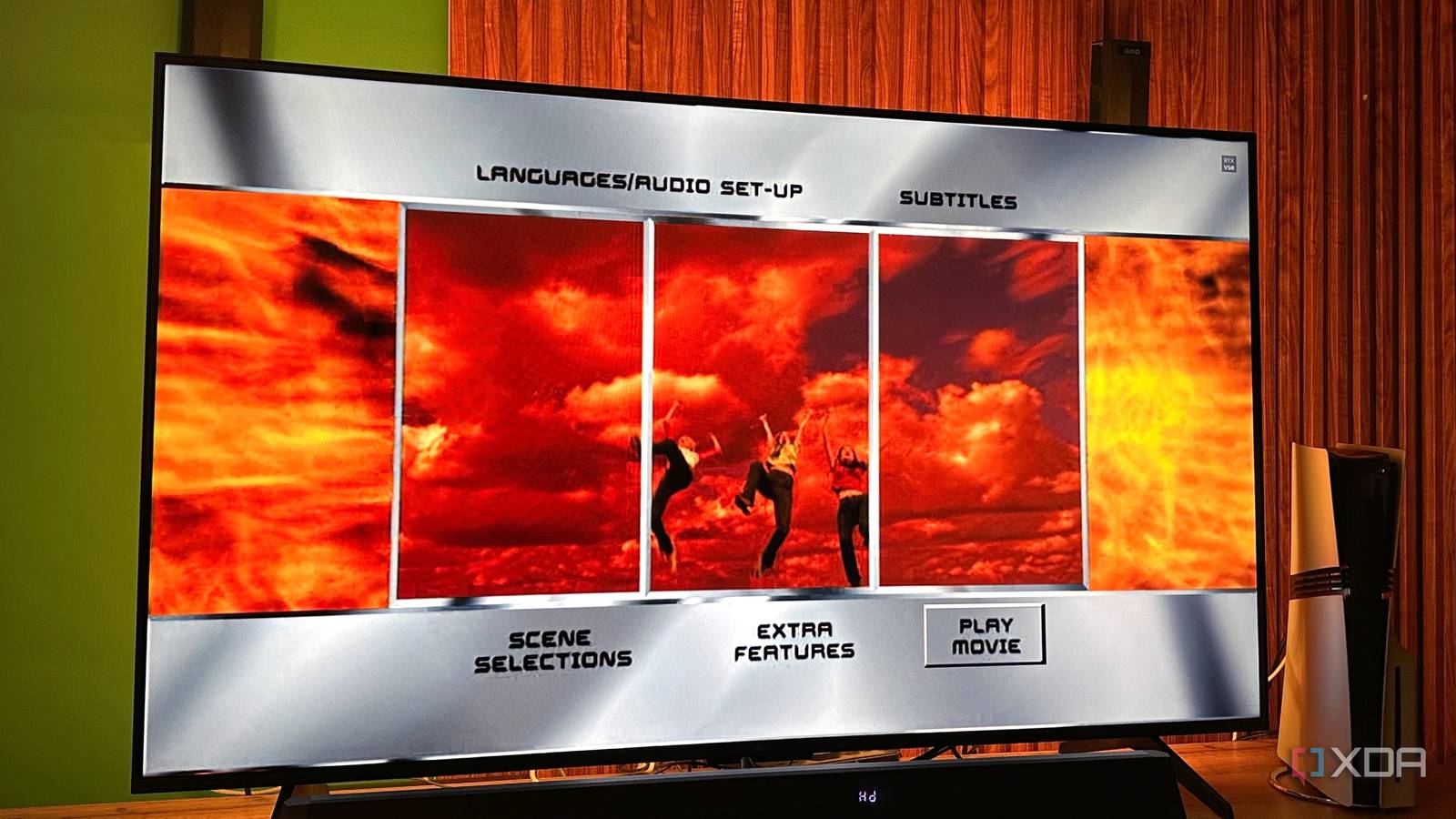
Published Nov 23, 2026, 3:00 PM EST Gaming has been Samarveer’s greatest passion, and the Literature graduate in him takes immense joy in dissecting games for their themes, messages, and impact. Samarveer holds a deep appreciation of gaming, and considers the platform to be the most immersive and impactful across all media. He can be found engaging with gaming communities online, always ready to debate the finer points of ray tracing or itching to write an 8-page collegiate thesis on any game that impacts him emotionally. Through several PC upgrades over the years, multiple storage migrations, and at least one questionable attempt to organize my media library, the one thing that has somehow survived the ravages of time is my tiny collection of movies from before 2010. The problem is that some of them never received a proper upgrade. My DVD rips of mid-2000s movies are still very much products of the 480p/576i era, and they look every bit as old as you'd expect when I throw them onto a 4K TV. Normally, I'd accept that as the price of keeping an old movie around. But I happen to have an Nvidia RTX GPU sitting under my desk, and VLC has a rather interesting trick up its sleeve. So I decided to see just how much punishment these ancient rips could take before they finally looked their age. My DVD rips were never meant for a 4K TV I had to see how bad they really were Years ago, I ripped the few DVDs I had of Alien, Austin Powers, and Charlie's Angels, and none of them has been blessed with some magical restoration before landing on my hard drive. These are ordinary DVD-era sources, complete with their limited resolution, compression, and other visual baggage of the time. Sure, I could replace them with Blu-ray or 4K remasters, but that rather defeats the point of keeping a local library in the first place. I wanted to know whether I could make the files I already own look less ridiculous without replacing them. That's when I realized I had the perfect opportunity to put my GeForce RTX 4070 Ti to good use. It already handles every gaming and LLM-centric workload I throw at it, but it can do so much more when needed. With Nvidia's RTX Video Super Resolution, I let my RTX GPU upscale my 480p DVD rips to 4K in real-time, and sat myself firmly in front of the 4K TV to decide if I could still notice I was watching a DVD. Plenty of pieces to move around and put in place First, though, I got the prerequisites out of the way, as should you if you want to use your RTX GPU for upscaling in VLC. For starters, your output resolution needs to be 2160p if you want RTX VSR to target 4K. Since I streamed my PC to my 4K TV for this experiment, I enabled GPU scaling in the Nvidia Control Panel and used DLDSR (Dynamic Super Resolution) to expose a 2160p desktop resolution. I also ensured that my VLC build actually supports Nvidia's VSR implementation. I used a version known to work properly with RTX GPUs, with Direct3D11 selected as the video output where necessary and VLC's video upscaling mode set to Super Resolution. For this, any version of VLC 3.0.19 or newer works. It's worth checking this before blaming your GPU, because VLC has enough rendering options to make troubleshooting unnecessarily entertaining. Finally, make sure your GeForce driver is current. RTX VSR is driver-dependent, and there is little sense debugging an AI upscaler with an ancient driver. RTX VSR does a surprisingly good job with terrible source material Some DVDs are easier to rescue than others Alien was the first reality check. Its dark scenes remained terribly difficult for VSR, with shadows turning into a mush of indistinct detail. But whenever the lighting opened up, the difference was genuinely impressive. Faces, textures, and background details looked noticeably cleaner than they did with conventional scaling. Austin Powers was an easier win. Almost everything looked better, from cleaner faces to brighter, more defined details. The difference wasn't subtle either. VSR seemed particularly comfortable with the movie's bright colors and relatively clean shots, giving the old DVD rip a surprisingly respectable appearance on my 4K screen. Then came Charlie's Angels, which reminded me that VSR still has limits. The action scenes were a problem, particularly around hair, arms, and rapidly moving body shapes. The source already had smearing, and VSR occasionally tried to reconstruct it into what can only be described as half-finished scribbles. Still, calling the results merely "serviceable" feels almost unfair. For several of these movies, I stopped thinking about the resolution entirely, which is probably the best compliment I can give an upscaler. RTX VSR isn't simply making the picture bigger It is trying to rebuild what the DVD threw away There is a distinction between scaling a DVD rip to 4K and improving it. A conventional scaler takes the pixels it has and calculates where they should go at a higher resolution. That can fill my TV, but it cannot recover detail that was never there. RTX Video Super Resolution takes an ambitious approach. Nvidia's model analyzes the frame, identifies edges, textures, and compression artifacts, then reconstructs detail at the target resolution. The Tensor Cores in RTX GPUs do the heavy lifting instead of VLC stretching the image until everyone's face looks painted with a potato. With DVD footage in the picture, that difference does matter. When an old source is blown up to 4K, compression artifacts, ringing, blockiness, and smeared detail become a lot more obvious. VSR is designed to address those problems while sharpening the image, rather than preserving ugly artifacts the DVD encoded. Still, truth be told, it would be a bit of an overstatement to call it "reconstruction." The GPU can't know what was lost, and it's only making an educated guess at best. Still, since those guesses create 4K detail that looks convincing from my couch, that ultimate result is more than satisfying. I wouldn't replace my DVDs just yet RTX VSR makes old rips worth keeping around Now, a proper 1080p or 4K remaster will always beat an AI-upscaled DVD rip, and no amount of clever reconstruction can conjure the original detail that a low-resolution source never had in the first place. If a better master exists, I'm taking it every time. That isn't really the point, though. RTX VSR took my old DVD rips and made them genuinely watchable on my 4K TV, with the difference between the original source and the modern resolution being a lot less obvious than it should have been. If I were about to spend money on buying another copy of something I already own, I could definitely save money with RTX VSR instead. More importantly, VSR on my DVD rips gave my old library some breathing room. If some obscure movie you like never received a worthwhile remaster, then its perfectly-serviceable DVD-era encodes shouldn't be rendered useless just because your TV has four times the pixels. If Nvidia's upscaler can make them disappear into the background from my couch, I'm keeping the rips. Maybe my DVD collection isn't obsolete after all There's nothing quite like getting more life out of hardware and media you already own. I don't need another subscription, streaming box, or even a new Blu-ray disc every single time an old movie looks a little rough on a modern screen. All I really need is sitting inside the PC I've already spent far too much money building. And that's probably what I like most about RTX VSR. It has effectively made my old DVD collection less embarrassing to use in 2026. That's a surprisingly useful distinction when physical media, local files, and enormous 4K televisions are all sharing the same living room. My DVDs may be old, but apparently my RTX GPU isn't ready to let them retire just yet. Gigabyte GeForce RTX 5070 Ti Eagle OC Ice SFF
I let my Nvidia RTX GPU upscale my old DVD rips in VLC, and they hold up on a 4K TV
Full Article
Original Source
Read the full article at Xda-developers →KhanList aggregates and links to publicly available news content. We do not host full articles from third-party sources. Always verify important information with original sources.