
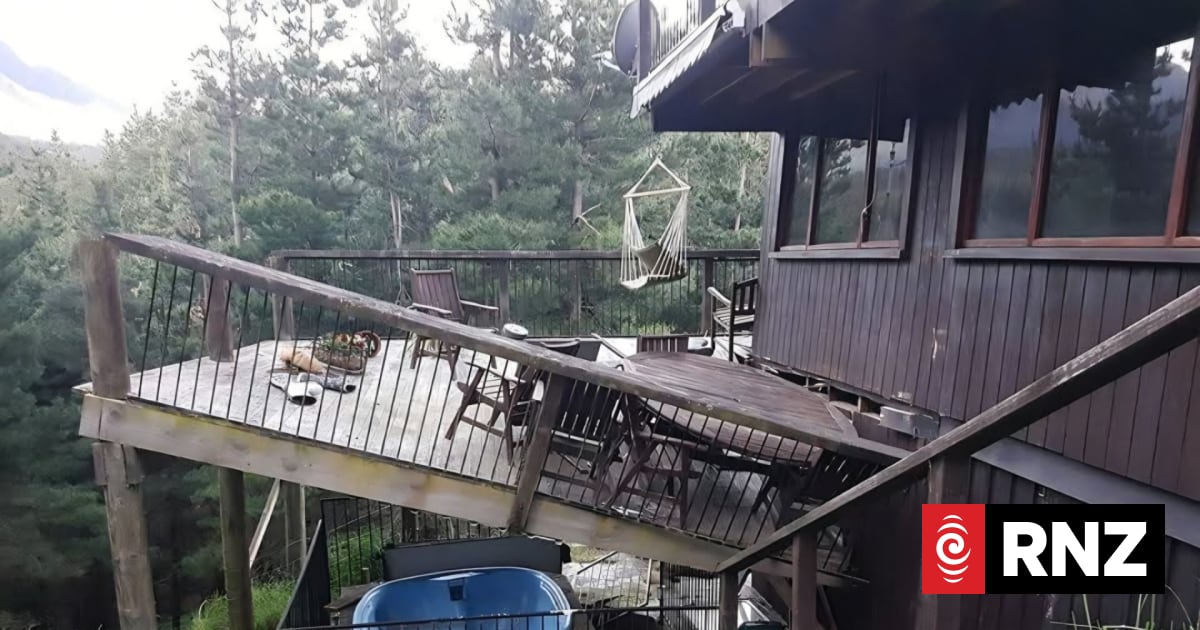
Gary Morton and his partner Jo-Anne MacKinnon spent the night watching an Adam Sandler movie before heading to bed at home in Mt Lyford on the night the Kaikōura earthquake struck.Morton got up to let their dog out when the violent 7.8 magnitude quake hit shortly after midnight on 14 November 2016."She was following me and then, bang, my house went up two-and-a-half metres in the air," he said.Morton was thrown out of the door and felt MacKinnon collide with his back."I still had the damn Sky remote in my hand and I was bouncing up and down, it went for about two minutes, 20 seconds or something, which is a long time."When the shaking stopped, Morton went inside and yelled out for MacKinnon. The power had gone out and he could not see her."I started the car up and backed that out and put the lights into the doorway and there she was lying on the ground," he said."I tried to bring her back to life as best I could."Gary Morton and Jo-Anne MacKinnon.Supplied / Gary MortonMacKinnon died in his arms. It was 14 hours before anyone reached the couple."It was just awful. I kept having this nightmare all the time, just this non-stop nightmare. I could have saved her, if this had happened, if that had happened, I kept reliving it. I just couldn't get it out of my brain," he said.Morton rebuilt the log cabin in Mt Lyford but was diagnosed with cancer not long after the earthquake and decided to move to Christchurch."We were just made for each other. I needed somebody strong, and God, she was strong," he said."I just loved her so much."Albert Louis Edgar, 74, also died in the quake when he was struck by falling debris and crushed to death in his Elms Homestead, while dozens of other people were injured.Jo-Anne MacKinnon died in the Kaikōura earthquake.Supplied / Gary MortonWidespread damage to road and railNear the coast, KiwiRail locomotive engineer Wayne Sullivan was driving a freight train south towards Kaikōura when it started to bang around and move from side to side."As I approached the tunnel I could see sort of silt and dust falling from the ceiling and it made me realise it was an earthquake. I was like, 'okay, throw the brake on and stop because this is pretty big'. I didn't want to keep going not knowing what the condition of the track was in ahead of me," he said.Sullivan thought the Alpine Fault was rupturing.The engine came to a stop on the other side of the tunnel where Sullivan sat in the cab while hundreds of aftershocks hit.At one point, he tried to clear some rocks off the road."I thought I'd be doing drivers a service by clearing the road a little bit so that no one crashed into them, not knowing that the whole State Highway had basically collapsed in different parts," he said.Sullivan thought the biggest threat was a tsunami, so kept an eye on the sea in case it receded. After receiving an official tsunami warning, train control told him to get to higher ground.He was picked up by a helicopter around 7am and, flying south, saw a massive pile of debris on the track near Ohau Point, which made him realise the scale of the damage and how lucky he had been to stop where he did.Kaikoura earthquake, tracks ripped from their beds in the quake.RNZ / Rebekah Parsons-KingThe main north line was so badly damaged that KiwiRail staff said they were not sure if repairs would be possible. The track was buried by slips and landslides in more than 100 places.KiwiRail and the New Zealand Transport Agency then joined forces to create North Canterbury Transport Infrastructure Recovery, which brought in contractors and engineering consultants to help restore road and rail links.At the height of the operation, around 1000 people were working on the rebuild from the Kaikōura area.KiwiRail general manager of project delivery Daniel Headifen said there were more than 1000 points of damage along the main north line after the quake."That was the real question, is the damage too big to even consider reopening the line? The next question after that was, if you couldn't reopen that line, what becomes of the South Island railway?" he said.Some rail tunnels were completely buried by slips, in other places the track had been picked up and thrown 50 to 100 metres into the sea.Ten months later the line was re-established in one of the biggest rail restoration projects ever completed. Restricted freight resumed in September 2017 and the first post-earthquake passenger train ran in December 2018.The road reopening took a little longer, with State Highway 1 north of Kaikōura opening one year, one month and one day after the quake.Major slips on State highway 1, north of Kaikoura, in 2016.RNZ / Rebekah Parsons-King'Cow island' makes international headlinesDerrick Millton was in St Arnaud that night and as more details came in about the quake over the radio, he knew he had to get home to his farm near the Clarence River mouth."We were the first car into the Kaikōura coast coming south from Ward and we had to dodge bridges that had poked out of the tar seal. At one place at Tirohanga straight there was a metre-wide gap in the road and we had to pick up a whole lot of pieces of tar seal and fill the gap up so we could hop over it, so we made the road as we went south," he said.Millton said the damage to Waipapa Farm, which is now owned by his son, was significant."From north of Kekerengu we could see how much damage there was. The whole hillside had fallen down and because it's limestone, it was showing up as a white face. We knew that there were 600 sheep on that block and clearly they must have known what was going on before the earthquake because they had sort of removed themselves off the steep part and we lost surprisingly few," he said.Around 12 kilometres of fencing on the farm needed to be straightened out, and farmers came from around the district to help.Cracks along the Kekerengu Fault.Supplied / GNS ScienceMillton's cows and a calf made headlines around the world with an aerial photo of the animals stranded on an island of grass after their paddock was ripped apart.He said they were in a state of total shock."The cows were scared, they were really suffering from the earthquake and they just stood behind the guys who were trying to rescue them and didn't do anything other than stop and wait for the track to be cleared," he said.Early on, then-Kaikoura mayor Winston Gray said the extent of the damage was not clear."At that time of the day, we were thinking we'd be closed up for a couple of weeks, we weren't aware of what was required and that the road north would be closed for so long," he said."We had so many people here in town to get out, that was one of the major problems."Tourists in the quake-stricken town were evacuated by helicopter and others on HMNZS Canterbury to Lyttleton.Gray said it was a struggle for many people in Kaikōura, at the beginning of the busy summer season, with the road shut and fewer tourists around."To be stuck like that, it was a real challenge, but the government at the time, they were pretty good, they acted really quick to help people," he said.The help included a $17.5 million business support package for people in Kaikōura, Hurunui and Wellington, paired with $5m in primary sector support and tourism advertising/wage subsidies.Additional funding was granted to restore the harbour at South Bay, pay off the Kaikōura Health Centre loan, support waste and debris management and to commission marine recovery research.'Kind of unprecedented'Earth Sciences NZ earthquake geologist Kate Clark.RNZ / Andrew McRaeEarth Sciences NZ earthquake geologist Kate Clark said the earthquake struck within the Marlborough fault system, which lies between the Alpine Fault and Hikurangi Subduction Zone.It started near the North Canterbury town of Waiau and ruptured around 20 different faults, all the way to Cape Campbell on the coast."A lot of earthquakes just rupture one fault, this ruptured over 20, so it was kind of unprecedented in how many faults it actually managed to jump across and rupture. Those faults were both onshore and offshore and a few faults ruptured on the seafloor as well," she said.Clark said scientists were still learning from the remarkably complex quake to understand the plate boundary movement across the faults, to determine which took most of the action from the Alpine Fault.She said a lot of work had been done to understand how the faults were linked to each other and at what depths."Why did this earthquake grow to be so large, rupture so many faults, why didn't it just stop as a small magnitude 6.5 down in Canterbury, what enabled it to propagate and grow larger and larger as it linked up lots of faults as it travelled to the north?" she said.Clark hoped the research would enable better forecasting of future earthquakes in similar settings.A series of events are being held in Kaikōura over the weekend for people to gather and remember the 2016 quake, 10 years on.
‘I just couldn’t get it out of my brain’: Kaikōura quake remembered 10 years on
Full Article
Original Source
Read the full article at Rnz →KhanList aggregates and links to publicly available news content. We do not host full articles from third-party sources. Always verify important information with original sources.