
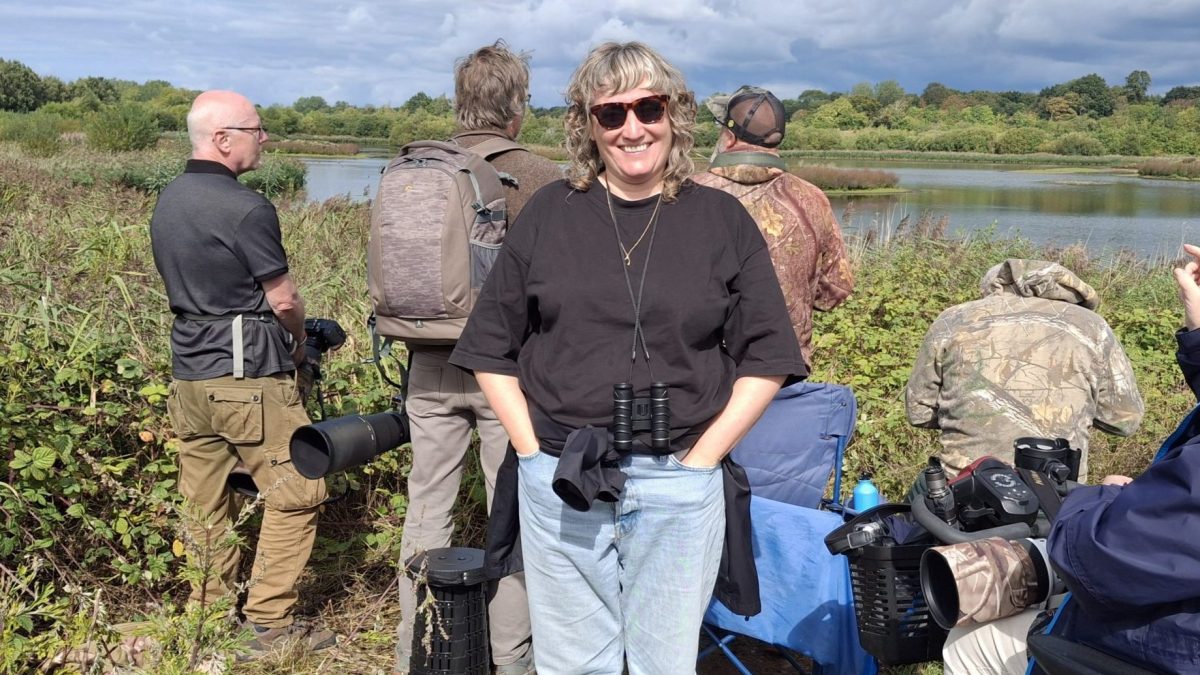
“Have you seen the glossy ibis? Take a look!” I’m about 20 minutes into my birdwatching session at RSPB St Aidan’s, just outside Leeds, when a smiling man with a very expensive-looking telescope invites us to take a closer look at what I’m later told is a relatively rare visitor to the UK. Efforts to see this dark wading bird with my binoculars have been disappointing, but peering through the eyepiece, I get a startlingly clear view of its iridescent green and purple feathers. As well as being a treat to see the bird, having a stranger share this special sight with us is a heartwarming moment. I’m here to meet a group of strangers for a women-only birdwatching session. It’s hosted by Birds and the Belles, a group for women interested in our feathered friends, founded by Shell Clarke in 2024. Since its first session nearly two years ago in east Yorkshire, it’s blossomed into a national network connecting hundreds of women through their love of birds. Shorts I arrive at the sprawling 355-hectare nature reserve in West Yorkshire around 9.30am on a September Wednesday to a packed car park and a host of very serious-looking people dressed in khaki clasping long-lens cameras. Apparently, a family of ospreys have arrived in recent days, “which seems to have brought all of Yorkshire out”, a volunteer tells me when I ask why it’s so busy during the week. There’s a good mix of ages at today’s session, which is composed of 13 women ranging from about 18 into their 60s. Each event is led by a local “ambassador” to welcome attendees, answer any questions and make sure everything runs smoothly. Today, Denise is leading the pack. The sky is blue and the sun is shining as we make our way along the trails that cut through a range of habitats including reedbeds, wetlands, meadows and woodland. Conversation happens organically and there’s a combination of returning members and newbies. While nature and the great outdoors are an increasingly large and important part of my life, it’s my first visit to a dedicated reserve to go birding; the birds in my garden are a major source of joy to me, along with those I see while out and about. It quickly becomes apparent that the other women in my group know much more about each species, as I excitedly call out sightings of “the white one!” [a pristine white egret]. Happily, no one bats an eyelid about my lack of knowledge, something that both Clarke and attendees note as being integral to Birds and the Belles. Joanna tries in vain to spot the elusive osprey at RSPB St Aidan’s – birding can be competitive “One of our catchphrases is ‘community over competition’ because birding can be so competitive,” Clarke tells me. “I think the majority of women bird slightly differently – we’re generally more community-orientated and women are allowed to not know the answer. To be fair to men, I think there’s more pressure on them to be right; society doesn’t let them be as vulnerable as women.” It’s a crucial factor that attracted some of my fellow attendees to join the group. Maria Young started birdwatching at an early age, but found Birds and the Belles offered her a greater sense of freedom. “What I found was that people could freely ask questions, such as ‘what’s that bird’ or ‘show me this’,” she tells me. “In previous birdwatching environments, I’ve experienced quite a degree of shaming and inhibition about asking questions – I felt I was expected to know everything simply because I had a pair of binoculars. It has been liberating to be somewhere it’s okay not to know and to just look at birds for enjoyment.” It’s a sentiment fellow attendee Helen Ripley agrees with. “Here, nobody talks down to you about your birding knowledge because no matter how much you know, there’s always so much more to learn,” she tells me. “I think so many people want to know more about birds and conservation but it can be hard to get an ‘in’ because the established people already know so much that you feel silly to ask what might seem like obvious questions.” And it’s this learning and discovering together that makes the experience such a positive one, coupled with being in such a peaceful place. Anecdotes and bird facts are shared freely among the group; to my delight, I learn that baby spoonbills are known as teaspoons – adorable! Sadly, the ospreys evade me, but I manage to spot a heron, cormorants, windchats, a great-crested grebe, mute swans, coots, egrets and, thrillingly, a little owl, a sighting that takes me nearly five minutes to actually identify, despite the diminutive bird sitting stock-still. The patience of my fellow attendees in persevering with their directional gestures and hand signals, instead of rushing off to get a coffee, was genuinely appreciated and testament to the warmth and support I felt throughout the morning. Making friends with the residents at RSPB St Aidan’s (Photo: Joanna Whitehead) The group fulfills another role, however. A peer-reviewed study published last month in Frontiers in Environmental Science found that the women surveyed described some ecological spaces – particularly birding – as male-dominated. Several interviewees said they felt intimidated or excluded in remote outdoor environments, with one participant describing seeing a hide and thinking, “No – we’re not going in there.” Columnist and nature writer Lucy McRoberts used her monthly column in August’s Birdwatch magazine to draw attention to the fact that “some [male] birders still can’t manage healthy interactions”, calling on readers to “believe women’s stories, empathise with our experiences and call it out”. Safety was a major consideration behind Clarke’s decision to establish Birds and the Belles. “Birding can take you to some really remote areas, such as woodland,” she says. “I’m into photography as well and sometimes I specifically want to go into the woods or the bushes and lie down on the floor to get close to nature and a good shot – and I just wasn’t comfortable doing that with men.” It’s also an issue mentioned by several of the women I speak to during our session. “I’ve heard stories of harassment in hides because they are unobserved, private places,” Young tells me. “You do have that sense of vulnerability, particularly if it’s just you and a man. It’s very likely he’d be completely safe, but I’d feel vulnerable. With lots of women, I feel safe.” Several Birds and Belles members said remote outdoor environments often made them feel unsafe as they would still face harassment from men (Photo: Joanna Whitehead) Feeling welcome birdwatching also extends beyond safety. “It’s nice to be able to come somewhere on your own as a female and do something like this,” Ripley tells me. “It’s not all men, but some of the men I’ve met through birding don’t always realise when they’re being patronising and chauvinistic.” On the day I visit there are significantly more men than women birdwatching, but as with the gentleman who shared his sighting of the glossy ibis, I came across men who were happy to share their sightings with us as we passed by. Despite this, the very existence of a women-only birding group has incensed some male birders, with Clarke revealing that many of the posters for upcoming Birds and the Belles events at several nature reserves have been ripped down or defaced as “sexist”. “The majority of people are nothing but supportive and understand the importance of our group being women-only, but about five per cent are really vocal, toxic and give us a really hard time,” says Clarke. “Ideally, I want us to be one big birding community where we share knowledge and focus on the important issue of protecting wildlife for future generations. But if these outdated opinions push another generation away, we’re going to lose a hell of a lot of that knowledge.” A cursory glance at the Birds and the Belles’ social media pages reinforces Clarke’s comments, despite the support of many men who agree that such behaviour is unacceptable. Thankfully, the benefits of groups like Birds and the Belles seemingly outweigh the minority of dissenting voices. Recent sightings at RSPB St Aidan’s. Posters for upcoming Birds and the Belles events at several nature reserves were ripped down or defaced because male birders claim the group is sexist (Photo: Joanna Whitehead) “I feel more competent with my birdwatching now than I’ve ever done before – and I’m enjoying it more because of the feeling that we’re all here for the same thing. We’re not here to be cleverer than anyone else,” Young tells me. “You get to know people and talk about all kinds of things. As well as learning more about birds, it’s also really good for your all-round well-being.” Clarke also highlights the inclusivity of the group, something I can attest to based on my experience. Birdwatching often involves patience – animals don’t always appear on cue – leaving time to get to know my fellow birders more. The combination of their warmth and being immersed in nature combine to ensure I say my farewells with a smile on my face that lasts for the rest of my day. “People often assume that you need equipment to join us and you absolutely don’t,” says Clarke. “We actively encourage newcomers to birding – and we love it when new people join us. We all learn from each other and it adds a new perspective. “I’ve found such purpose through Birds and the Belles and it’s amazing to share this with other people. Nature and wildlife are such a tonic.” How to get into birdwatching 1. Pick a local patch to start watchingThis doesn’t need to be a nature reserve or a park. You could even start with something as simple as what you can see from your garden or kitchen window.2. Slowly build your knowledgeThere’s a real variety of species that can be seen in both urban and rural environments. You could pick up a field guide (or visit rspb.org.uk ) for tips on how to visually and aurally identify birds. The Merlin app can also be really useful in helping to ID different birdsong.3. Be present in the momentBirdwatching is an opportunity to step back from the busy pace of modern life and reconnect with nature, something that research shows has tangible benefits for our well-being. Taking time to be still, quiet and immerse yourself in nature not only improves your chances of spotting anything from a great tit to a greater-spotted woodpecker but can also lower stress and boost serotonin levels.4. Discover ways to support natureBirdwatching is a great way to become more aware of the nature that we’re all a part of. With habitats facing increasing pressures, there has never been a more important time to help protect them. It could be volunteering on a local conservation project, signing a petition calling for nature-positive development or even making your garden or outdoor space more wildlife-friendly. Louise Mahon, RSPB spokesperson
I joined a women-only birdwatching group – and found instant friendship
Full Article
Original Source
Read the full article at Inews →KhanList aggregates and links to publicly available news content. We do not host full articles from third-party sources. Always verify important information with original sources.