
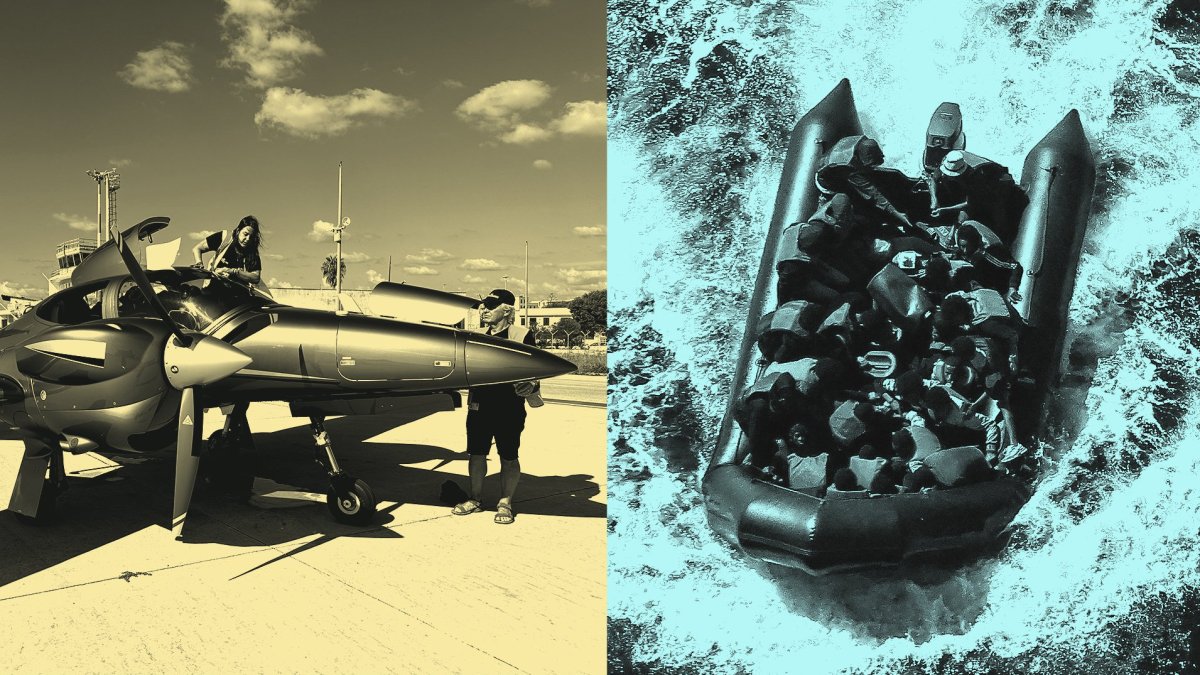
Something is bobbing in the distance in the deep blue of the Mediterranean Sea. From the windows of this tiny plane, soaring high above the water, it is almost indistinguishable. The aircraft tilts sharply and zooms closer, as the crew hold their binoculars to the glass. It comes into view: it is a small, blue wooden boat packed with around 25 people, including women and children. Few have life jackets. They are making a perilous attempt to reach Italy from Libya, travelling along the deadliest known migration route in the world. Shorts I am on board the Albatross, a humanitarian monitoring plane that patrols the Mediterranean, looking for small boats and documenting the actions of the Libyan coastguard as it tries to turn them back. Last year, this irregular migration route was the most active into the EU, peaking at 150,000 arrivals in 2023. But in the first nine months of this year, the number of arrivals has fallen to 22,500, a 56 per cent drop on the same point in 2025. Deaths along the route have, however, risen. The Albatross is key to working out why, shedding rare light on the murky world of Mediterranean people smuggling. The plane is the size of a small car and can fit just four people on board. The crew, from humanitarian organisation SOS Méditerranée, remain glued to the windows for around five hours at a time, documenting what they find with a long-lens camera. It sets off from the Italian island of Lampedusa, which has one of the highest rates of small boat arrivals anywhere in Europe, nearly every day of the week. The crew, from humanitarian organisation SOS Méditerranée, remain glued to the windows for hours at a time (Photo: Reuters/Manon Cruz) The small blue boat the crew has spotted is overcrowded and unstable. If it is not rescued, there is a serious risk it will capsize or drift, leaving its passengers stranded and starving. Over the plane’s radio, the crew make a mayday call to alert the Italian and Maltese coastguard of the boat’s location: around five hours from the coast, at its current speed. There is no response. They call in again, but are ignored. They make the difficult decision to fly on; now they have notified the authorities, there is little they can do, and their presence can alarm the passengers. The migrants on board have already turned off the engine, perhaps out of fear, perhaps because they believe the plane belongs to authorities who may try to identify who is driving the boat and prosecute them for smuggling – though humanitarians say this is usually just a migrant who has been offered a cheaper fare. During the patrol, the crew spots five empty boats, mostly deflated rubber dinghies that float along the water. It is a sign they have been rescued or shipwrecked, but there is no way to know which. Sometimes, they find corpses. Although tiny, they are easy to identify; the fluids released by the decaying body make a ring of lighter-coloured water around it. The crew shows me a photograph of a body found last month; a man, fully clothed, floating face down in the water, his legs beginning to discolour. He is one of nearly 27,000 people who have died or disappeared in the past 12 years while trying to reach Europe via this route, with at least 996 believed dead so far this year alone. The Albatross frequently witnesses Libyan coastguard vessels intercepting small boats to take back to Libya, something widely believed to be illegal under international law. The UN’s 1951 Refugee Convention makes it clear that a refugee should not be returned to a country where they face serious threats to their life or freedom, which Libya – accused of “systematic” abuse of migrants – is likely to constitute. The rising pace of these pushbacks is believed to be a key reason behind the drop in successful arrivals to Italy this year, along with controversial, hardline border policies from prime minister Giorgia Meloni such as offshore migrant processing centres. The pushbacks are often “very violent”, says Albatross tactical coordinator San Trouvé, with Libyan vessels ramming into boats to stop them. Recently, the crew watched as the coastguard rammed one boat so forcefully that a migrant fell into the water. They have also seen the Libyan coastguard beating migrants, and shooting at both small boats and humanitarians, the crew says. Last year, a Libyan coastguard boat opened fire in international waters on SOS Méditerranée’s search-and-rescue vessel, the Ocean Viking, from which The i Paper has previously reported. It shot at the ship for 20 minutes, breaking windows, damaging its assistance boats and floatation devices. Those on board feared for their lives. In an unnerving twist, this very Libyan coastguard boat appears below us during the patrol flight. The crew photograph it through the window before hiking the plane upwards to stay out of the range of any weapons it may have on board. A migrant boat seen from an aircraft during the Albatross aerial monitoring mission (Photo: Reuters/Manon Cruz) “We have been witnessing an increase of this violence,” says Trouvé, who joined the organisation after working as a nurse. “The amount of Libyan assets that are now in the vicinity, paid by the European Union with some vessels donated by Italy, are more and more present and using more and more intimidation, shadowing [search-and-rescue] vessels assets, and opening fire.” During her time in the Mediterranean, both on the Albatross and Ocean Viking, Trouvé has met hundreds of people trying to cross to Europe. There is a perception that all migrants are young men, but she regularly sees women, children and babies too. Many are fleeing conflict or extreme poverty. Some had been tricked into false employment, others had “no clue that they’re going to be forced onto a boat and departing to Europe”. “Everyone has their own reasons for leaving,” she says. “What I could tell from the people I met is that most of them had really no choice.” The Italian island of Lampedusa has one of the highest rates of small boat arrivals anywhere in Europe (Photo: Reuters/Manon Cruz) The Albatross is flown by a volunteer pilot from the Humanitarian Pilot Initiative. On my patrol, the pilot is Olivier Wilmart, a retired airline pilot from Belgium. He spent decades flying holidaymakers and businesspeople with Air France and decided that he wanted to use his skillset “for a good cause”. “I had the chance to do the job of my dreams for my whole life. But I think it’s just fair to be able to give back a little bit of that incredible luck, and I think the best thing you can offer is your time,” he says. Wilmart has, however, lost friends over his work in the Mediterranean. “We’re not a political organisation, but we’re doing something which is not appreciated by people with far-right views and positions,” he says. “They [believe] that Europe should close the borders, and of course, you cannot do what I do if you believe in that.” When he first arrived in Lampedusa, Wilmart knew little about migration in the central Mediterranean, “just the news on the TV or on the papers popping out from time to time”. “I didn’t realise that actually the crossing of the Mediterranean Sea is the end of a very, very long journey for those people,” he says. “When you watch those boats and how overcrowded they are, with women and children and babies on board, it’s really shocking.” “Nobody is doing that for pleasure, and nobody is willing to leave his native country if they had another choice, that’s for sure,” Wilmart says. “You would do whatever you can to save your family. I think everyone can understand that.” Wilmart finds it most difficult when he sees a boat get close to Italy before being caught by the Libyan coastguard and returned. He knows all too well what they will face there, with well-documented allegations of torture and abuse inside Libyan detention centres. “We know that’s the end of hope,” he says. “We know that there’s going to be a hard interception. We know what’s going to happen to those people afterwards, and for me, that’s the most terrible thing to watch. “To be honest, after some flights you don’t sleep very well, you have nightmares,” he adds. “There are good days and bad days. Some days you’re coming back with a big smile, and other days you’re just crying.” The crew witnesses “shocking scenes”, but also happy endings, the pilot says. “When we spot a boat and we see that they are rescued either by the NGO ships or by the Italian coastguards, then well, we’re feeling so relieved. Those are the happy days for us.” Once, Wilmart was shown a drawing a child had done after being rescued and taken to the migrant arrivals centre on Lampedusa. “They had drawn the plane,” he says. “Just talking about it gives me goosebumps.” It turns out that I’ve joined the patrol on one of the good days. Towards the end of the flight, the crew return to the last location of the small blue boat and find it empty. But its passengers are safe. The ground team confirms that it has been rescued by the Italian coastguard, with its passengers now on their way back to land. For those 25 people, the perilous journey is nearly over. But thousands of others will never make it to Europe, instead being forced back to detention centres or vanishing into the Mediterranean Sea.
I joined a migrant rescue patrol and saw the harrowing reality of people smuggling
Full Article
Original Source
Read the full article at Inews →KhanList aggregates and links to publicly available news content. We do not host full articles from third-party sources. Always verify important information with original sources.