
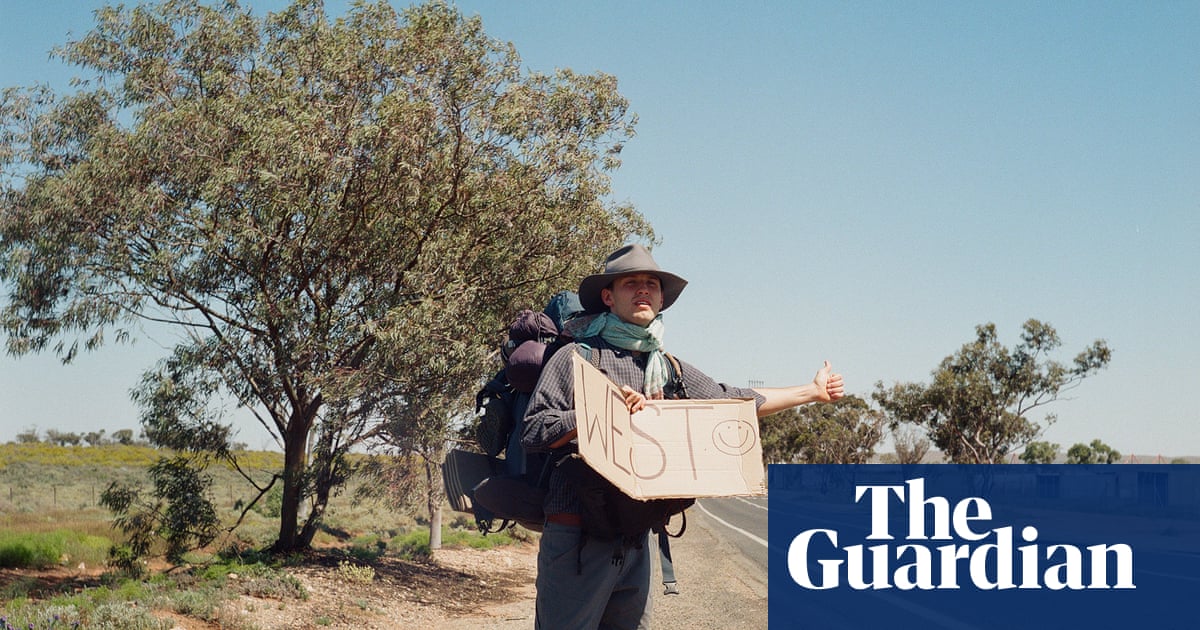
I’m alone, hunched over by a dusty road junction, and feeling the bite of the morning sun. I’ve already been waiting here, on the outskirts of Esperance on the south coast of Western Australia, for more than three hours. Another wave of traffic approaches. I smile, stretch out my arm and raise my thumb.Most drivers who pass wave or give me a thumbs up. One gives me the finger. There isn’t much traffic. Someone tosses a water bottle out their window at me.Just as I start to catastrophise in the dust, a four-wheel-drive quietly pulls off the road and comes to a stop behind me. I hoist my backpack around my shoulder, run over and jump in the passenger seat, thanking the driver profusely.One of my stranger interests is hitchhiking. I’m drawn to the idea of abandoning control and finding comfort in a stranger’s company. It’s a subculture, an art, and a way of travel that satisfies wanderlust like no other trip. Plus, it costs nothing.Once a popular way to travel in the 70s and 80s, these days it’s pretty rare to see a hitchhiker on the side of Australian roads. For starters, its reputation was overwhelmingly tarnished by its association with serial killer Ivan Milat, who murdered several hitchhikers in the early 90s. Australia is also one of the few countries in the world that make it legally fraught to hitchhike, with laws explicitly naming hitchhiking as an offence, though legislation differs between state and territories.Dehydration while waiting for a lift is a concern for hitchhikers. Photograph: Aston BrownAccording to Hitchwiki (Wikipedia for hitchhiking), most jurisdictions essentially prohibit a pedestrian from standing on or moving on to a road to hitchhike, though the wording and what legally constitutes “the road” varies. However, in the ACT hitchhiking is legal in most circumstances and Tasmania removed any reference to hitchhiking from its road rules in 2019.But safety and legal baggage aside, there are some signs hitching is making a comeback. Online resources such as the hitchhiker community Hitchwiki and its offshoot, Trustroots, which has more than 120,000 members, are steadily growing. And according to the University of Western Australia’s Dr Fang Liu, who studies adventure tourism, social media accounts sharing extreme ways of travelling are demystifying and normalising hitchhiking.Hitching is making a comeback as social media influencers normalise hitchhiking. Photograph: Aston Brown“Young international travellers are seeing people online and think, ‘Oh, I can do that too,’ but they may be unprepared and unaware of the risks,” she says.“In a lot of places there’s no [phone] signal and you might have to wait hours for someone to stop. By then you’ve probably already dehydrated. Social media doesn’t convey that.”Inside strangers’ carsI introduce myself to my latest ride. The driver is Doug Hilton, the boss of Australia’s national science agency, CSIRO. His job will make for good conversational fodder, but more importantly, he’s driving 500km west to Albany, his car has air conditioning, and the dusty intersection is in the rear-vision mirror.I’ve hitchhiked in Australia a few times before, once up Tasmania’s east coast and across Flinders Island on the Bass Strait, and another time from Canberra to Sydney. But never as far and never as ambitious as this latest leg – the plan is to go all the way from Sydney to Perth, mostly inside strangers’ cars.It’s the final leg of my journey and things have taken a fortunate turn.‘You’re the first hitchhiker I’ve seen in decades,’ Mike tells Aston Brown as they drive through South Australia. Photograph: Aston Brown‘Here we feel so safe’Five days earlier I’m fresh and clean-shaven, standing outside Broken Hill in outback New South Wales. I wait just five minutes before an SUV with a bull bar doubles back and offers me a ride.Inside is Miranda and her two children, originally from Zimbabwe. The car is crammed with pillows and baggage, but they find room for me. While I ram my backpack into the boot, Miranda’s teenage daughter moves to the backseat, squishing in beside her younger brother and an Esky packed with yoghurt cups and juice boxes.The family immigrated to the US a few years ago, but because of gun violence and immigration crackdowns decided to leave. “I never would have picked up someone there, but here we feel so safe,” Miranda says, the desert rushing by.Miranda with her two children in South Australia after giving Aston Brown a lift from Broken Hill, NSW. Photograph: Aston BrownThey now live in the regional Queensland town of Chinchilla, where Miranda says they’ve been embraced by the community. “We are so happy here,” she says. “Every day I thank God for where we have ended up.” From the backseat, her daughter says she wants to study medicine when she finishes high school.After four hours of meandering conversations between long silences, we part ways somewhere in rural South Australia. They’re headed to Adelaide to visit a family friend and make the most of school holidays. I’m going west.‘Milat changed things’Soon I’m racing through rolling hills of green oats and yellow canola flowers draped in golden afternoon light. Hulking wind turbines spin on the hilltops. Mike, 67, is in the driver’s seat of his Toyota troop carrier. He spends his retirement restoring century-old farm tractors and is headed to Cowell to pick up some engine parts. He says by sundown we’ll be in Jamestown, a small town with a pleasant campground by the river.“You’re the first hitchhiker I’ve seen in decades,” he says. “Milat probably changed things.”Canola fields whiz past in South Australia. Photograph: Aston BrownIvan Milat was convicted of the murder of five female and two male backpackers between 1989 and 1992 in NSW, several of whom had been hitchhiking. It’s alleged he’s responsible for dozens more unsolved murders or disappearances.There’s no denying the act of hitchhiking is inherently risky. But I am a white male. Whatever the risks I face, they are not the same dangers a woman or female-presenting person can encounter hitchhiking alone. Hitchwiki offers specific safety advice for female hitchers, but maintains “you have a right to be respected and it is not true that while hitchhiking you expose yourself to a risk at your own wish”. They also point out that women will usually spend less time waiting to be picked up.Mike in front of his vehicle in Jamestown, South Australia. Photograph: Aston BrownOn my journey I follow the general rule of thumb when it comes to hitching safely: I stand well off the road, in places with good visibility, with enough room for cars to pull over, and slow-moving traffic. I stick to footpaths where I can.When a car does pull over I give the driver a once-over and follow my gut. If I feel uncomfortable or unsafe, I know I’m under no obligation to get in the car. Though that’s a hypothetical. Every experience I’ve had has been positive so far.The wide open road in South Australia. Photograph: Aston BrownOver beer and dinner at the Jamestown pub, I learn about Mike’s extended family and how proud he is of his overachieving daughter. The next morning I tag along with him further west, snaking up a mountain pass before plunging into a treeless and barren plain below. Across the Spencer Gulf, grey and faint in the distance, is the Whyalla steelworks. Last month more than 500 of the plant’s employees lost their jobs.“People are feeling pissed off – there’s only bad news now and the major parties have no solutions,” Mike says. Talking about politics is a staple of the journey, though in a stranger’s car I prefer to do most of the listening. “Still, we are a lucky country, it’s just a lot of us don’t realise how lucky,” Mike says. An hour later we part ways.‘Middle of everything’By midday I meet Neil, a 79-year-old widower on the final leg of a four-month road trip across the continent. Neil, who lives in Geraldton in Western Australia, has stopped in his ute. His first joke is about hitchhiking.“A hitchhiker gets into a car,” Neil tells me. “He says to the driver, ‘You’re fairly brave picking up a hitchhiker these days. For all you know, I could be a mass murderer.’“The driver turns to him and says, ‘Well, what are the chances of us both being axe murderers?’”Neil provides a running commentary as they drive through South Australia. Photograph: Aston BrownAs we get comfortable, Neil’s running commentary begins. There’s a “ripper” wheat crop over there and another a few kilometres later, much the same. Over there is a slag heap from an abandoned iron ore mine. But where are all the sheep? And what could that truck be hauling?I learn about his life, too. Marrying at 21, raising a family, working 96-hour weeks driving trucks and saving prudently. We talk about relationships, love and getting to the “pointy end”. His motto is: “If you never go, you never never know.”At dusk we pull off the Eyre Highway at a truckstop and Neil disappears into his camper trailer for the night. I pitch my tent beside it. The ground is gravel and my sleep is restless. In the morning we set off at dawn and I doze off in the passenger seat.Rain falls on the Nullarbor Plain along the Eyre Highway in Western Australia. Photograph: Aston BrownBy the time I wake the sun is high and the landscape has transformed, thickets of silver saltbush and red dirt as far as the eye can see. We’ve reached the Nullarbor, a vast arid plain stretching 1,200km across southern Australia. “Middle of nowhere,” I say. “Nah mate, middle of everything,” Neil replies, road trains swooshing by endlessly.Towing his camper, Neil sticks to about 80km/h for safety and fuel efficiency, so it’s slow going. In the afternoon we drive down the 90 Mile Straight, the longest straight road in the southern hemisphere, and that night, under a gibbous moon, we share a dark beer, dinner and a Magnum mini vanilla ice-cream by the fire, all courtesy of Neil.The 90 Mile Straight on the Nullarbor Plain in Western Australia. Photograph: Aston BrownThree days and 1,900km since we met, Neil pulls up outside a campground in Esperance. We take a selfie and exchange a warm handshake. I know it’s probably the last time I’ll see him.A birding detourI don’t know it yet, but Doug from the CSIRO, 62, will be the last driver to pick me up before I hit Perth.I bookend my journey by talking to Doug about his passion for moths, his dream of inventing a way to eradicate feral cats, and the benefits of therapy to his mental health. Among other scientific pursuits, he’s on his way to Albany to meet with two Menang Indigenous elders who co-authored a paper with him about moths in the region, including three newly discovered species of primitive jaw moths.In the afternoon I take up his invitation to join him bird watching by the ocean. We park at a headland, Doug grabs a Nikon Z9 with a huge telephoto lens out of the boot, and we start walking through thick coastal scrub. At sunset we witness a brown blur scurry across a dirt track. Doug misses the photo but is nonetheless ecstatic and wraps his arm around me in joy.The Nullarbor Plain. Photograph: Aston BrownApparently we’ve just seen one of Australia’s rarest birds, the noisy scrubbird, presumed extinct until it was rediscovered in 1961. The significance of the sighting is lost on me but Doug assures me I’ve just hit the peak of my bird-watching career. I didn’t know I’d started it.We pull into Albany at dark and Doug drops me off at a hostel. It reeks of marijuana and there’s no hot water but I’m just happy to be sleeping on a thick mattress. When I wake up it’s miserable outside so I make the call to take the bus for the final six hours of the route to Perth. I’m comfortable, but it’s decidedly dull as the sprawling suburbs of the world’s most isolated capital city start rolling by. I’ve spent 4,360km travelling across the most isolated inhabited continent on Earth, yet for all the distance, I’ve rarely felt alone.
I hitchhiked from Sydney to Perth, and found comfort in the company of strangers
Full Article
Original Source
Read the full article at Theguardian →KhanList aggregates and links to publicly available news content. We do not host full articles from third-party sources. Always verify important information with original sources.