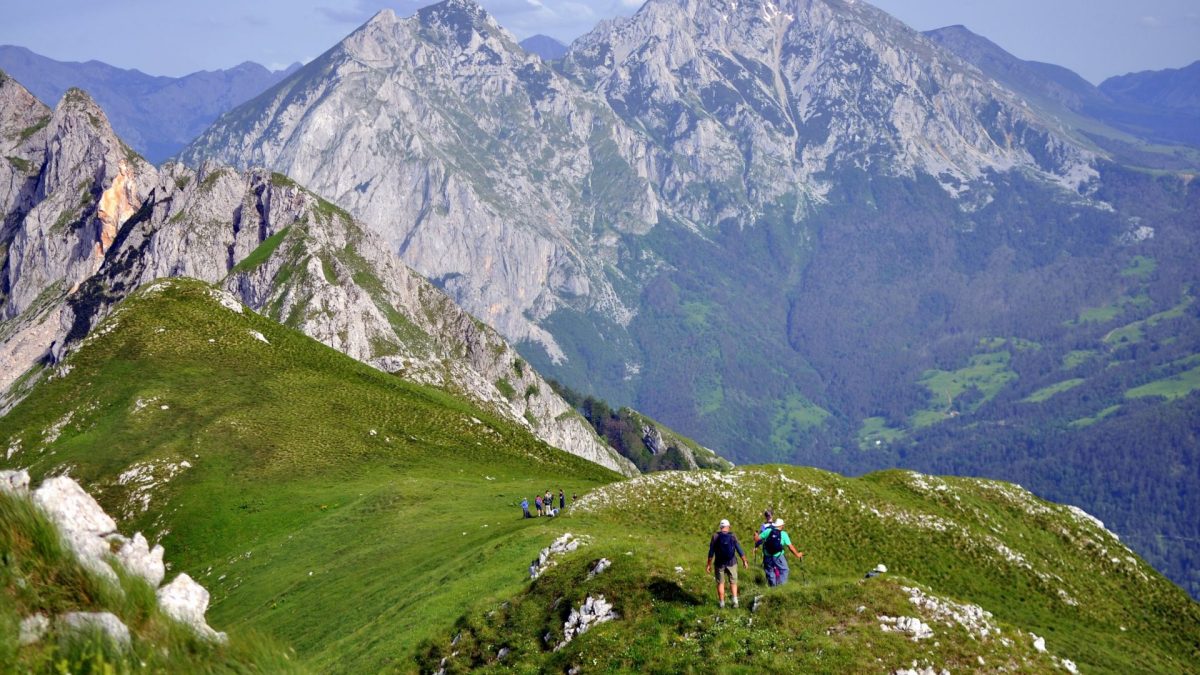
“Look right there – there’s a dragon hiding in the mountainside,” Samer says as we make our way towards an innocuous-looking, dun-coloured rockface. We’ve been following a trail on Bjelasnica, one of several mountains surrounding Bosnia’s capital, Sarajevo, as part of a multi-day trip exploring the Balkan country’s remote and wild corners with Exodus Travel. Today’s hike has taken us on a loop around the small highland village of Umoljani, populated mostly by goats and sheep, and a handful of humans. Here, rural life continues much as it has for centuries – villagers living off the land, growing potatoes, cabbage, rye and oats and shepherds spending summers in rudimentary huts made from wood and sheet metal. Despite the fog, the landscape – when it does reveal itself through the atmospheric swirls of mist – is gloriously scenic, all verdant plains and hillsides carpeted with trees. Unlike neighbouring Croatia, Albania and Montenegro, Bosnia is landlocked, and mountains make up 60 per cent of the country, while 40 per cent is forested. Up here, temperatures can be at least 10C cooler than down at sea level. Summers are typically cool and short. Umoljani in Bosnia and Herzegovina (Photo: Muslic Kenan/Exodus) It feels wonderfully lush, and the scenic-factor swiftly cranks up to spectacular when we reach a vertiginous viewpoint looking over the dramatic Rakitnica Canyon; plunging down 2,600ft, it’s the second-deepest in Europe. Later, we reach Studeni Polje plateau, which flattens out into pretty meadowland studded with occasional clumps of wildflowers, a serpentine silver stream through its middle. On the approach to the rockface that heralds the end of our walk, guide Samer reveals a local legend. “In ancient times, a dragon crawled out of the canyon looking for food,” he says, a twinkle in his eye, “and the stream we passed is the mark his tail left as he approached the village.” Apparently, the creature was defeated by prayer – an imam recited passages from the Quran, and when the dragon tried to escape, it was turned to stone. I peer closely and can just about make out an S-shape etched into the surface of the tall slab of rock; the hill itself supposedly reflects the creature’s outline. The following day we visit Sarajevo, a city that, until now, I’ve only been familiar with through news coverage of the horrific conflict that tore Bosnia apart between 1992 and 1995. Bullet holes pockmark many buildings, while in front of the Sacred Heart Cathedral is one of several “Sarajevo Roses”, poignant memorials where craters left by mortar shells have been filled in with red resin resembling petals. Sacred Heart Cathedral in Sarajevo (Photo: Ran Dembo/Getty) We reach a bridge at the point the Miljacka River flows past the imposing, Arabesque town hall, and Samer points out a small white building. “That’s the House of Spite,” he explains. The story goes that when the Austro-Hungarian empire – which ruled Bosnia between 1878 and 1918 – wanted to construct a town hall, the site was occupied. Its stubborn elderly owner refused to move, unless the authorities had the home dismantled and rebuilt, brick by brick, in its present position. “This beautifully illustrates the Bosnian concept of inat,” says Samer. “It’s our national trait of defiance and a refusal to back down.” Bosnians have certainly needed this over the centuries, not least when they were conquered by the Ottomans in 1463. The Ottoman influence is visible throughout Baščaršija, Sarajevo’s twisty, maze-like, medieval bazaar, marked with streets named after craftsmen, such as Ulica Tabaci (leatherworkers) and Ulica Bravadžiluk (locksmiths). The sound of hammering copper rings out, one of the ancient trades that prevails today, and we pass stores selling deliberately named “Bosnian delight” and “Bosnian coffee”; apparently feelings still rankle. Everything is spectacularly good value. Bosnia is still cheap compared to Western Europe, and I bag souvenirs for the equivalent of a couple of quid. Tasty traditional dishes such as pita (cheese pie made from filo-like pastry) and cevapi (grilled minced meat sausages served in flatbread), meanwhile, will leave you change from a fiver. Lunch in Lukomir (Photo: Michele Cohen/Exodus) One of the highlights of the trip is the chance to see the legacy of Sarajevo’s 1984 Winter Olympics. Our group ascends Mount Trebević by a vertiginous cable car ride, looking down on the network of pretty hiking trails. We set off on one with the aim of reaching the peak, 5,344ft above sea level. We ascend valiantly through thick pine and spruce forests, spotting the odd black-and-yellow patterned salamander scuttling through the grass and listening to the soothing sounds of cuckoos, robins and chaffinches. Bad weather, alas, foils our plan, so we deviate to a mountain hut. Thankfully genial Slovenian owner, Primosz, is on hand with bowls of soup to warm us up. On the way back down, we head to the quirky sight of the abandoned – and partially war-destroyed – bobsled and luge track. Samer informs us it’s still used for training, as well as for mountain biking and extreme cycling. Covered in bright and colourful murals, it stands out amid the landscape, and we walk slowly up it to the cable car station, trying to picture athletes hurtling down at speeds of up to 100 km/h. Bosnia is being hailed as the next European frontier for adventure travel; with its rugged peaks, long-distance trails, deep canyons and dense forests – not to mention the absences of EES border delays (unlike Croatia, it’s outside the Schengen Area), it’s easy to see why. Come before it gets too touristy; just beware of dragons. Booking it Exodus Travels’ nine-day group trip, Walking in Bosnia & Herzegovina, starts from £1,889pp, excluding flights, exodus.co.uk.
I hiked in a cool Balkan mountain range – it’s perfect for a summer break without EES hassle
Full Article
Original Source
Read the full article at Inews →KhanList aggregates and links to publicly available news content. We do not host full articles from third-party sources. Always verify important information with original sources.