
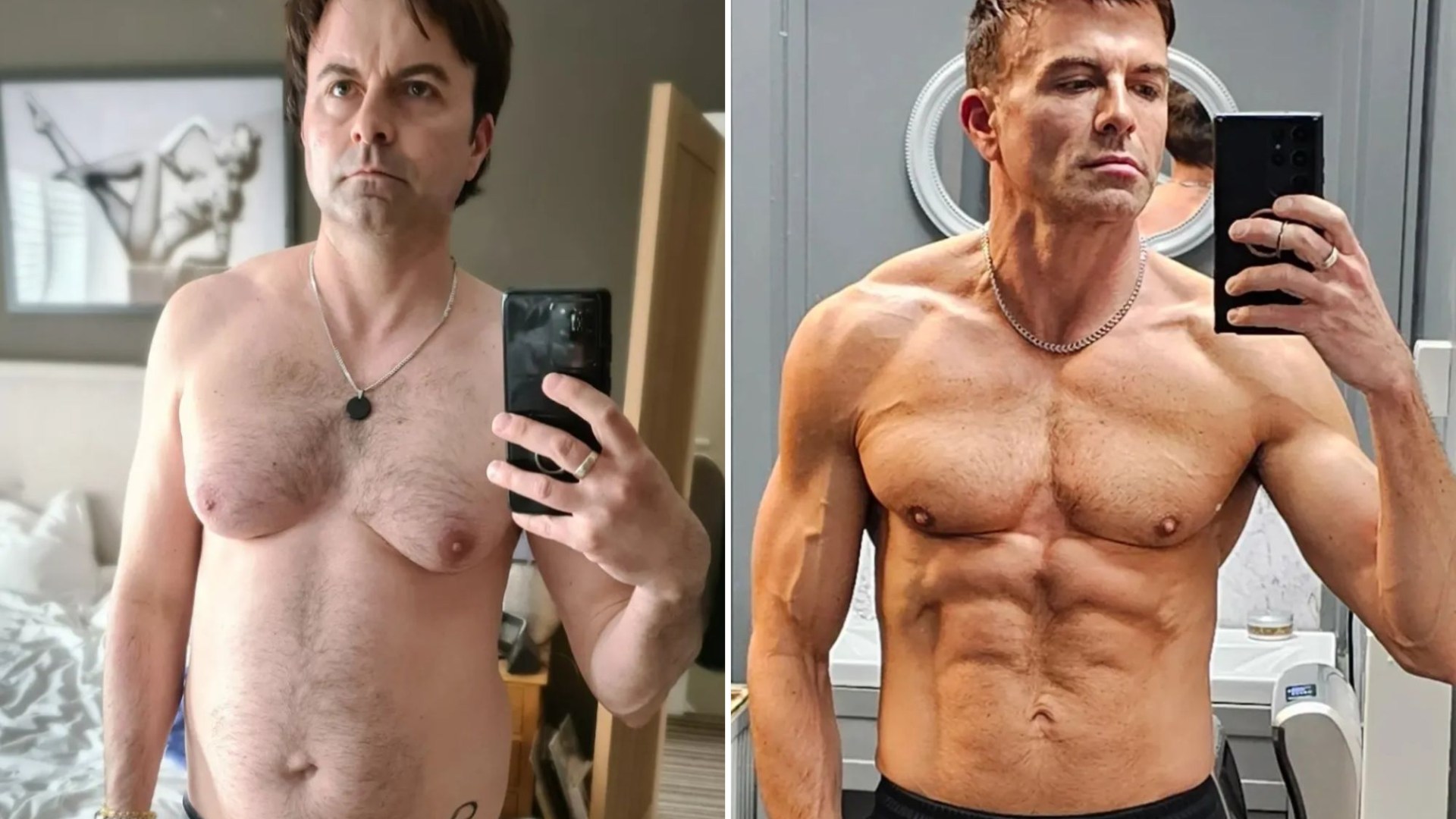
WHEN Aaron Calder was drinking vodka from a water bottle at work, he managed to convince himself he didn’t have a problem, despite his yellowing eyes, bloated belly and puffy face. But by the time the 47-year-old hit absolute rock bottom – vomiting blood and what he feared were chunks of his liver – he’d already tried the usual methods to cut back, from AA to rehab, without success. Aaron Calder, 47, before he turned his life around, quitting the alcohol that had destroyed his body Credit: Supplied Pictured recently, Aaron had tried everything to stop drinking but found an unlikely fix after he was sent to rehab Credit: Supplied The words of a doctor who told him “You’re killing yourself” in 2013 proved a turning point for the Brighton-based fundraising officer, who had spent more than a decade obliterating his body with alcohol. At his worst, he was waking up and downing neat vodka, stealing money from his partner, Tony Dundee, 45, a florist, to help fund his habit. Thirteen years on, and you’d have no idea he was living with chronic liver cirrhosis and “ticking timebomb” veins in his oesophagus that could rupture at any moment. “I was always very shy, so when I started going to clubs when I was 17, 18, I would always binge drink; it was never just one vodka Red Bull,” says Aaron. “I would drink and have blackouts and forget what happened.” It was in his mid-twenties that his drinking went from nights out partying and a self-esteem boost to something much more serious. “I got a good job working in Richmond, London, as a personal assistant and the person I worked for would have a bottle of wine open every night. “Over time, it progressed from me having a couple of glasses to a bottle, to two bottles, to buying boxes of wine and drinking alone. “I would literally drink until I blacked out almost every night.” At first, he was good at hiding his boozing from friends and family, but he did start to notice he was “putting on a bit of weight, getting red in the face and quite puffy”. “Then there was the forgetfulness and being tired all the time, sleeping in, being late for things,” he says. By the time Aaron was in his late 20s, his drinking was out of control. “I would wake up and have to have a drink to stop myself from shaking,” he says. He got a job working in a supermarket – knocking back a glass of wine before the interview – and was soon drinking on the job. “I used to sneak vodka in a water bottle and drink during my shifts.” When his family and colleagues questioned his behaviour, he says: “I was very good at lying and denying it, to myself and to them.” He’d use eye drops and chew extra-strong mints to try to cover up that he’d had a drink, but part of him knew he had a problem. “I did go to an AA meeting, got a hypnotherapy CD, and I went to see a hypnotherapist twice and bought a book about it,” he says. “And I went through a phase of going to the gym for about six months where I didn’t drink at all, and then I’d relapse and start again.” Eventually, Aaron was told to take leave from work and sort himself out. Aaron’s drinking got out of control in his 20s. He was drinking vodka at work Credit: Supplied Aaron hit rock bottom in 2013, having been hospitalised the year prior with liver damage Credit: Supplied “But I just carried on drinking,” he says. “I’d literally wake up and drink neat vodka on an empty stomach, and then try and go about my day as best I could, pretending there wasn’t an issue.” There were signs his body was starting to crumble. “I’d started having yellowness of the eyes, bloodshot eyes, very red and puffy skin, a bloated stomach,” he remembers. “I had gout (a kind of arthritis caused by too much uric acid in your blood) in my ankles. “I went to the hospital and they said, ‘Do you drink a lot?’ And again, I said, ‘No’. “Drinking vodka every day costs a lot of money, so I would take out payday loans – I got myself into £2k debt. “I would ask my family for help, but not say it was for alcohol, and sometimes, when he was asleep, I’d take my partner’s bank card, go to the shop and buy a bottle of vodka, come back and sneak his card back in his wallet. “I was spending almost £500 a month on alcohol.” Aaron was no stranger to drink driving, and one time drove the wrong way down a motorway. Eventually, Aaron was admitted to hospital in January 2012 and told he had liver damage. “I was in hospital for about two weeks, they had to detox me and get my liver function back to normal,” he says. Aaron pictured when he was in hospital. On his second admission, he was told he had twisted veins in his food pipe that was pumping blood into his stomach Credit: Supplied Where to get help You may need help for alcohol problems if: you often feel the need to have a drink other people warn you about how much you’re drinking you think your drinking is causing you problems Speak to your GP, and ask about any free local support groups and other alcohol counselling. Find alcohol addiction support services in your area. If you have become physically dependent and need to stop drinking completely, stopping overnight could be harmful and you should get advice on stopping safely with medicines. If you’re worried about your own or someone else’s drinking, you can call the free Drinkline helpline in complete confidence on 0300 123 1110 (weekdays 9am to 8pm, weekends 11am to 4pm). If you think that you have a drug addiction then please contact your GP. You can also visit FRANK for honest information about drugs and to find local treatment services. If you are having trouble finding the right help, call the FRANK drugs helpline on 03001236600 Or click here to visit the NHS website for more advice and support “When I got out of hospital, I was sober for a few weeks, and then the doctor said to me, ‘Your liver is doing really well,’ and I took that as, ‘I can drink again’.” He relapsed in March and then in August 2012, woke up the morning after a friend’s birthday with a “metallic taste” in his mouth. “I thought, ‘That’s weird’, and then I threw up – it was blood,” he says. “I actually thought my liver was just falling apart and I was throwing bits of it up because there were clots.” Rushed to hospital, it turned out he had varices, which are twisted veins in the oesophagus that are related to liver disease. The veins can leak and burst, and are life-threatening. “Blood was literally pumping into my stomach from these burst veins,” says Aaron. “My body just couldn’t cope anymore.” At age 32, doctors told him, “It’s not good, you might die, you’ve got serious liver damage”. Aaron’s liver was shutting down, he had a kidney infection on top of the gout, and his spleen was also in trouble. He underwent surgery to secure rubber bands around the varices to seal them to stop the bleeding and then put him on steroids, anti-inflammatories and vitamins, because he was also malnourished. Doctors managed to stabilise him and told him he couldn’t drink again, unless he wanted to put his life at risk once more. “In the middle of the night, I had ascites, which is where fluid builds up in your stomach, so they have to syringe it out,” he says. “I remember a specialist said to me, ‘Basically, you’re killing yourself.’ “And he said, ‘I wish I could take you into the ward where there’s people dying from liver failure, so you can see what they look like’. ‘The fear made me want to achieve a lot more in my life,’ says Aaron Credit: Vista Visuals Drinking is ‘no longer an option’ for Aaron Credit: Supplied “He was very blunt with me, and I thought, ‘Okay, I need to stop now’. “That’s probably the first time I admitted I have a problem and could never drink again.” A biopsy confirmed Aaron’s liver damage had worsened – cirrhosis (long-term scarring) and fatty liver disease. After two weeks in hospital, he was discharged and sent to a rehab centre for his boozing. “This was probably the moment for the first time I admitted to myself I had a drink problem and that I came very close to death,” he says. “The fear made me want to achieve a lot more in my life.” Following tests, he was told he’d probably need a liver transplant. It was after watching some documentaries while recovering at home that he decided to try going vegan, which was the moment things really changed for him. “I was reluctant to go vegan at first as I always thought it was extreme and restrictive. “I also thought I needed milk and eggs for protein, but the research I did said otherwise and so did my health. “It was hard at first but I very soon got used to quickly reading ingredients on products and learning how to make all my favourite meals, but all plant-based. “After just two weeks I felt so much better. My skin got better, I had more energy and the whites of my eyes got whiter.” At a routine check-up six months later, his specialist said his cholesterol and blood pressure were perfect and his liver function had dramatically improved. “I wouldn’t be where I am today if I hadn’t gone vegan,” says Aaron, who now shares his story and fitness journey on Instagram (@aaroncaldervegan). “Focusing on diet, as well as exercise, is a good way of distracting from ever wanting to drink again. “I like having control, whereas before, alcohol controlled me. “I have invested so much in my health, diet and life that drinking again is not an option.” He now has a checkup with a specialist once a year, as well as an endoscopy – a camera down the throat – two or three times a year to check the varices in his throat aren’t going to rupture again. If they did, he could bleed out, so although you wouldn’t know it by looking at him, it’s like “living with a ticking time bomb”. In fact, doctors went so far as to warn him against doing excessive exercise, because putting his body under pressure could cause them to rupture. “I was told not to exercise as it would put my body under too much stress,” he says. But, “once my health improved, after I changed my diet, I felt strong enough to start doing light exercise which soon turned into weightlifting. “My specialist was shocked when I told her I was working out every day. “She now tells me to keep doing what I’m doing as it’s working.” These days, he goes to the gym for two hours every day and has completely transformed his body. He says: “I feel good. I’m still sober. I don’t get any cravings, I don’t go to AA meetings. “There’s alcohol in the house and I’m not tempted. “I was given a lot of negative outlooks in terms of health and survival and a lot of people said, ‘You’ll be on medication for life’. But I don’t take any medication at all now.” At first, he was on a cocktail of pentoxifylline (for blood flow), steroids, propranolol (a beta-blocker), and diuretics amongst others. Aaron is currently training to be a qualified drug and alcohol addiction counsellor. “I want to use my horrible experience to help people, to give them hope if they get ill like I did, and also to show them that you can turn your life around,” he says. If you are struggling with addiction, he says: “You need to speak to someone, whoever it is, friends, family, a professional, that’s the first step, and admitting that you’ve got a problem. “There’s a lot of shame. “I didn’t want to admit I had a drink problem because I saw it as a weakness, but if I can get better, anyone can do it.” What are the benefits of going plant-based? There is no 'best diet' - though vegans and meat-eaters would tell you otherwise. Scientists say the ‘best diet in the world’ is the Mediterranean diet, which emphasises plant-based foods but also includes some red meat and fish. Other diets that fall under ‘plant-based’ include vegan, pescatarian and flexitarian. So what is ‘plant-based’ and how might it benefit you? What is plant-based? The easiest way to consider plant-based is vegetarian. But while the main focus of eating vegetarian is to avoid meat, the main focus of plant-based is to eat as many plants as possible, i.e. fruits, vegetables, grains, legumes, nuts and seeds. Why is it beneficial? The Mediterranean diet – a good example of eating primarily plant-based – has been shown in both large population studies and randomized clinical trials to reduce the risk of heart disease, metabolic syndrome, diabetes, certain cancers (specifically colon, breast, and prostate cancer) and depression, says Harvard Health. Plant-based diets are often higher in fibre, which is linked with bowel cancer prevention (the opposite is said of red and processed meats). Fibre can also help with weight management. What to be wary of Anyone who eats primarily vegan or vegetarian may need to supplement if they are not reaching nutrient targets, namely iron and B12. Also, many plant-based products that are versions of fake meat or cheese may appear to be healthier on the surface but are often laden with salt or other processed ingredients. If you’re going to give plant-based a try, it’s a good idea to learn some new recipes rather than rely on meat substitutes. Plant-based foods list Vegetables Fruits Whole grains (brown rice, brown pasta, quinoa, barley, oats, buckwheat, bulgur) Legumes (chickpeas, kidney beans, black beans, peas, lentils and more) Nuts and seeds (almonds, cashews, peanuts, pumpkin seeds, sesame seeds and more) Plant-based proteins (tofu and tempeh)
I hid vodka in my water bottle & feared I was vomiting bits of LIVER… even that didn’t stop me boozing – shock cure did
Full Article
Original Source
Read the full article at Thesun →KhanList aggregates and links to publicly available news content. We do not host full articles from third-party sources. Always verify important information with original sources.