
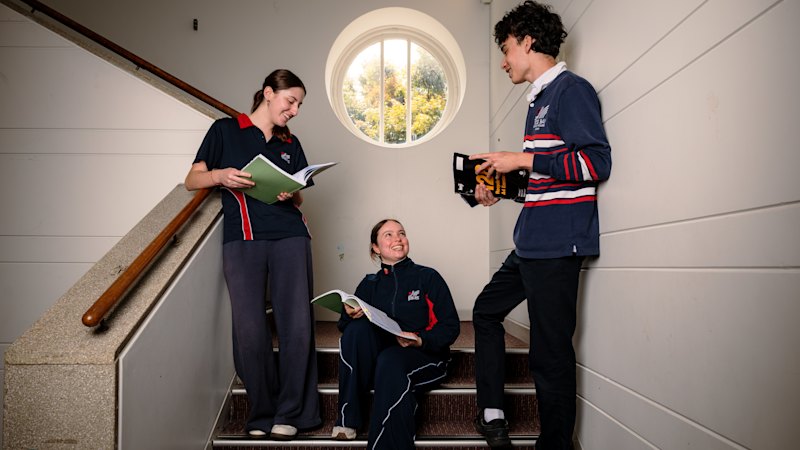
October 16, 2026 — 5:30pmRose Bay Secondary College modern history teacher Emily Lawson appears popular with students, but she harbours views which might prompt a double-take in the staff room.“I have very strong opinions that modern history is one of the hardest examinations to go through,” she says.Rose Bay Secondary College history teacher Emily Lawson.George ChanThe years of history her students covered included the Russian Revolution, Hitler and World War II, to the apartheid state of South Africa, culminating in a three-hour exam sat by 11,012 pupils across NSW on Friday.Students must have a strong command of historical knowledge, interpretation, argumentation, engagement with scholarship and historiography, Lawson said. She has noticed her politically engaged Gen Z students’ curiosity for historical detail powers their dedication to the subject.“They just love learning more about the world and that it’s so connected to today,” she said.In the school’s hall after the exam had finished, Lawson flicked through the exam with its historical source photographs of Nazis and communists. She was very positive about the questions but feared the wording may have confounded some students.That included one on an extract from a 1934 Daily Mail article which was a pro-Nazi article reporting on the Night of the Long Knives, asking students to explain the problems the article raises for a historian.“Explain the problems. I haven’t seen that in a paper before,” Lawson said.“We usually get like value questions, but explain the problems? That will be an interesting question potentially.”Her train of thought is interrupted when one of her students approaches. “You’ve been the best teacher in the whole entire world,” the boy says.“I didn’t pay him to say that,” she says. But back to the exam.Teya Whitcombe, Auriane Lacroix and Asher Jacoby after their HSC modern history exam.George ChanAsher Jacoby, 17, had 600 palm cards with modern history facts and quotations on them. He walked in remembering about half of them. The trickiest part for him was the USSR question he opted for, which asked students to evaluate the accuracy of this statement: Social and cultural change was an essential feature of Stalin’s totalitarian control over the USSR.“You can broaden that out to talk about social, political, and economics,” he said.Remembering all the facts was just one element of the subject.“Modern history is a really great subject for not just learning about history, but learning about writing in general … you have to have a thesis, and then you have to support that thesis with argumentation,” he said.For the section on WWII, Auriane Lacroix, 17, tackled the essay question on Allied leadership.“I think that was a good question,” she said.She argued it was a significant factor in victory, referencing Britain’s use of the air force and D-Day landings.When Teya Whitcombe, 18, saw that question on Allied leadership she had a different take, due to its specificity.“I thought that was a bit strange,” she said. Overall, she thought the exam was “a bit weird … but nothing too horrible”.She never intended to study history but enrolled late because her friends did it. “I’ll treasure my modern history knowledge, even if I won’t really use it,” she said.And then there was Ms Lawson. “She’s a very good teacher,” she said.Start the day with a summary of the day’s most important and interesting stories, analysis and insights. Sign up for our Morning Edition newsletter.More:HSCFor subscribersSchoolsHigh schoolSydneyRose BayFrom our partners
‘I haven’t seen that before’: Surprise wording in the HSC modern history exam
Full Article
Original Source
Read the full article at Smh →KhanList aggregates and links to publicly available news content. We do not host full articles from third-party sources. Always verify important information with original sources.