
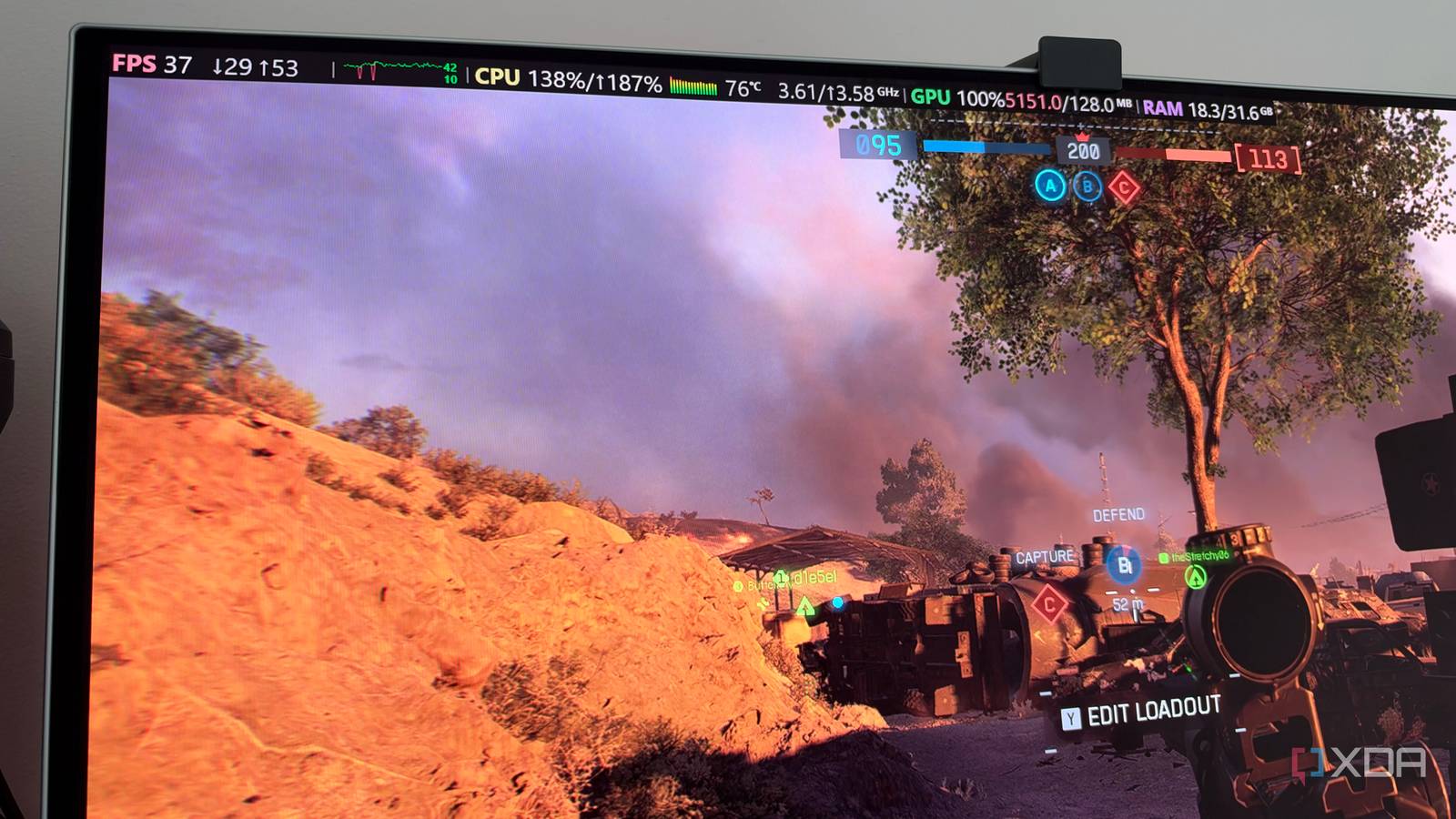
Published Oct 9, 2026, 4:30 PM EDT His love of PCs and their components was born out of trying to squeeze every ounce of performance out of the family computer. Tinkering with his own build at age 10 turned into building PCs for friends and family, fostering a passion that would ultimately take shape as a career path. Besides being the first call for tech support for those close to him, Ty is a computer science student, with his focus being cloud computing and networking. He also competed in semi-pro Counter-Strike for 8 years, making him intimately familiar with everything to do with peripherals. Integrated graphics are usually an afterthought, especially on a mini PC that's decked out for home lab use. The Minisforum box I have and its Intel Core Ultra 9 389H aren't particularly adept at gaming, but when trying a handful of titles on it, new and old, it surprised me. It has a cut-down version of the integrated graphics in the full-fat chip, featuring only a third of the Xe3 cores. It also only has one stick of DDR5 SODIMM memory, which is about as bad of configuration as you can give an integrated GPU. Despite that, it ran most of what I threw at it. The 386H gets the smaller version of Intel's Xe3 graphics It's not the full graphics package Intel's Panther Lake chips come with two very different tiers of integrated graphics. The Core Ultra X parts carry the Arc B390 with 12 Xe3 cores, and that's the one behind most of the gaming coverage. The Core Ultra 9 386H in the MS-03 mini PC I have isn't an X chip. It uses the same Xe3 architecture with only four of those cores, so it's significantly cut down compared to the main version. I tested a handful of games on Windows 11 with the performance BIOS profile and mostly at 1080p to give this thing a fighting chance. The main thing working against this particular box is that it's limited to one stick of SODIMM DDR5, which doesn't only severely hamper memory performance, but also puts more strain on the iGPU, since it relies on system memory for VRAM. Older games ran comfortably A solid average framerate Black Mesa was the first thing I tried. It's the 2020 remake of Half-Life, built on Valve's Source engine, and at native 1080p on low settings it averaged around 70 FPS. That's not a demanding game, but it's a full 3D shooter running at native resolution with no upscaling. GTA IV was more interesting. The 2008 PC port has a long-standing reputation for running badly on hardware that should handle it easily, so it's a useful test of whether a system has headroom to waste. On low settings it averaged about 100 FPS at 1080p and about 60 FPS at 1440p. The frame rate fell roughly in step with the extra pixels, which suggests the graphics side was the limit at those settings and not the CPU. Either way, 60 FPS at 1440p from four Xe3 cores is more than I expected, especially for a game like this. GTA V Enhanced was a pleasant surprise More than playable on a box of this size is impressive GTA V Enhanced is the 2025 PC update that brought over the ray tracing features from the current console versions, and Rockstar's minimum spec asks for a dedicated card with 4GB of VRAM. I ran it on the game's minimum preset at 1080p, and it averaged around 90 FPS through the opening sequence. This is, of course, with the caveat that gameplay within Los Santos could suffer a little more, but even so, the game could lose a third of its framerate and still be at a very playable 60 FPS. For integrated graphics running on one stick of RAM, that's a strong result. A recent triple-A title is asking too much Battlefield 6 is well optimized, but this is asking too much of the 386H and its iGPU I decided to stretch my luck and try a more recent game. Battlefield 6 has been a mainstay in my library, so I decided to fire it up. It firmly pushed this box to its limit. With XeSS set to ultra performance at 1080p, this thing averaged around 35 FPS in an online Domination lobby. On paper, that clears EA's minimum spec of 30 FPS at 1080p for a dedicated card with 6GB of VRAM, but that's at native rendering. XeSS ultra performance renders at a third of the output resolution on each axis, so the game was drawing a 640 by 360 image and scaling it up. That's a ninth of the pixels, and there isn't much image left to work with at that point. On my 32" 4K OLED, the game looked like a shambles. It was somewhat playable, but not what I would consider a great experience. Vehicle combat might not be too bad, but infantry stuff is off the table here. One stick of RAM means these numbers are the floor Adding another stick would boost performance significantly Since iGPUs rely on system memory for VRAM, it's no surprise that this configuration suffers specifically in BF6. The minimum requirements call for dual-channel memory, and that's with a dGPU. With one stick installed, the MS-03 is running single-channel, which gives the iGPU roughly half the theoretical memory bandwidth it would have with two. If you were to add a second stick to his configuration, you'd see a significant boost in performance in all games. Panther Lake's worst iGPU in a bad setup is still decent Even though it's suffering with single-channel RAM, the iGPU in this Core Ultra 9 386H is impressive. I'm surprised that it was able to push such playable framerates in a title like GTA V Enhanced, though it's no surprise why it falls short in Battlefield 6. For older titles, even those that are triple-A, integrated graphics has become surprisingly good. MINISFORUM MS-03 $2168 $2710 Save $542 RAM 32GB DDR5-5600 (Up to 128 GB) CPU Intel® Core™ Ultra 9 386H
I handed a worst-case scenario to Intel's cut-down iGPU, and its gaming performance still surprised me
Full Article
Original Source
Read the full article at Xda-developers →KhanList aggregates and links to publicly available news content. We do not host full articles from third-party sources. Always verify important information with original sources.