
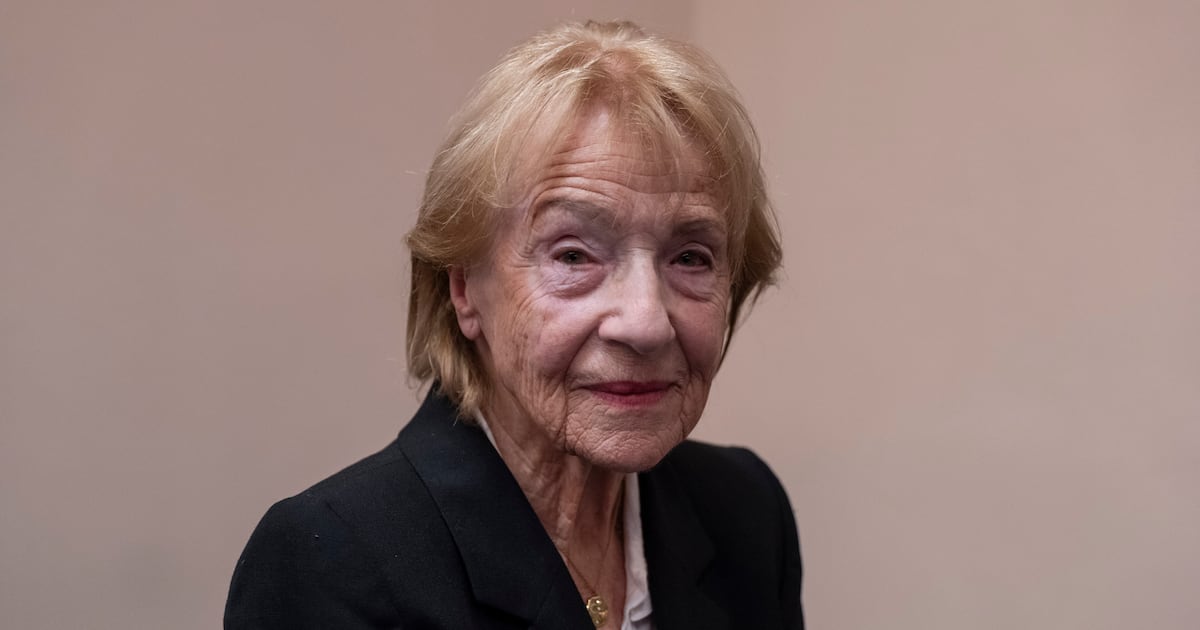
It was in the 1980s, when Gillian Deeny was 52 years old, that a pain in her lower abdomen left her in excruciating pain. She felt discomfort in her lower back and at her shoulder blade. The Wexford-based artist thought, at the time, the pain was from an ulcer on her small intestine as she was “always wrestling it and minding it”.After tests, Deeny was told it was something much more concerning: she was diagnosed with pancreatic cancer.“I had no idea it was something like cancer. I never took it on board; I had no idea it was so serious,” she says.READ MOREDeeny told her story on Wednesday at a public meeting of cancer experts and survivors called the “Dare2Cure” public symposium held as part of a Dublin conference on bringing cancer research to patient treatment. Her father, James Deeny, the former chief medical adviser for the State who later worked for the World Health Organisation, was very concerned. “I think [my parents] thought I wouldn’t be here for very long,” she says, due to the late stage at which she was diagnosed.Prof Oscar Traynor of St Vincent’s University Hospital in Dublin carried out a “whipple” procedure: a complex operation to remove tumours and other conditions in the head of the pancreas, duodenum and bile ducts.[ New drug offers ‘first glimmer of hope’ in treatment of pancreatic cancerOpens in new window ]“I never had any chemotherapy. It had metastasised into one of my lymph nodes so that was removed. I think they thought I was palliative. They didn’t give me anything; probably because they thought I wouldn’t be able for it,” she says.“I remember seeing my father standing when I was in intensive care. He just stood there with tears rolling down his cheeks. I never saw him cry again, but that’s all I remember: the tears rolling.”Deeny says she was in the Dublin hospital for “the best part of a month”. “I was in a nursing home to rehabilitate for another month or so. And then I went back to my lovely old thatched cottage,” she says.[ Pancreatic cancer: ‘I just can’t explain what it felt like hearing those words’Opens in new window ]Deeny celebrated her 90th birthday last May. She never thought she would be here today; at one point she even bought herself a grave. But she has lived a full life. She works as a painter and is a stained-glass window artist, with her work including the nave windows in Galway Cathedral.Pancreatic cancer survivor Gillian Deeny. Photograph: Paolo Nunes Dos Santos for The Irish Times “I’m very old. I was a war baby, really,” she says.“Pancreatic cancer is always viewed as a really sad story, but I’m still here. I was 90 last May. It’s a mystery. I just wanted people to know that the odd one of us does make it. It’s not all hopeless.”Though Deeny’s survival surprises even herself, for people with a more recent diagnosis of pancreatic cancer, the tide is beginning to turn.About 600 people are diagnosed with pancreatic cancer – one of the most aggressive forms of cancer – in the Republic every year.Survival rates for the disease are particularly low due to the vague nature of the symptoms associated with early-stage disease and subsequently the late-stage diagnosis.Only about 10 per cent of patients in Ireland are still alive five years after diagnosis. This is compared with five-year survival rates of about 88 per cent for breast cancer and 93 per cent for prostate cancer.But there is hope on the horizon for improved survival rates and treatment options.Earlier this year, an advanced clinical trial led by Irish woman Dr Eileen O’Reilly, an oncologist at Memorial Sloan Kettering in New York, revealed that the drug daraxonrasib doubled the survival time for people with metastatic pancreatic cancer when compared with chemotherapy.Dr Eileen O’Reilly speaks during a public talk on breakthroughs in pancreatic cancer at the Herbert Park Hotel in Dublin on Wednesday. Photograph: Paolo Nunes Dos Santos for The Irish Times According to the study, patients receiving the drug lived for a median of 13.2 months, compared with 6.7 months on standard chemotherapy.This is the first time a single anticancer drug was found to target a gene called RAS, which is one of the drivers of pancreatic cancer. O’Reilly says the finding represents a “sea change” in the treatment of the condition.“It’s been traditionally treated with chemotherapy. Chemotherapy has been helpful to shrink cancer and extend life, and that’s been the major tool that we’ve had,” she says, speaking to The Irish Times on the fringes of this week’s conference hosted by Dublin City University and Cancer Clinical Research Trust.“What’s been known for a long period of time is that RAS, this gene, is switched on in pancreatic cancer and it’s involved in the development, growth and spread of the cancer.” She says there have been many, many approaches over decades “based on really solid science trying to target RAS, but it just hasn’t been effective.“It’s a very insidious disease, and for more people there aren’t early warning signs. This [finding] was unprecedented in pancreatic cancer. That notion of it being non-druggable is now firmly refuted,” says O’Reilly.The drug has now been approved for use by the Food and Drug Administration in the US and was fast-tracked for review by the European Medicines Agency this summer.Pancreatic cancer is typically viewed as a disease of older people. But O’Reilly says prevalence is increasing generally and it is also being seen more frequently in younger people. A similar, concerning trend has been identified in colorectal cancer.[ Bowel cancer: ‘I truly know what it means to live and am genuinely loving life’Opens in new window ][ ‘I kick myself about not going to a doctor’: the dangers of ignoring bowel cancer symptomsOpens in new window ]“It’s most common in people in their 60s to mid-70s. But even within that, we’re seeing younger people developing pancreatic cancer. There’s not a week goes by without seeing someone in their 30s or 40s with it,” she says.That’s why the recent discovery is so important, O’Reilly says, though she believes it is “just the start of more things to come”.Dr Eileen O’Reilly speaking to attendees after a public talk on breakthroughs in pancreatic cancer. Photograph: Paolo Nunes Dos Santos for The Irish Times The focus now is on examining whether other drugs or treatments could be effective, as well as early detection and vaccination. “The goal now is not just to develop one drug but multiple drugs and to get them in earlier stage of disease where the impact will be greater. We’re looking at combining [drugs] with other therapies, including chemotherapy and immune therapy,” says O’Reilly, a graduate of Trinity College Dublin.“We’ve moved the bar, but we’re not curing people, and that’s something that’s a worthy goal. If we can shift the curve of people diagnosed with metastatic disease, where survival is modest, that will [mean] having people living healthier for longer. That’s a success compared to where the field was.”
‘I had no idea it was so serious’: Woman’s back and shoulder pain was pancreatic cancer
Full Article
Original Source
Read the full article at Irishtimes →KhanList aggregates and links to publicly available news content. We do not host full articles from third-party sources. Always verify important information with original sources.