
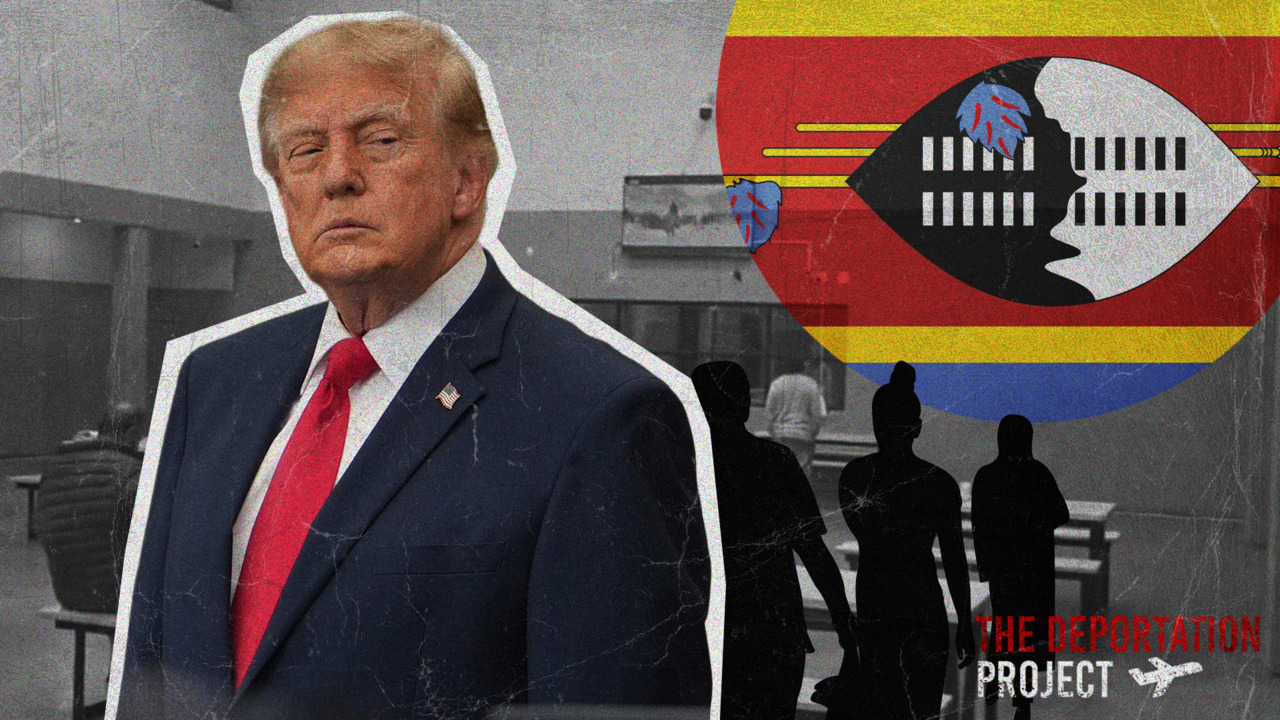
Protests are rare in the small southern African kingdom of Eswatini, and largely repressed. But that didn’t stop more than a hundred women from gathering on July 18, 2025 in front of the US embassy in Manzini, the economic capital of the country still widely known by its former name of Swaziland. “Come out, ambassador! Come out and talk with us!” they shouted. What the women wanted to talk about was the secret arrival of foreign “criminals” who had just been transferred to Swazi prisons. Fearing for the safety of their children, the demonstrators were demanding that these prisoners be sent back to the US – where they had just been deported from. Over the course of a year, four planes have discreetly touched down in Eswatini carrying 32 migrants deported by the administration of US President Donald Trump. Wedged between Mozambique and South Africa, this country is preparing to host 160 deportees in total. Watch moreICE, Trump and Africa: Secret deals, broken lives All of them will be held in the central prison of Matsapha, not far from Manzini. In a country where daily life is still largely shaped by tradition and where few dare to question the decisions of King Mswati III, the secret arrangement with Washington has nevertheless set off an outcry of rare force. “If South African media hadn’t announced it, we never would have known,” said Sibusiso Nhlabatsi. Determined to meet these migrants face-to-face, the lawyer has been turned away from the prison five times. A well-known attorney and human rights specialist as well as a former colleague of Thulani Maseko, a human rights lawyer shot dead in 2023, Nhlabatsi is not taking no for an answer. He took his case to the Supreme Court, which ruled in his favour in 2025. The government appealed the decision. In March 2026, the High Court of Mbabane finally authorised the detainees to see him. “They had been transported like a bag of potatoes – and even with a bag of potatoes, if you transport it from one country to another, there are concerns that you have to go through, there are standards that must be met,” Nhlabatsi said. “They’ve been thrown in prison, despite the fact that they have never committed a crime in Eswatini.” ‘Whether we sign or not, we're still going to get left here’ Nhlabatsi has since travelled every week to the brand-new wing of the high security prison in Matsapha. The detainees’ cases can be hard to untangle, as the detainees come from as far afield as Vietnam, Laos, Yemen, Cuba, Ethiopia, the Democratic Republic of Congo or Jamaica. The only thing they have in common is having been previously convicted by US courts – though Nhlabatsi stressed that they were not the monsters they were being made out to be. “Most of them have been rehabilitated, most of them have rehabilitation certificates,” the lawyer said. “It’s not like they were taken straight from jail in the United States of America and then deported. They have been living in American society.” The feeling of injustice is keenly felt behind the bars of Matsapha’s high-security prison. But not every detainee has the same strength left to fight for their return to their families in the US. The Deportation Project: behind the investigation on Trump administration’s mass deportations As part of a consortium of 26 media outlets coordinated by Forbidden Stories, RFI and FRANCE 24 spent six months investigating the secret deals struck between the administration of US President Donald Trump and several African countries. These “third countries” have agreed to host undocumented migrants detained by ICE and deported from the US. From Ghana to Cameroon and Eswatini, our journalists spoke to the people deported to countries utterly unfamiliar to them. Those who were the first to arrive are the most beaten-down by their fates. “I had never heard of Eswatini,” said Vietnamese deportee Dung Nguyen in an exclusive interview with FRANCE 24 and Forbidden Stories. "They ... asked us to sign some papers, and I refused to sign the papers. And they said, whether we sign the papers or not, we're still going to get left here." Nguyen was convicted of rape in 2011, and released in 2015. He has since married, bought a house and found work. Nguyen was living as a free man when he was arrested and bundled onto a military plane on July 16, 2025. Despite his newfound detention, he said, he is not subject to the same strictures of Swazi inmates – he watches TV, eats better meals and has access to social media. Under the supervision of prison staff, he can even leave the prison to go to the nearest shopping mall. The ‘Coca-Cola king’ Like Nguyen, most of the migrants held in this prison had never heard of King Mswati III, who has ruled the country since 1986. Over that time, he has earned another name for himself – the “Coca-Cola king”. It’s not hard to see why. Not far from the prison, the largest Coca-Cola factory on the African continent stretches across more than 6,500 square metres. A wholly owned subsidiary of the Coca-Cola Company, Conco Ltd is the kingdom’s single largest source of foreign currency. The royal family controls a 40 percent stake in Eswatini Coca Cola Beverages – the authorised bottler – through the Tibiyo Taka Ngwane sovereign wealth fund set up by king Sobhuza II in 1968. Read moreInvestigation: In Cameroon, the victims of Trump’s deportations face uncertain fates ‘An evil deal’ The US and Eswatini have seemed to enjoy a good relationship for decades. But according to Siboniso Mkhabela, the national organising secretary of the opposition People’s United Democratic Movement (PUDEMO), that relationship has taken a turn since Trump came to power. He described the agreement on migrant deportations struck between the US and Eswatini as “an evil deal". "Before Trump came into the White House, we were this close to achieving a milestone in our struggle," the opposition activist said. "This resolution was simply saying those who were involved in the killing of a human rights lawyer and many others during the unrest in June 2021 must be held accountable." But for many people, Washington has since kept its eyes firmly closed in the face of a regime that grows more repressive by the day in a monarchy that has never been so absolute as it is now. Watch moreLawyers and activists in Eswatini challenge government for accepting US deportees Mkhabela said that he can no longer wear a PUDEMO tee-shirt in public. Many opposition party supporters remain behind bars as a result of expansive counter-terrorism laws. Critics of the agreement between Washington and Mbabane point out that the deal was negotiated during the period when the second Trump administration was dismantling its USAID programme, on which Eswatini heavily relied – more than half of the kingdom’s national budget for its AIDS programmes were financed by the US. Backed into a corner, the government may have had little choice but to make a deal. While Swazi authorities have confirmed having received people deported from the US, the details of the deal have never been made public. But FRANCE 24 was able to obtain a copy of the document, signed on May 14 by Prime Minister Russell Dlamini. The agreement states that Eswatini will receive 160 migrants deported from the US, as well as the sum of $5.1 million “for reinforcing border and migrant migration capacity”. ‘How long are they going to stay?’ "The Nation is assured that these inmates pose no threat to the country or its citizens," government spokesperson Thabile Mdluli said, adding that the deportees were only “on transit” through the country. Justice Minister Prince Simelane insisted that the detainees would not be treated as prisoners, but as “guests of the king”. These statements have done little to stem the rising anger in Eswatini’s population, with many people expressing shock that the detainees are allowed to walk around the Matsapha shopping centre. “Why do they have better living conditions than other prisoners?” “How long are they going to stay in Eswatini?” “What’s going to happen if they have children with our women”? These are just a few of the questions that have been asked in Eswatini’s parliament in recent months. Mzwandile Masuku, the son of opposition leader Mario Masuku, has another question to add: what’s happened to the $5 million? “Our minister of finance is on record as having said that he had not seen the funds,” he said. “We cannot point to where the money was received and where those funds have ended up.” To display this content from YouTube, you must enable advertisement tracking and audience measurement. One of your browser extensions seems to be blocking the video player from loading. To watch this content, you may need to disable it on this site. Cover image: Sofia Alvarez Jurado, Forbidden Stories, Paris, September 21, 2026. © Screengrab 09:59 Questioned in parliament, ministers have given contradictory answers. Prime Minister Dlamini has stated publicly that there was no financial compensation, but that the agreement was intended to foster “better relations” between Eswatini and the US. The finance minister later clarified to say that the funds had been deposited into an account belonging to the National Disaster Management Agency, to which he does not have access. Government spokesperson Mdluli rejected repeated requests for an interview, saying that the information already shared with the public was sufficient. Masuku, whose father has been imprisoned on multiple occasions, knows that he has to be careful. But he has been working tirelessly with his colleagues for months now to have the deal overturned before all 160 deportees arrive in Eswatini. Whether he’s successful or not, the fact remains that Eswatini can’t keep these people behind bars indefinitely – and only five have returned to their home countries. Others hope to be granted permanent residency in the country they now find themselves in. But they’ll first need to shake off the image of “criminals” that the US has imposed on them. In Matsapha, the detainees know that their future no longer depends on the US justice system, but on the goodwill of a kingdom they had never in their lives imagined setting foot in. This article has been translated from the original in French. The Deportation Project: our full coverage
‘I had never heard of Eswatini’: Deported by the US to a country that rejects them
Full Article
Original Source
Read the full article at France24 →KhanList aggregates and links to publicly available news content. We do not host full articles from third-party sources. Always verify important information with original sources.