
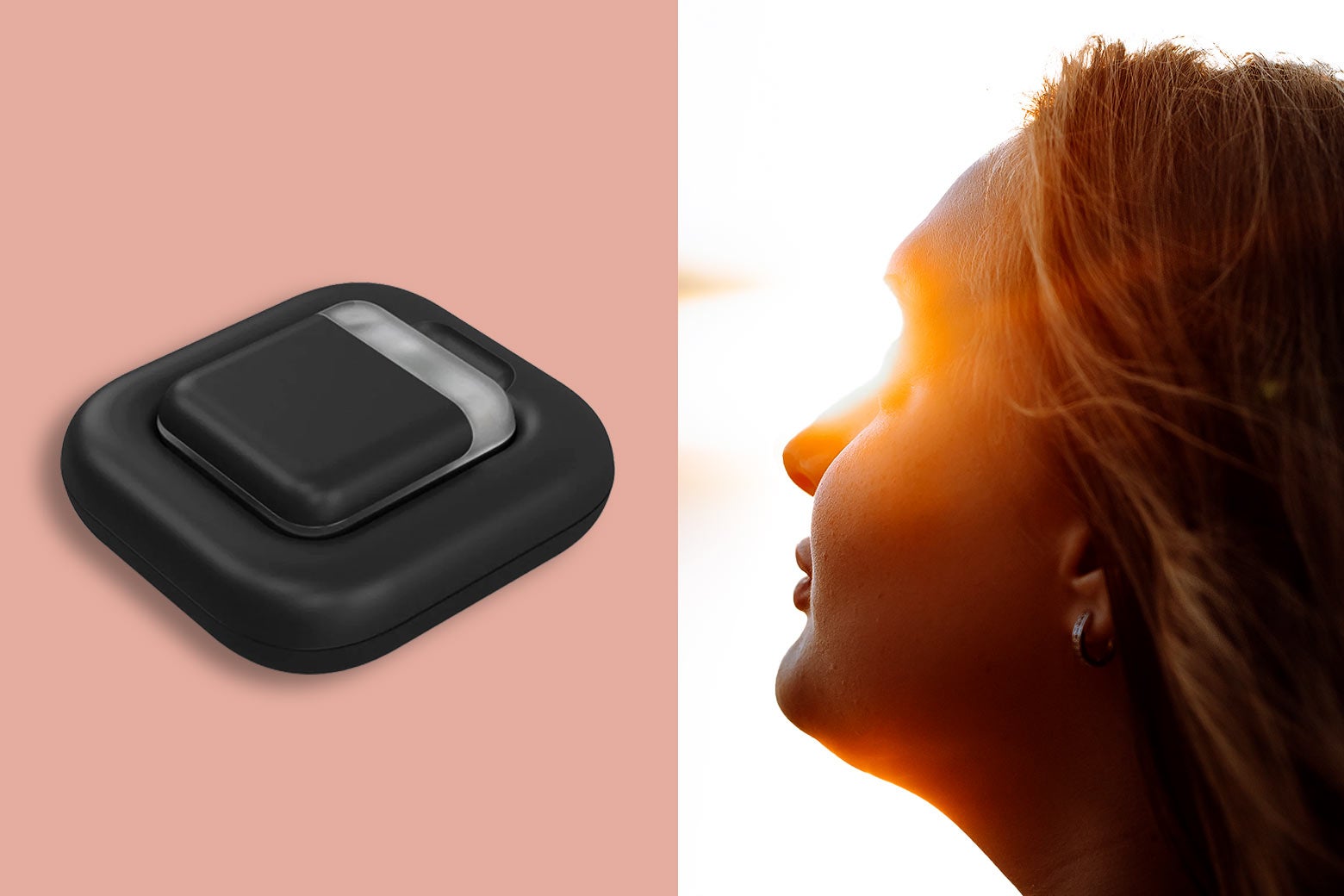
Life Let There Be Light I wore a light-tracking device to see if it could improve my health. I’m shocked by what it showed me. Photo illustration by Slate. Photos by Circadian Health Innovations and Iuliia Burmistrova/Moment. Sign up for the Slatest to get the most insightful analysis, criticism, and advice out there, delivered to your inbox daily. For years, I’ve suspected that light was having a major impact on my mood and metabolism. Midwinter, I’d watch the sun dip below the hills at 4 p.m. and feel the dread rising. Midsummer, I’d marvel at my energy and well-being. Seasons aside, I’d noticed that long days with the laptop led to sleepless nights. But my fixation on light and health really took off a few years ago, when some alarming studies dropped. People exposed to low amounts of natural sunlight have higher rates of all the big diseases—diabetes, obesity, cancer, heart disease, dementia, depression, you name it. Meanwhile, people exposed to high amounts of artificial light at night have higher rates of all the same ills. Those discoveries have led to an explosion of interest in using light as a healing modality. Red and infrared light is being used by everyone from dermatologists to dentists to accelerate healing, reduce inflammation, and improve metabolism. Green light relieves migraines, pain, and anxiety. Blue light increases cognition and alertness and has a marked effect on depression. Ultraviolet, the highest-energy wavelength, can damage skin cells and lead to skin cancer, but it also produces vitamin D and lowers blood pressure. Having written a book and countless articles about light science, I knew all this, but I still didn’t know how much of any particular kind of light I was getting in any particular environment. The light-meter app on my phone could give me a spot reading of overall light, but how much of that was blue and how much red? What about infrared or ultraviolet? I had no clue. It seemed strange that in an era when anyone can track their heart rate, aerobic capacity, blood oxygen level, and daily steps, we’re flying blind on this key component of health. My curiosity piqued when I saw a video by Roger Seheult, a California doctor who has been a pioneer in using light to improve patient outcomes. He was testing a new light-tracking wearable called MiEye. The device was developed by a team of scientists in Australia led by Sean Cain, who specializes in light and its impact on circadian rhythms. Most of that research used clumsy wristwatches that measure light, but Cain was frustrated by their limitations. They don’t differentiate sleep-suppressing blue light from other wavelengths, and they can’t detect infrared or ultraviolet light at all. They also tend to get covered by sleeves. So Cain invented the MiEye, a magnetic watch-sized chicklet that measures all the important types of light, including photopic (all visual light), melanopic (the bluish wavelengths that govern sleep and alertness), infrared, and ultraviolet. All these can be tracked on the MiEye through your phone. The device, which costs $399 and can be worn as a necklace, brooch, or clip, will be available to the public next year, but I got my hands on a prototype. With its insights, I hoped some helpful patterns would emerge. Maybe I could light my way to circadian bliss. For me, the first eye-opener was just how little light actually finds its way indoors. Light is measured in lux. A candle held at arm’s length delivers 1 lux of light to the eyes. At noon on my front lawn in Vermont on a crisp, clear fall day, 76,000 lux was pouring down on me. But when I stepped inside my house, just 172 lux had found its way inside. Less than 1 percent. That pattern held wherever I went. The local Walmart felt plenty bright inside, but it was just 200 lux. Grocery store? Eighty-eight lux. Hospital ward? A creepy 64 lux. Maybe Vermont wasn’t representative? I spent a few days in Manhattan to find out. It was no better. A modern office building was 190 lux. Warby Parker was 257. The subway was a grim 45 lux. Museums? You may as well be dead. I popped into a toney coffee shop in Midtown that was filled with warm wood, soft lighting—and a pathetic 7 lux. Thank god for the coffee. Outside, the skyscrapers blocked big chunks of sky, allowing only a few thousand lux to filter down—less than one twentieth of my country lawn. In natural settings, the sky goes from zero lux at night to thousands at dawn, and it often touches 100,000 lux in the middle of the day. I took the MiEye camping to get a sense of what that feels like. At dusk, the light plunged from 5,000 lux to 5 lux as soon as the sun dipped below the ridge, then reversed course at dawn. It bobbed around 3,000 lux in the woods during a hike (weirdly similar to the Manhattan canyons), then hovered around 30,000 lux in the car as I drove home. It was a friggin’ light spa, and it felt as good as that sounds. But there was more to the camping story than just overall light. The MiEye was also able to track infrared light, which makes up the majority of the sun’s rays, and is suspected to play a major role in health. Shine infrared light on skin, metabolism speeds up, inflammation drops. Cells make energy more efficiently, with less wear and tear. That has led some researchers to believe that one of the big benefits of natural sunlight is its infrared portion—and to worry that we might be suffering indoors from a kind of “modern-day scurvy,” as one expert put it. I began taking infrared readings wherever I went, and I quickly understood the concerns. Modern LED lighting produces no infrared light at all. Walmart, the mall, hospital corridors, the Met—nada. My house was barely better. Outside, readings were thousands of times higher, even in the woods. (Leaves reflect infrared light, so it is bouncing all around the understory.) I didn’t even need to expose my skin to reap the rewards—infrared passes fairly easily through clothing. When I moved the MiEye inside my shirt, 60 percent of the infrared still shone through. So is the secret to good health simply renouncing society and moving to the bush? Maybe—but that’s obviously not practical. Thankfully, my other MiEye revelation made it clear that circadian deliverance can be unlocked right in the cozy confines of the modern world—we just have to tinker with blue light. In ancient times, the only source of blue light was the sun. (The sky is blue because blue sunlight scatters off molecules in the atmosphere.) When it set, that was a signal to the brain to release melatonin, the sleep hormone, and to transition the body to rest-and-recovery mode. When it rose, blue light shut off melatonin and switched the body to high-energy mode. Without that big swing in blue light levels, our body clocks get muddled. This shows up not just in poor physical and mental performance, but also in higher rates of obesity, cancer, diabetes, depression, Alzheimer’s, Parkinson’s, heart disease, and even the big kahuna, death itself. To achieve a healthy circadian rhythm, experts recommend that we spend as many daylight hours as possible in more than 500 lux of blue light (the brightest office), and our evenings in less than 10 (one dim bulb). Unfortunately, in the modern world, we do just the opposite. We now spend, on average, more than 22 hours per day indoors in levels of light that don’t read as day or night. (Unless, of course, we sit near a window, which generally lets in thousands of beneficial lux during the day.) At night, the blue light emitted by LED bulbs in our homes can be a concern, but to my surprise, the MiEye showed me that the screens on my devices were not a big part of the problem. It takes about 25 lux of blue light to suppress melatonin production by 50 percent. A normal iPad screen at its brightest can exceed that, but most modern phones and tablets have “adaptive brightness” features that automatically adjust to the ambient brightness of the room. Additionally, most modern devices have “nightshift” settings that swap bluer tones for warmer red ones. With both adaptive brightness and nightshift settings turned on, I found that reading my iPad in bed with the lights off delivered a remarkably inconsequential 0.4 lux of blue light to my eyes. That still felt too bright in the dark room. When I banked it down to a comfortable level, it was just 0.1 lux—not enough to rattle even the touchiest sleeper, and it certainly did nothing to me. What about those who prefer print, or otherwise interacting with real human beings in something other than darkness? A “bright daylight” LED bulb will easily exceed 25 lux, and my bedroom lighting was no exception. But when I switched the bulb in my bedside lamp to a “warm” LED, which gets that golden look by producing mostly red and orange tones, it produced 18 lux of overall visual light (plenty for reading or gazing earnestly into the face of another), but only 6 of those lux were the bluish, sleep-crushing ones. I slept like a champ. (Which, it should be said, has been hard for me in the past.) In that sense, the MiEye gave me data that directly improved my life. I stopped worrying and came to love the firelike glow of my evening household and the ghostly flicker of my barely-lit screen in the black nothingness of night. I stopped worrying about blueblocker glasses, too. During the day, I got all the blue I could get, and at night, I just red-shifted away from it. I loved my improved sleep and mood most of all. Did I need an expensive, state-of-the-art wearable to tell me this? Not exactly. The prime takeaways it conveyed are common sense: Spend more time outside. Windows are your friend. Dimmer bulbs and screens in the evenings, preferably with golden light. For most people, tracking the specifics won’t matter as much as simply brightening their days and darkening their nights. And yet, you could say the same about diet and exercise, but that hasn’t stopped millions of people from benefiting from the constant reminders delivered by their wearables. No matter how much we know what we should be doing for our health and longevity, the modern world often pushes us in the wrong direction. And we don’t always realize how much we’re giving in until we see the data in front of our faces. So if you have a malady like insomnia or depression that might benefit from better light hygiene, or if you are an optimizer who has long suspected that something key has been missing from your routine, track your light. I think you’ll find it illuminating. Medicine Science Nature
I Got My Hands on a Tiny Device That Can Help Improve Nearly Every Aspect of Health. I’m Shocked by What It Showed Me.
Full Article
Original Source
Read the full article at Slate →KhanList aggregates and links to publicly available news content. We do not host full articles from third-party sources. Always verify important information with original sources.