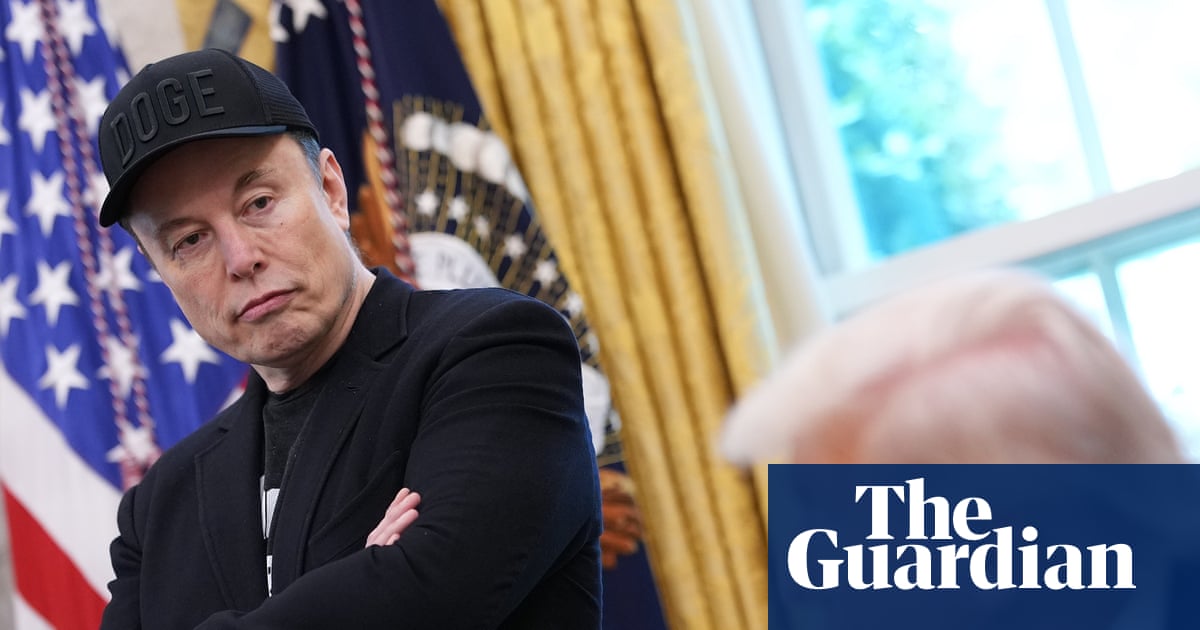
Elon Musk has admitted he became too consumed by politics during his volatile alliance with Donald Trump and his brief appointment as the president’s financial axman, running the so-called “department of government efficiency” (Doge).The world’s richest person, and briefly its first trillionaire after his SpaceX company floated on the US stock exchange in June, made the confession in a wide-ranging interview with the Economist published on Thursday. He shared his positions on subjects from foreign wars to AI, and made a number of eye-opening predictions for the future.“I got carried away, frankly,” Musk said of his relationship with the president, whom he helped get elected in 2024 with $200m in financial backing, then served during his controversial tenure as head of Doge, overseeing $150bn in “harmful” budget cuts and forcing tens of thousands of people out of federal jobs.The owner of Tesla did not expand on the statement, but appeared cognizant of the impact of his dalliance with the levers of power in Washington DC.In December, he offered in a podcast with Katie Miller, wife of Trump’s White House adviser Stephen Miller, that his wrecking-ball approach to the federal government had been only partially successful, and that given the opportunity he probably wouldn’t do it again.“I think instead of doing Doge, I would have basically worked on my companies,” he said at the time.Talking to the Economist, however, he appeared to relish the attention his political involvement had garnered, and the influence he believed he exerted. “People don’t realize that what I’m saying will come to pass,” he said, the outlet referring to Musk – at least in his own mind – as a modern-day Cassandra.The interview, a 90-minute conversation for the publication’s video platform The Insider, recorded at a Tesla factory in Texas, was Musk’s first since the SpaceX flotation, in which his personal wealth briefly topped $1.25tn before dropping back to a relatively penurious $750bn.He reflected on moving from “exhilaration to terror” in a single day, but was not referring to the SpaceX share price. Instead, he was talking about artificial intelligence, which he believes will ultimately render work by humans “optional”.AI systems and robots will eventually handle most digital and physical jobs, he said, and the merger of his own AI venture with SpaceX will allow him to develop systems to perform cognitive tasks such as software programming while Tesla manufactures humanoids.Musk, the Economist said, plans to power his AI venture with datacenters in space, which experts have warned will be “catastrophic” for Earth.Within five years, Musk said, AI intelligence systems may surpass the sum of all human intelligence. Within 10 years, robots in the workplace will help usher in an era of such “amazing abundance” that money will become meaningless.It was, however, Musk’s political views, and predictions, that were perhaps the most contentious parts of the interview. The UK, a country he has not visited for years, but whose politics, especially on immigration and race, have become a recent obsession, will become engulfed in a civil war within 20 years, he claimed.Asked if he was anti-Muslim, Musk attacked the questioner, a policy of diversion similar to that which has served Trump well, and which he has employed previously, notably calling the Guardian “irrelevant” when it decided to withdraw from his “toxic” social media platform X.“I’m against rape and murder. I’m against the imposition of rules and laws that are contrary to what we’ve come to accept in the west,” he said. “It’s a crying shame that traditional media, like you, don’t recognize this.”He described the media’s characterization of Europe’s far right as “false, misleading and nonsense”, and argued that it is made up of “normal people” seeking safe cities, secure borders and sensible spending, the Economist said.In an analysis piece accompanying the interview, the outlet acknowledged that Musk is a divisive figure. “His political views, disseminated to his 240m followers on X, strike many as plain-speaking and strike many more, including The Economist, as plainly bigoted,” it wrote.“But he is also one of a handful of men who are pioneering AI and who thereby have an outsize influence on its trajectory. When he speaks, he reflects the debates they are having. His datacentres in space could power AI’s future.“For all his political polemics, he has a record of being right about technology in fields such as electric cars, rockets and satellite communications that confounded other engineers and entrepreneurs.”Another Musk prediction: after AI destroys jobs, there may need to be a large-scale wealth redistribution to create “universal high income” for humans.He said he would be willing to pay “trillions in tax” then, conversely, argued that money will become irrelevant inside 10 years. In which eventuality, he said, governments should “issue people cheques”, because, he said, amid an infinite supply of goods and services produced by machines, deflation will be a bigger problem than inflation.He also shared thoughts about the Ukraine war, in which his Starlink satellites have been used to help that country’s military against Russia’s aggression. Despite this, Musk said any peace deal should include territorial gains for Russia.The interview concluded with an assessment by Musk of his achievements and ambitious current projects, in AI and in space, a field in which he has also made a number of bold predictions. He said in 2024 that humans can set foot on Mars by 2028 (currently Nasa is targeting 2028 for a return to the moon, which many analysts think is unlikely).The universe, Musk said, according to the Economist, could be a computer simulation created by aliens. “The things I’m doing are so preposterous that it’s hard to believe they’re real,” he said.
‘I got carried away’: Elon Musk expresses regret about Doge and wading into Trump’s orbit
Full Article
Original Source
Read the full article at Theguardian →KhanList aggregates and links to publicly available news content. We do not host full articles from third-party sources. Always verify important information with original sources.