
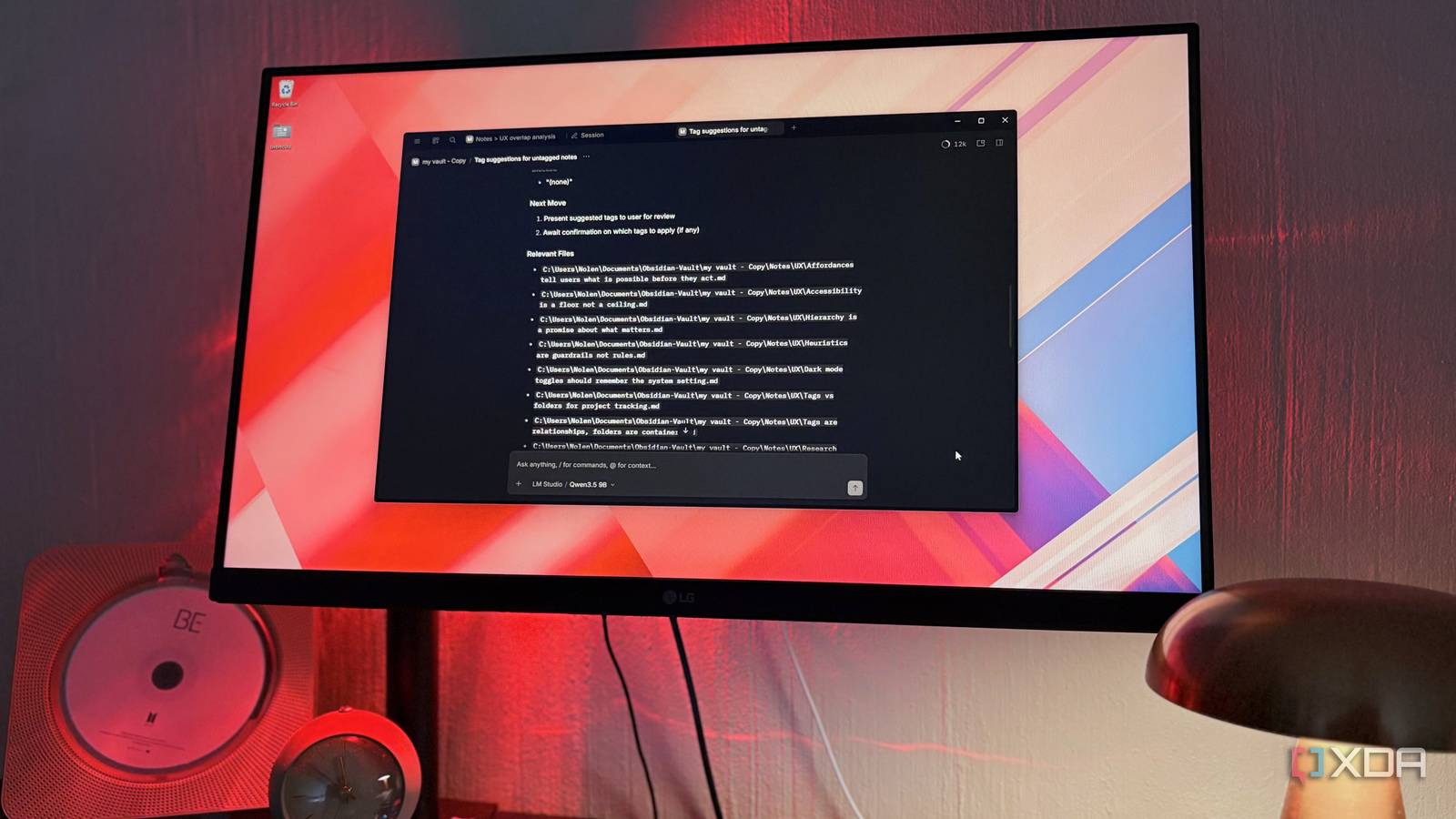
Published Oct 29, 2026, 12:31 PM EDT Nolen began their writing career in 2019, with three years dedicated to editing the Creative section at MakeUseOf. Their expertise lies at the crossroads of technology and creativity, covering areas like photography, video editing, and graphic design. Outside of work, you'll often find Nolen diving into a good book, writing their own stories, or playing video games. Even though Claude's made a lot of improvements with their rate limits this year, they still have a habit of showing up at the most inconvenient times. And it's not even because of anything complex, it's usually that the session got used up on chores, like checking what's in a large folder of files before tidying them up. Tasks like these honestly don't need Claude's best models though. A gaming PC like mine with an 8GB GPU can run surprisingly capable models locally. And OpenCode, Claude's free rival, can work with pretty much any local model you point it at. So the real question is whether my 9B models could handle that same grunt work that tends to shoot up my Claude usage. Getting my local models into OpenCode The desktop app makes it very simple Even though I've been getting used to running AI agents from the terminal, I decided to start using OpenCode's desktop app because that clickable UI will always be superior for visual workers like me. I run most of my local models via the LM Studio server, so the first step is loading my model in the Developer tab. I went with my tried-and-true Qwen 3.5 9B, but I also brought in my new favorite, Qwythos 9B, which is a Qwen model trained on Claude's reasoning. Both are quantized at Q4_K_M and both are pretty strong at tool calling too. And when I loaded them, I set the context length to around 30k, which is usually plenty for basic sessions and strikes a good balance on my hardware. OpenCode picks up models from LM Studio, Ollama, and vLLM automatically as long as they're running at their usual local addresses. My whole LM Studio library showed up in the Models tab of OpenCode's settings, and I toggled on the ones I wanted in the model picker. Hovering over a model there shows its context size and whether it supports tools which is important because tools are how OpenCode actually opens and edits files. Going local also sidesteps a restriction on the Claude side. You can't plug a Claude Pro or Max subscription into OpenCode, since Anthropic prohibits it. Letting a local model read through your files This is where 8GB VRAM will limit you pretty fast Before a coding agent can do anything useful, it has to read. OpenCode gives the model tools to search a folder and open files, and every file it opens gets added to the conversation, which can dig into the context limit pretty fast if you've set the context low. My first attempt was asking Qwen to find untagged notes across my entire Obsidian vault, which it couldn't handle. It kept opening files until the context ran out, and then OpenCode compacted the session, which is an automatic step that condenses the conversation (replaces it with a shorter summary) once the context is full. After each compaction, Qwen lost track of which notes it had already checked and started reading them again. So I just stopped it at that point and limited it to one small folder, which did end up working. The same held for a small habit tracker I vibe coded a few months back, for example, where asking what each file does got me a useful rundown. Qwythos reasons through a problem before it answers, which can make it a little slow. For example, in one session I asked for a rundown where my notes overlapped, and it took over six minutes to complete its response. But it ended up coming back with two notes I never would have thought to connect and suggested linking them. I don't think this replaces Claude for a big project, and I'm still not sure how many files it can take before it starts to struggle. But it works; your biggest contraint here will be your hardware and the models you can run. Letting local models edit my files The chores are always what ate my Claude sessions OpenCode makes edits to specific lines and shows a diff of what changed. It also takes snapshots of file changes by default, so anything the agent does can be undone within the session. I asked both models to make some changes and add things like tags to my files without touching anything else. Both Qwen and Qwythos showed off their instruction adherence because both did exactly what I asked for without touching the rest, which is something even some flagship cloud models overstep sometimes. Also, OpenCode's diff made it easy to see exactly what they touched. Where they slipped was formatting. A 9B model will follow your instructions very literally, so it can make a change that looks right in the diff but uses syntax the app reading that file doesn't recognize, for example. That's why I open the file in whatever app actually uses it before considering the edit done, instead of assuming the model's summary understood the full context. Context token limits apply here too. OpenCode's context meter showed eight file reads already taking up around 17k, so this kind of forces me to treat one session as good enough for only one file or a smaller batch of files, and rather starting a fresh one for any new task. This still covers plenty of cases, like fixing a button label across just a couple of files in the codebase. These are actually the type of chores that drain my Claude usage. Pro runs on a rolling five-hour window plus a weekly cap, and both pull from one pool shared by claude.ai, Claude Code, and the desktop app. I'd estimate that moving just the chores over frees up maybe a quarter of my weekly usage, possibly a third on heavy weeks. But Claude still gets the hard work I still reach for Claude for anything that needs a little more horsepower, but my GPU can surprisingly handle the smaller boring tasks that easily stack up in Claude, draining my usage. I don't plan on upgrading my hardware any time soon, so I have to rely on somewhat outdated models, but they get the job done just fine. OpenCode
I gave OpenCode a local model on my 8GB card, and stopped worrying about hitting Claude's rate limits
Full Article
Original Source
Read the full article at Xda-developers →KhanList aggregates and links to publicly available news content. We do not host full articles from third-party sources. Always verify important information with original sources.