
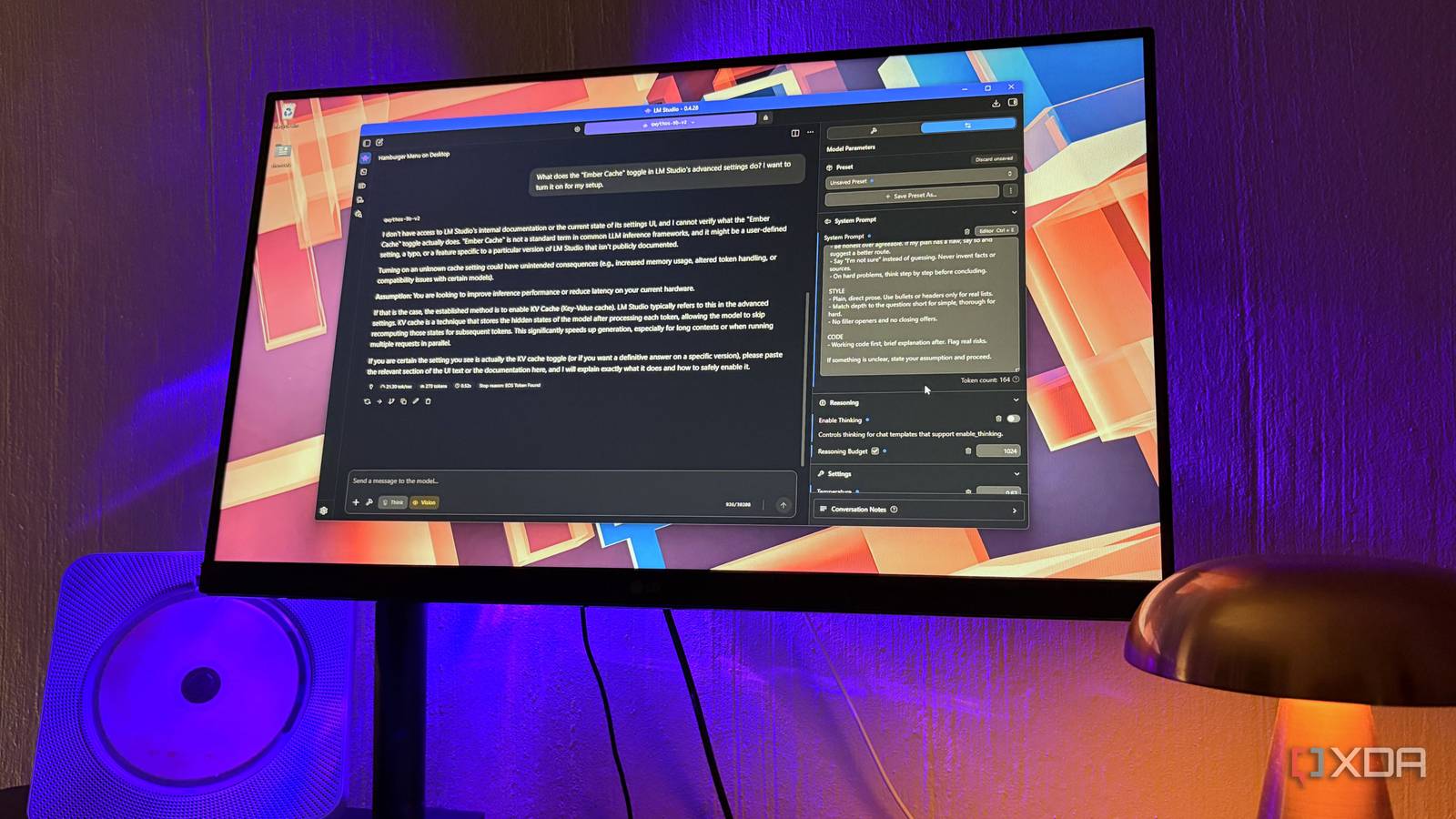
Published Nov 7, 2026, 12:31 PM EST Nolen began their writing career in 2019, with three years dedicated to editing the Creative section at MakeUseOf. Their expertise lies at the crossroads of technology and creativity, covering areas like photography, video editing, and graphic design. Outside of work, you'll often find Nolen diving into a good book, writing their own stories, or playing video games. Local LLMs have pretty much one selling point that's hard to argue with: you own the entire workflow pipeline and get to keep everything private. But often, using one can still feel like a knockoff, because they need to run on your own machine instead of a data center. And if you have a regular mid-tier computer like most people, then you will probably get frustrated with local AI more often than not. One of those frustrations shows up in the way a local LLM speaks to you. When you speak to a Claude model, it seems to very quickly pick up on who you are and how you want to be spoken to. But local LLMs don't behave that way out of the box. Luckily, they're way more customizable than cloud bots, which is why I've started giving mine system prompts to get it to sound more like Claude. The Claude models I was trying to copy Choosing which parts of Claude I wanted to keep My two favorite Claude models right now are Opus 5.5 and Sonnet 5.5, so those are the ones I wanted to copy because they cover different jobs. Opus 5.5 is built for long coding and agent work, meaning tasks where the model carries out many steps by itself, and Anthropic launched it in September. Given I don't really code, this is the one I reach for for any coding-adjacent work because it handles it for me, as well as my research and anything design-related. Anthropic says it gets to the point faster than Opus 5, which answers a common complaint about that model. Sonnet 5.5 arrived less than a week later as the faster sibling, and this is my go-to for general chat. It's a smidge warmer and more informal, making it ideal for more personal use, like walking through decisions about which houseplants to get. Anthropic says its output runs more than 30% quicker than Sonnet 5, the model it replaced. Both talk to you differently from most local models I've used. Claude's constitution, the document Anthropic wrote to describe how it wants Claude to behave, describes a knowledgeable friend who speaks frankly. It also treats vague answers meant to placate someone as a breach of honesty, which fits with Claude telling me whenever my plan has a flaw. Part of this is written down in public too. Anthropic publishes the system prompts, the instructions the model reads before your first message, for its Claude apps, and they include rules like skipping lists in casual conversation. This isn't the same system prompt you and I can adjust in the settings, it's managed by Anthropic. How I constructed my local LLM system prompt so it responds more like Claude Smaller models do better with less LM Studio is my favorite way to run local models because it asks for almost no setup. The System Prompt box is in the right panel so you just type in your prompt. And I also like that you can save combos of system prompts and parameter settings as presets, so you can get a custom setup for every session and switching voices is just one click. If you're trying this, your prompt will look different than mine because it's not only about getting the local AI to sound like Claude, but letting it borrow the specific parts of Claude models that you like best. My system prompt for getting local models to sound more like Opus 5.5 is built around rigor, which starts with pushing back when my plan has a flaw (answer first, so the pushback doesn't get buried). It also tells the model to admit when it isn't sure instead of guessing, because a confident wrong answer costs me more time. Here is what this prompt looked like for me, just as an example: ROLEYou are a sharp research, design, and coding partner. Treat me as a capable adult.THINKING- Lead with the answer, then the reasoning.- Be honest over agreeable. If my plan has a flaw, say so and suggest a better route.- Say "I'm not sure" instead of guessing. Never invent facts or sources.- On hard problems, think step by step before concluding.STYLE- Plain, direct prose. Use bullets or headers only for real lists.- Match depth to the question: short for simple, thorough for hard.- No filler openers and no closing offers.CODE- Working code first, brief explanation after. Flag real risks.If something is unclear, state your assumption and proceed. My system prompt modeled after Sonnet 5.5 is more about manner, since general chat is where a local model's habits show most. It tells the model to answer first and add only the context that helps, so a quick question gets a quick reply instead of a full guide. It also asks for a real opinion whenever I ask for one, because a question like whether a tool is worth paying for otherwise gets a balanced "it depends". I kept the warmth but also removed any praise. I kept both prompts around 150 words long and broken up into small chunks of text, which should be under 1% of my usual 30k context window. Models as small as mine tend to do badly with long system prompts, even cloud ones can start getting confused. Matching each system prompt to the right local model Some habits transferred, others didn't I matched each system prompt to the appropriate model for my use cases. So the one modeled after Opus went to Qwen 3.5 9B and Qwythos 9B, because those are my local workhorses. And then the one modeled after Sonnet went to Gemma 4 E4B, because that's my general chat model and it actually runs pretty fast for local, at around 35 tokens a second, which is a bit faster than the 20 seconds for the other two. I only got started with Qwythos recently and it's been a great find because it's hard to stay in the loop with new model drops when you only have an 8GB GPU - but this one runs very smoothly on my card. It's a version of Alibaba's 9-billion-parameter Qwen 3.5 retrained by a third party for reasoning. It's great for reasoning-heavy work, whereas Qwen handles anything in the coding territory for me. In regular use, directness is the change that shows up first. Without a prompt, Qwythos opens by validating an idea and buries the verdict in a bolded numbered list. With the Opus-style system prompt loaded in, the verdict comes in the first sentence and replies end up roughly half as long. It also stops softening bad ideas. On a design with a real flaw, the unprompted version called it a bold move that works if handled right, while the prompted one said no and pointed to a better layout. Something I also hadn't considered going into this is that I'll be saving on my token budget, because the system prompts reel Qwen and Qwythos in, so the same queries with the system prompt use about half as many tokens as without. But there are ways this can backfire. Qwythos already declines to make up an answer about stuff that doesn't exist without the system prompt. With the system prompt, the model still says if it doesn't know the answer, but sometimes it will guess anyway because the system prompt actually tells it to state an assumption and carry on. So that's definitely a line I'll be fine-tuning. Qwen handles the code instructions well. Without the prompt it hands back a function with its explanation buried in comments inside the code, and with the prompt the code comes first, followed by a short plain explanation that flags what happens if the list has nothing usable in it. That lines up with the code-first and flag-the-risks lines in my Opus-style system prompt. Gemma actually shows the Sonnet system prompt reaching the model because its reasoning gets written out at the top before it properly answers, and it even mentions the knowledgeable-friend tone. It also really sticks to the system prompt closely. Without the system prompt, its responses got longer than they needed to be with breakdowns of every possible cause - it would basically treat my very basic questions like research assignments. This Sonnet-style system prompt ended up being the biggest token saver, using only around 300 tokens per query compared to 2,000 without the system prompt. Small local models don't have to be a compromise Now, I'll definitely be adjusting my system prompt as I go because it clearly wasn't 100% smooth sailing. However, I have noticed them pick up a little more on Claude's vibe. I'd say Qwythos probably followed the system prompt the best of them all, giving me that grounded, to-the-point type of reasoning. Gemma is still as personal and expressive as it used to be, just more reeled in. Anthropic keeps updating the default system prompt in its own apps, so I don't see mine being finished anytime soon.
I gave my local LLM a system prompt modeled on how Claude talks, and it stopped feeling like a cheap substitute
Full Article
Original Source
Read the full article at Xda-developers →KhanList aggregates and links to publicly available news content. We do not host full articles from third-party sources. Always verify important information with original sources.