
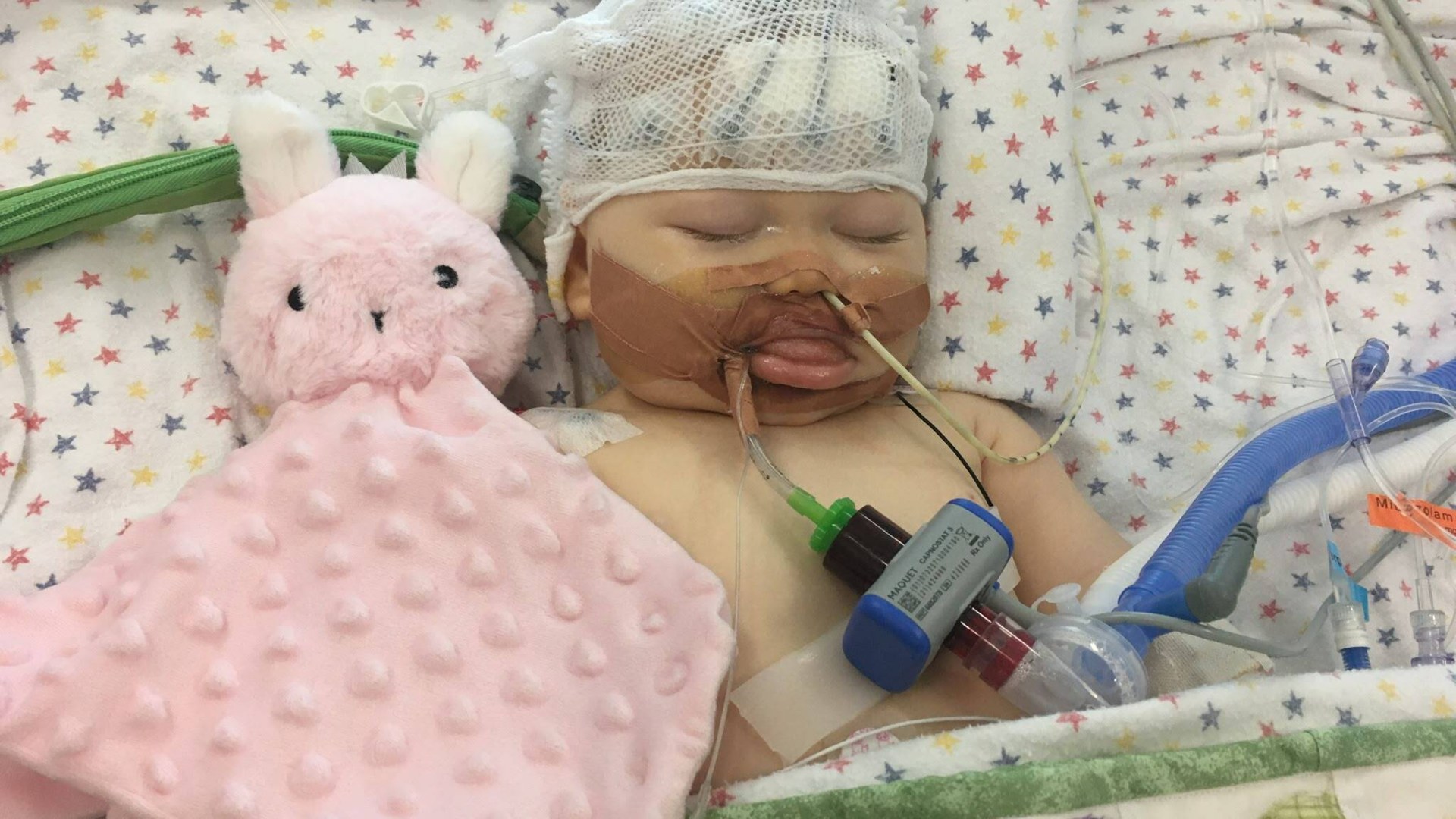
IT was any normal day in the Macdonald household, as Stephanie, 43, prepared snacks for her two little girls – Rani, eight months old, and Millie, three. But moments later, chaos ensued as she and husband Rogan, 46, desperately tried to save little Rani’s life in what would be every parent’s worst nightmare. Rani Macdonald’s life changed forever when she was just three months old Credit: Supplied Rani started choking on a piece of food when her mum turned her back for a second Credit: Supplied “A few months earlier, we’d started introducing Rani to solid foods,” says Stephanie, who lives in Corindi Beach, New South Wales, Australia. “She loved purées, soft fruit and vegetables, and with her two tiny front teeth she happily chewed everything we offered her. “I’d sliced up some mango and avocado and watching Millie sitting at the kitchen bench and Rani in her highchair enjoying afternoon tea together filled my heart.” It was April 2020. Stephanie says: “While they were eating, I turned away for just a few seconds to gather ingredients from the pantry and get a head start on dinner. “Then I noticed the room had fallen eerily silent. “When I turned around, I was horrified to see Rani gasping for air. “I ripped her from her highchair and desperately tried to remove the piece of mango from her throat with my fingers. “I patted her back and did everything I could think of, but the fruit was lodged too far back for me to reach.” To this day, the family don’t know if the incident was brought on by Rani choking on the mango alone, whether she had an allergic reaction to the fruit, or whether it was a combination of both. “I performed back blows, praying it would dislodge, but nothing worked,” the mum said. “Panicking, I ran outside to the backyard where my husband, Rogan, was building the girls a cubby house. Her mum tried everything but she couldn’t get the piece of mango out of Rani’s throat Credit: Supplied Rani was left without oxygen for 18 minutes and suffered a brain injury as a result of this Credit: Supplied “I screamed that he needed to come and help as Rani was choking.” As Rogan took over trying to revive her, Stephanie called the emergency services. By then, Rani had stopped breathing and was turning blue. The emergency operator instructed Rogan, who had first aid training through his work as a coal miner, to immediately begin CPR. For 18 agonising minutes, he worked tirelessly on Rani as she lay motionless, while Stephanie prayed she would survive. When paramedics arrived, they took over before rushing Rani to Emerald Hospital in Queensland, where doctors stabilised her. Two retrieval doctors were flown from Brisbane before Rani was transferred 829 kilometres by Royal Flying Doctor Service aircraft to Queensland Children’s Hospital, with her mother by her side. A team of specialists immediately whisked her away for emergency tests before placing her into an induced coma. Stephanie said: “The following day Rogan and Millie made the long drive to the hospital to be with us. “But four days later we received devastating news. Rani had suffered a diffuse hypoxic ischaemic brain injury.” Rani had been without oxygen for 18 minutes while the piece of fruit was lodged in her airways. “The lack of oxygen had caused catastrophic damage to her brain,” says Stephanie. Pictured on her parents’ wedding day, Rani, now 6, was left with several health issues as a result of the incident How to stop a child from choking Choking in young children most often happens while they’re playing or eating. The best way to avoid this is to make sure small objects like marbles and beads are kept out of children’s reach. To avoid choking while eating, think about size, shape and texture when preparing your child’s food. No matter how careful you are, your child may choke on something. NHS tips on choking If you can see the object, try to remove it. Don’t poke blindly or repeatedly with your fingers. You could make things worse by pushing the object further in and making it harder to remove. If your child’s coughing loudly, encourage them to carry on coughing to bring up what they’re choking on and don’t leave them. If your child’s coughing isn’t effective (it’s silent or they can’t breathe in properly), shout for help immediately and decide whether they’re still conscious. If your child’s still conscious, but they’re either not coughing or their coughing isn’t effective, use back blows or chest thrusts (babies under 1 year), or back blows or abdominal thrusts (children over 1 year). You may need to use more than 1 method to stop choking. It doesn’t matter which order you do these methods in. If one method doesn’t work, try another. Keep trying each method until the object comes out. There’s also plenty of advice on how to prepare food safely for your child here – Preparing food safely for babies – Best Start in Life – NHS Source: NHS “We were told our beautiful baby girl would never walk, talk or eat independently again. “Our world just collapsed around us. All the hopes and dreams we’d had for our girl were shattered.” The next day, doctors began bringing Rani out of her coma. Nobody knew if she would survive. But against all odds, she started breathing on her own. Stephanie said: “All I could think was, thank God she’s still with us.” Further testing confirmed Rani was tetraplegic, meaning she had lost movement in both her upper and lower body. She was also diagnosed with dystonia and hypertonia, the former causing involuntary muscle contractions and the latter causing muscle stiffness. She also had a seizure disorder and multiple other complex medical conditions. Her brain injury left her non-verbal, vision and hearing impaired, and dependent on tube feeding. Stephanie said: “In the weeks following her injury, Rani was constantly distressed while doctors worked to find the right medications to manage her symptoms. “Watching her cry in pain and discomfort was absolutely heartbreaking. We just kept whispering over and over to her that we loved her. “She had nine days in intensive care, and then she was moved for a six-week stay on the hospital ward, where we learned how to care for our beautiful daughter. “Then we moved to a children’s hospice, where we were finally able to begin processing everything that had happened together as a family with Millie. “We had to gently explain to her that Rani had an accident and now she needs lots of love. “Four weeks later, we returned home and while Rogan went back to work, I became Rani’s full-time carer until funding was approved five months later, allowing us access to support workers and therapists who became an important part of our family’s journey.” Rani has no movement in her upper or lower body and is also non-verbal Credit: Supplied Rani is pictured here with her new baby brother Oakie Credit: Supplied Despite the tragic event, Rani continues to smile, laugh and inspire everyone she meets. Stephanie says: “Life continued to bring beautiful moments. In June 2023, Rogan and I were married, with our two precious daughters proudly walking beside us as flower girls. “And for Rani’s fourth birthday that September, Make-A-Wish Australia created an unforgettable celebration for her. “She adores animals, and they organised a beautiful barnyard picnic where she cuddled ducklings, lambs and bunnies and all kinds of farm animals. It was one of the happiest days we’d shared as a family.” In April 2024, the girls proudly became big sisters to their little brother, Oakie. Stephanie said: “Rani is now six and she can smile and laugh. “Although she is completely dependent on others for every aspect of her care, she continues to amaze us every single day. “Millie is constantly by her side, looking after her, and little Oakie smothers her in love.” Since Rani’s accident, Stephanie has connected with several other families whose children also suffered devastating brain injuries after choking on mango. She said: “To this day, doctors still don’t know whether Rani’s injury was caused by choking alone or whether a severe allergic reaction also played a role, although she had eaten mango before without an obvious reaction. To this day, doctor’s don’t know whether Rani’s injury was caused by choking alone or whether an allergic reaction also played a role Credit: Supplied How to perform CPR on a child Step 1 – After you have performed a primary survey, (check for response, open the airway and check for normal breathing and signs of life for no more than 10 seconds). If you find that the child is unresponsive and not breathing, you should ask a helper to call 999 for emergency help while you start CPR. Ask a helper to find and bring a defibrillator, if available. Do not leave the child to make the call or to look for a defibrillator, unless you do not have a mobile phone and there is no help available. If this happens, go for help after giving one minute of CPR. If you are on your own, you need to give five rescue breaths first, then dial 999 on a speaker phone and start chest compressions. If you don’t have a speaker phone, give one minute of CPR before calling 999. Step 2 – Start CPR. Place them on a firm surface and open their airway. To do this, place one hand on their forehead to tilt their head back and use two fingers from the other hand to gently lift the chin. Step 3 – Give five initial rescue breaths. Take the hand from the forehead and pinch the soft part of the nose closed, allowing the mouth to fall open. With the head still tilted, take a breath and put your mouth around the child’s, to make a seal. Blow into their mouth gently and steadily for up to one second, until the chest rises. Remove your mouth and watch the chest fall. That’s one rescue breath. Do this five times. Step 4 – You will then need to give 30 chest compressions. Kneel by the child and put one hand in the centre of the child’s chest. Push down a third of the depth of the chest. Release the pressure allowing the chest to come back up fully. Repeat this 30 times at a rate of 100 to 120 compressions per minute. The beat of the song ‘Stayin’ Alive’ can help you keep the right rate and the emergency medical advisor will tell you what speed you need to push at. Step 5 – After 30 compressions, open the airway and give two breaths. Keep alternating 30 compressions with two breaths (30:2) until: emergency help arrives and takes over the child starts showing signs of life and starts to breathe normally a defibrillator is ready to be used. It is vital that you perform rescue breaths as a cardiac arrest in a child is likely caused by a respiratory problem. Step 6 – If the helper returns with a defibrillator, ask them to switch it on and take the pads out while you continue with CPR. They should remove or cut through clothing to get to the casualty’s bare chest. They also need to wipe away any sweat. The defibrillator will give voice prompts on what to do They should attach the pads to the casualty’s chest by removing the backing paper. Applying the pads in the positions shown. The first pad should be on the upper right side below the collarbone. The second pad should be on the casualty’s left side below and in line with the armpit. The defibrillator will analyse the heart’s rhythm. Stop CPR, and make sure no one is touching the casualty. It will then give a series of visual and verbal prompts that should be followed. If the defibrillator tells you that no shock is needed, continue CPR for two minutes before the defibrillator re-analyses. If the defibrillator tells you that a shock is needed, tell people to stand back. The defibrillator will tell you when to press the shock button. After the shock has been given, the defibrillator will tell you to continue CPR for two minutes before it re-analyses. Step 7 – If the child shows signs of becoming responsive such as coughing, opening eyes, speaking, and starts to breathe normally, put them in the recovery position. Monitor their level of response and prepare to give CPR again if necessary. If you have used a defibrillator, leave it attached. Source: St John Ambulance “I never imagined that a simple piece of fruit could change our lives forever. “We are incredibly grateful that Rani is still here and our focus now is giving her the happiest, fullest life possible. “She attends mainstream school alongside her sister, supported by an incredible school learning support officer. “The school have been amazing, they have really embraced who she is, and she feels like she truly belongs. “She loves disability surfing, animals, playgrounds, swings and racing down slides, has a huge circle of friends at school, and is adored by everyone who meets her. “She may not be able to tell us how she feels with words, but she’s our little warrior and her smile says everything.” To follow Rani’s journey, visit Hope 4 Rani on Facebook.
I gave my baby girl a piece of mango to snack on… it robbed her of her life – she will never walk, talk or eat again
Full Article
Original Source
Read the full article at Thesun →KhanList aggregates and links to publicly available news content. We do not host full articles from third-party sources. Always verify important information with original sources.