
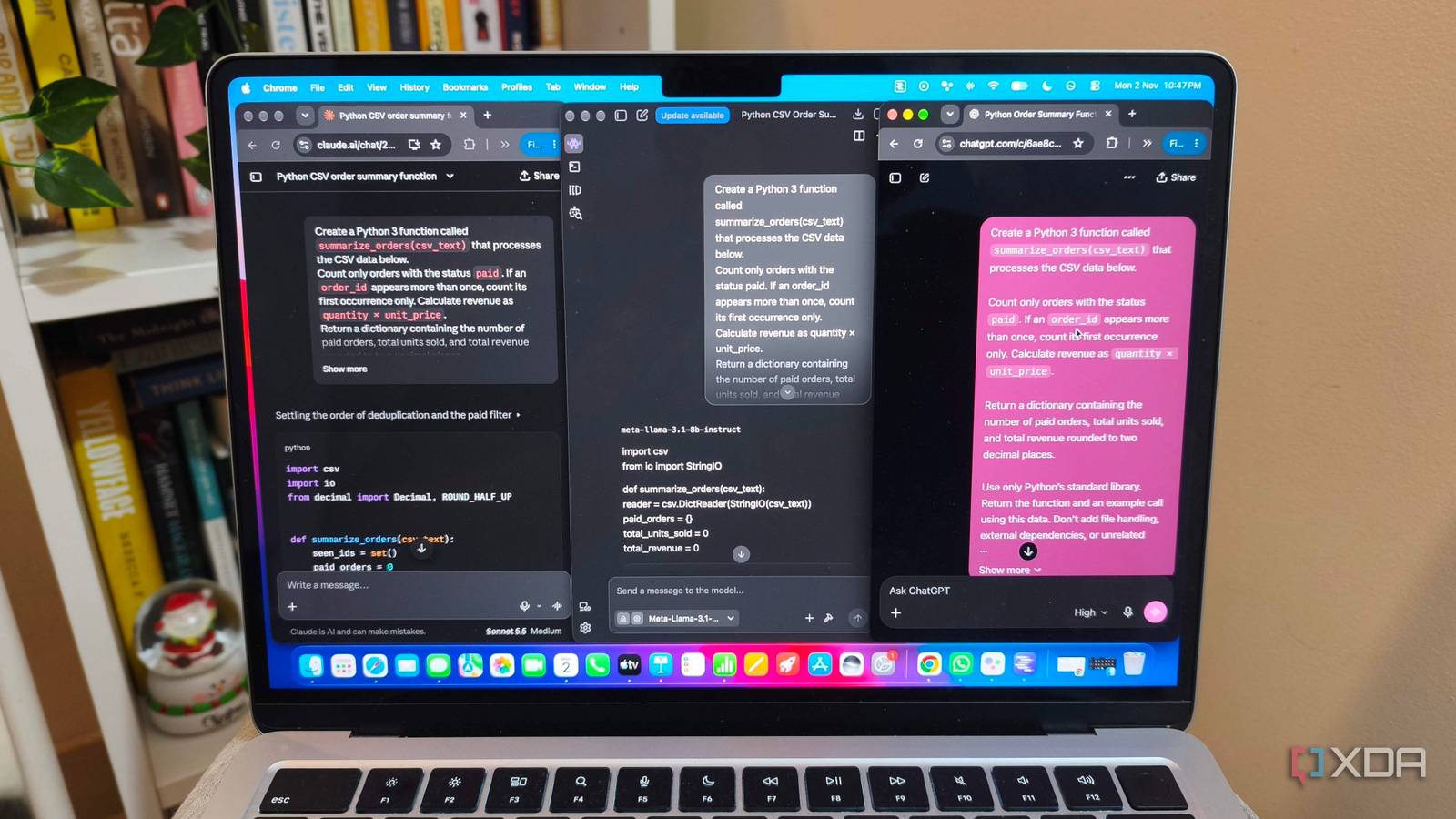
Published Nov 3, 2026, 2:00 PM EST Anurag is an experienced journalist and author who’s been covering tech for the past 5 years, with a focus on Windows, Android, and Apple. He’s written for sites like Android Police, Neowin, Dexerto, and MakeTechEasier. Anurag’s always pumped about tech and loves getting his hands on the latest gadgets. When he's not procrastinating, you’ll probably find him catching the newest movies in theaters or scrolling through Twitter from his bed. As we head into 2027, Anthropic’s Claude and OpenAI’s ChatGPT both make a convincing case for a subscription. I personally use ChatGPT more because I can get more done within its usage limits than I can with Claude. But if you’re a tinkerer like me with a local model running on your computer, you also have to ask whether you need to pay for either. So I gave Claude, ChatGPT, and the Qwen3.5-9B model running through LM Studio the same 20 tasks I regularly do, including coding, troubleshooting, and automation. I compared the responses for accuracy, how much I could actually use, and how much guidance each needed to finish the task. I wanted to know which subscription earned its place, and whether the free local option could save me the expense. I started with the everyday requests Small tasks gave me a baseline I use AI for plenty of small jobs when I’m tinkering with my self-hosted setup. I regularly ask it to explain a configuration setting, help me understand an error, or generate a short function for something I’m building. These requests make up a useful part of my everyday AI use, so I included them in the comparison. I wanted to see how much the models differed on work that shouldn’t require extensive reasoning or a long conversation. For coding, I started with requests where I could describe exactly what I needed. Giving the local model a function’s inputs, expected output, and any constraints gives it a reasonable chance of producing useful code. It also handles general technical questions and explanations of short code snippets. I still need to check its answers, but keeping the scope small makes that manageable. The difficulty increases when I ask it to make decisions about a larger task. If I want to add a feature, I get further by breaking it into individual changes and asking the model to handle each one separately. That works, although I’m doing much of the planning myself. I have to decide what information it needs, supply that information, and check whether each change fits the rest of the project. ChatGPT gives me useful help with less of that preparation, even on its free tier. Claude also handles these smaller requests well, although they give me fewer reasons to pay than the more demanding work does. The local model gets enough right to remain useful for narrow questions and small coding jobs. Claude pulled ahead on the bigger jobs Following through takes more than code Most of the projects I use AI for involve changing something that already exists. If I need to use AI to add a feature to an app, it needs to understand the current code, find the relevant files, and make changes that work together. If something breaks, the model should be able to investigate the problem and continue. I’ve used Claude Code to build a shared grocery app for my family, with sign-in, a shared list, and reminders. That kind of project involves enough connected decisions that checking individual code snippets only tells me so much. I need help carrying a feature through the app and getting it working. Claude gives me the most usable assistance with that work, and I spend less time correcting its approach. The same applies when I give the model access to tools. You can connect an MCP server to make its tools available, but the model still has to choose the right tool, supply the right arguments, and understand the result. Browsing adds another layer – it needs to find relevant information and use it to complete the request. I get the most consistent results from Claude across these longer sequences. My local 9B model struggles so much with them that I can’t rely on it to carry the task through. ChatGPT is also useful for these tasks, and I still use it for a lot of technical work. In my experience, Claude's advantage is how directly its help translates into progress. With the local model, I spend too much time supervising decisions and checking whether it has actually accomplished what I asked. The tasks made the differences clearer Claude needed less help to finish To get into the details of which model performed better across the tasks, let’s look at five examples that show where the differences became most obvious. I started with a Python function that I needed to process analytics data. Claude and ChatGPT easily handled the request. The local 9B model also produced usable code, although I had to correct its course multiple times. Next, I asked them to help troubleshoot a Docker container that wouldn’t start. Claude gave me the clearest direction for investigating the configuration and logs. ChatGPT provided equally useful troubleshooting help. The local model could explain individual errors, but needed a lot of handholding and often gave outdated instructions and commands. For the app-development task, I asked them to help add a feature to my family’s grocery app. Claude handled the connected changes most effectively and needed fewer corrections. ChatGPT remained useful for implementation and debugging. With the local model, I had to break the feature into smaller changes and take responsibility for how they fit together. I also included an n8n workflow for identifying emails that needed a reply. Claude gave me the most usable JSON for connecting the steps and troubleshooting the workflow. ChatGPT also handled the logic competently. The local model couldn’t do the full workflow, although checking individual messages against predefined criteria remained a more realistic job for it. Finally, I asked them to research a self-hosted app using its current documentation. Claude and ChatGPT made much better use of browsing tools. The local model needed considerably more supervision to find and use the information, which reduced the benefit of handing it the task. Claude earns the subscription for me Claude’s tighter usage limits frustrate me, and I still reach for ChatGPT more often. But when I need help finishing a complicated project, Claude gives me usable results with fewer corrections. That’s enough to justify the subscription for me, even with a free local model sitting on my computer.
I gave Claude, ChatGPT, and a local 9B model the same 20 tasks, and only one was worth paying for
Full Article
Original Source
Read the full article at Xda-developers →KhanList aggregates and links to publicly available news content. We do not host full articles from third-party sources. Always verify important information with original sources.