
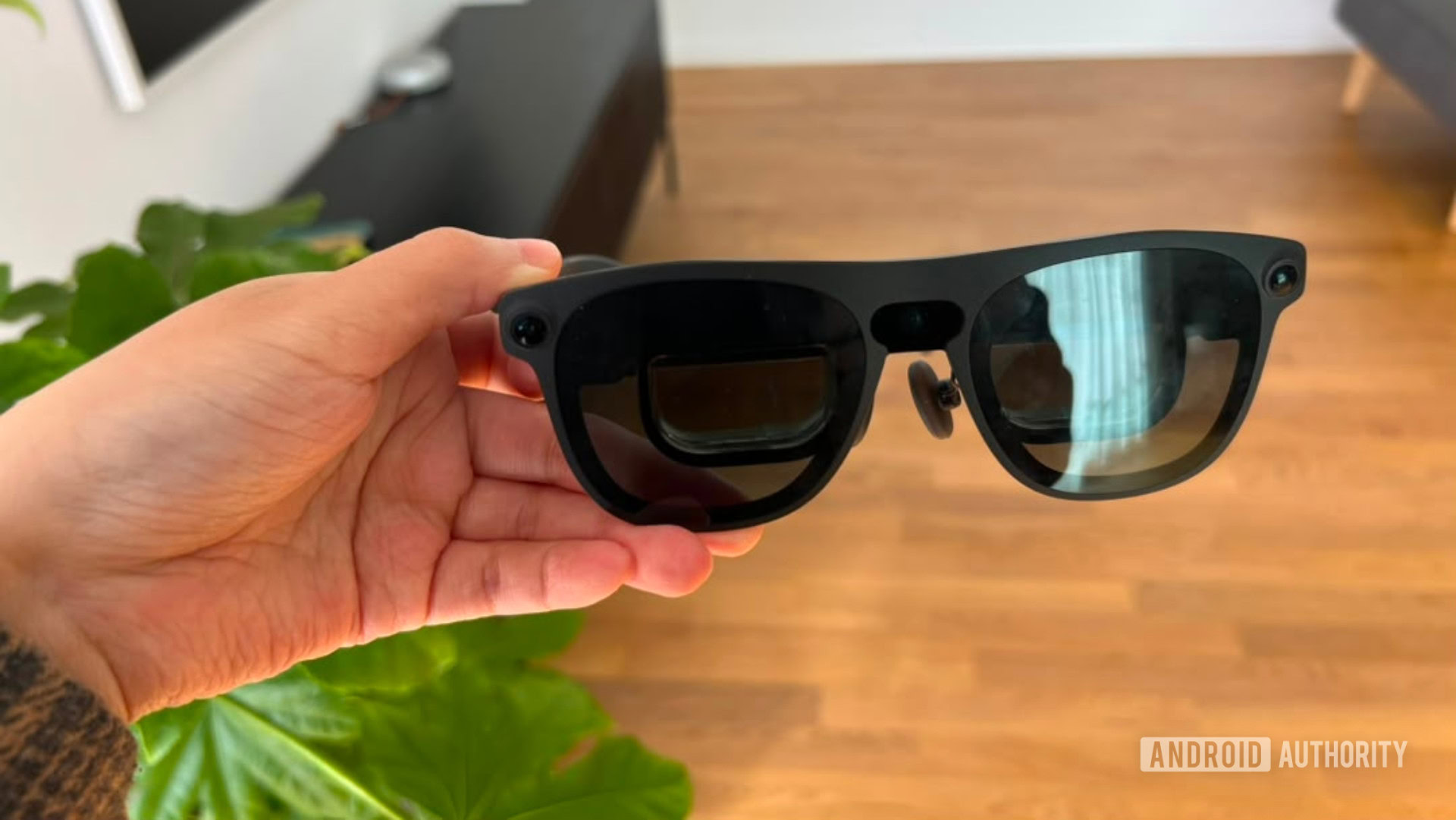
Add Android Authority on Google: I have been hearing about XREAL’s Project Aura glasses for so long, and all this while, I’ve found myself wondering whether they would truly live up to all the hype. After all, this is a completely new modality for Android, and as is often the case with early-stage tech, I’ve had my apprehensions about just how well-baked the experience would be. Now that I’ve had a chance to try the glasses out, I find myself counting days until they launch.Would you buy the XREAL Aura glasses?6 votesXREAL has been teasing a fall launch for months, but the company is nowadays sharing a much more concrete timeline, and the Aura glasses are expected to launch before the end of 2026, with a price of under $1,500.I came away from my demo more excited about the Aura than I expected to be.The company was actually quite careful about that number when I spoke to its representatives at IFA. “Under $1,500” does not necessarily mean $1,499, I was told, so there is still some mystery around the final price. Nevertheless, after spending some time with the glasses, I came away from my demo more excited about them than I expected to be.Android, but on your faceThis might sound like a strange thing to say about a pair of glasses, but if you have been following the development of XR, you will know that the biggest challenge has never really been demonstrating what the technology can do. Companies have been making impressive AR and VR tech for years. The harder part is making the experience feel natural enough that you can imagine using it regularly.After my brief time with Aura, I think XREAL is getting surprisingly close.If you are completely new to the idea of Android XR, the easiest way to understand what the likes of XREAL, Google, and Samsung are trying to do is to imagine taking the Android experience you already know from your phone and bringing it into the space around you.The actual interaction does not feel alien.Instead of looking down at a rectangular display in your hand, you can have apps, screens, and other digital objects appear on a screen suspended in the world around you. You can look at a huge virtual display for YouTube, explore a city through Google Maps, or interact with other content without having to hold a screen in front of your face.That sounds futuristic, but one of the things I liked most about Aura is that the actual interaction does not feel alien.My demo started with a brief introduction to the basic hand gestures. I learned how to pinch, tap, drag, and scroll through the interface, and while I obviously had to think about what I was doing initially, it did not take very long before the gestures started to feel natural.After about 10 minutes, I had largely stopped thinking about the controls and was simply using them.XREAL told me that the introduction I received was only a small part of the full onboarding experience. When someone wears Aura for the first time, they will apparently go through a more elaborate gesture-training sequence designed to teach them how to interact with the interface.If you've spent years using an Android phone, there's not an entirely new OS to learn here.I can see why that would be useful, but I also think that the fact that I could get the hang of the basics during my relatively short demo says something about the friendliness of the interface.If you’ve spent years using an Android phone, there is not an entirely new operating system to learn here. The apps, navigation concepts, and basic interactions are built around an ecosystem you already understand.For people who have never used an XR headset before, that familiarity could make the transition much easier.The hardware is more complicated than it looksOf course, making Android work on your face is not quite as easy as putting a tiny Android computer inside a pair of spectacles.Aura is the result of a fairly tight collaboration between XREAL, Google, and Qualcomm. Google provides the Android XR platform and its ecosystem, Qualcomm provides the Snapdragon computing platform, and XREAL brings its experience in AR glasses, optics, and spatial computing to the hardware.The main platform is Snapdragon Reality Elite, while XREAL has developed its own X1S Spatial Coprocessor for the glasses. I’m told that the latter might also be a TSMC product, just like the Qualcomm chip.I didn't find the design offensive, but it's definitely not something that'll work for everyone.The glasses pack a pair of Sony Micro OLED displays into the frame, with a resolution of 1,920 x 1,200 pixels for each eye, up to a 120Hz refresh rate, and a 70-degree field of view. The company also uses its X Prism optical system to get those displays into a traditional eyewear form factor.Whether you think Aura actually looks like a normal pair of glasses will probably depend on your face and your ability to tolerate slightly chunky glasses. Personally, I didn’t find the design offensive, but it’s definitely not something that’ll work for everyone.That said, XREAL has at least considered people who need prescription lenses. The Aura will come with support for prescription inserts, so you do not have to wear a second pair of glasses underneath them.Google Maps might be my favorite use case The most impressive part of my XREAL Aura demo was easily Google Maps.Of course, I’ve used Google Maps for years, but using it through the Aura glasses made the whole thing feel completely different. I could zoom in and out of cities and landmarks, and explore them with an amount of clarity and precision that made the experience feel almost magical. I could genuinely sit down and spend hours just exploring different cities this way.The experience becomes even more interesting for locations that support Google’s immersive experiences. In some places, you can see a little bubble that lets you effectively enter a building and explore its interiors as if you were standing right there.I could genuinely sit down and spend hours just exploring different cities this way.I tried this with a restaurant in New York, and I could see everything, from how the tables were arranged to the entire floor plan, as it would look in real life, complete with ambient lighting. I wish I could show you how I walked around in different sections of the place, though I had to be careful not to bump into objects in the room while doing so, because the glasses can get darker when you need to be immersed.The Aura uses electrochromic dimming, allowing the lenses to become darker when you want to focus on digital content. During the more immersive parts of my demo, the glasses darkened enough that I was not constantly distracted by everything happening in my peripheral vision. However, I could still look down and see the real world around me.The Aura glasses make that transition from immersive to functional very well.That balance is important because I don’t think most people want a pair of glasses that completely disconnects them from their surroundings. If I am walking around a city, an airport, or even my own house, I still want to know where I am going and avoid walking into furniture. The Aura glasses make that transition from immersive to functional very well.YouTube convinced me these could be fantastic for travelAnother part of my demo involved watching YouTube. Unfortunately, a bug caused the standalone YouTube app to crash, but I still managed to watch YouTube the old-school way in Chrome.On the Aura glasses, you can make the virtual display absolutely enormous, essentially giving you a giant screen floating in front of you that can feel more like a projector than a phone or tablet.If entertainment is the primary reason you are interested in Android XR glasses, this is probably one of the easiest use cases to understand.I can picture myself sitting on a long flight, putting on the Aura, making the virtual screen as large as I want, and watching a movie without having to rely on the tiny display attached to the seat in front of me.The glasses should be able to last around four to five hours for something like streaming.The same applies at home. You could be lying in bed watching something on what feels like a huge TV without actually having a huge TV taking up half the room.Of course, the obvious question is how long you can actually do that before the glasses run out of power.XREAL did not give me every battery longevity detail I wanted, but I was told that the glasses should be able to last around four to five hours for something like streaming with the 4,455mAh battery housed in the external compute unit rather than all being crammed into the glasses themselves.The cable connecting the glasses to the compute unit is still something I’ll want to live with for longer before deciding whether it’s genuinely annoying, but I didn’t find it all that distracting or uncomfortable during my demo.What about other apps?I also spent some time scrolling through Google Photos, and this was another example of a relatively mundane smartphone experience becoming more interesting.Instead of flicking through tiny thumbnails on my phone, my photos could be displayed more like a giant slideshow on a television.It is not necessarily the sort of thing that will convince someone to spend $1,500 on Android XR glasses, but it shows the platform’s potential.There's still a big question mark around app compatibility.A lot of the things we already do on our Android phones could make more sense when they are freed from the limitations of a small rectangular display. And because the Aura glasses have access to the Google Play Store, XREAL does not have to build an entirely new ecosystem from scratch.That said, there’s still a big question mark around app compatibility. XREAL did not tell me much about the specialized apps and partnerships it has lined up for launch, although the company said it would have more to announce at release.While the hardware is impressive and having Android and Google Play gives XREAL a huge head start, a successful XR platform needs apps designed specifically for it. Google is clearly serious about Android XR, and Samsung is also working on its own generation of Android XR hardware. While the two companies are working with eyewear brands such as Warby Parker and Gentle Monster on their non-display glasses, Samsung Display has also been showing off extremely small RGB OLEDoS displays that could eventually enable an Aura-like visual experience.That makes me wonder whether XREAL is deliberately waiting for Google and Samsung to make some of their own announcements before Aura finally arrives on the market.Nevertheless, XREAL’s glasses are a great example of what happens when you combine Android with displays, spatial tracking, and a glasses form factor. I can’t wait to see what else the XREAL Aura can do. Here’s hoping that wait’s not too long.Thank you for being part of our community. Read our Comment Policy before posting.
I finally tried XREAL’s fully-baked Android XR glasses, and now I’m counting down to launch
Full Article
Original Source
Read the full article at Androidauthority →KhanList aggregates and links to publicly available news content. We do not host full articles from third-party sources. Always verify important information with original sources.