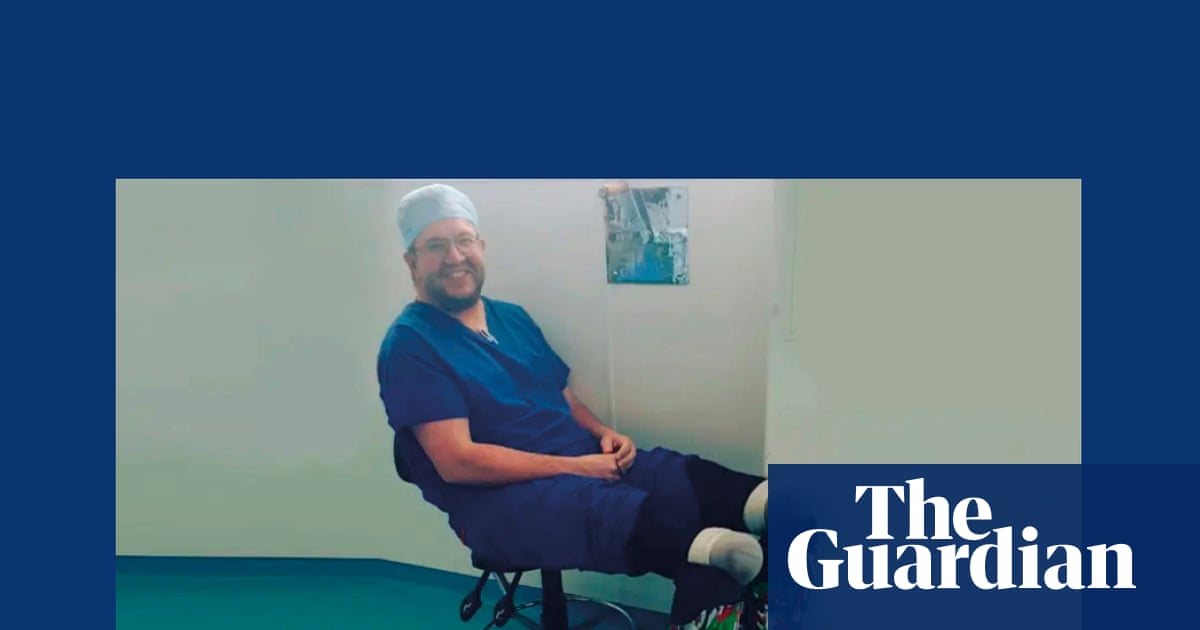
Of all the things that happened in the fraught days after 72-year-old Liz Spooner had her leg amputated at the Royal Cornwall hospital in Truro in 2022, one memory remains vivid in the mind of her daughter, Faye Harrison. Liz’s surgery had taken much longer than anticipated, Faye remembers, and, delirious after the anaesthetic and morphine, Liz had begun to refuse food and medication. That’s when Faye was ushered into a side room with a consultant surgeon.“He was smiley. He came across as quite charming and caring,” Faye recalls. He ran through a long list of the medications Liz was taking, and began explaining why she needed them. “I remember looking down – you look down at the floor a lot when you have these kinds of conversations – and I noticed he’d got metal sticks coming out of his trouser legs.” Faye blinks in disbelief at the memory. “I thought, blimey, he’s operated on my mum, but he’s also an amputee.”Neil Hopper was a celebrity in the world of vascular surgery – the specialist field involving veins and arteries, and therefore amputations. He had been a consultant for a decade by the time of Liz’s operation, and had received awards for clinical excellence. But in May 2019, following suspected sepsis, Hopper himself had had to undergo double below-the-knee amputations. When he walked into the surgical theatre on prosthetic legs in January 2020 ready to perform amputations on patients again, a BBC camera crew was there to film his heroic comeback. He talked about his experience of sepsis on the sofa of ITV’s This Morning, dressed in shorts that proudly exposed his prosthetics. Using the handle @bionicsurgeon, he had documented his experiences as a disabled doctor on social media. He even applied to the European Space Agency, hoping to be the world’s first astronaut with a disability. He won multiple accolades: named one of the coolest people in Cornwall, and one of the bravest people in Britain.Hopper tells his story on ITV’s This Morning, 6 March 2020. Photograph: Ken McKay/ITV/ShutterstockBut Faye chose not to mention his legs during their 15-minute conversation about her mum. Instead, she made some small talk: noting Hopper’s Welsh accent, she declared Cornwall’s beaches to be far better than Wales’s. It was an odd scenario, but there was at least something reassuring about knowing the man caring for her mother was himself an amputee. “I remember thinking, God, he must have amazing empathy.” Coming out of the side room, Faye told her husband about the extraordinary surgeon she’d just met. “It’s awful, really, but I remember saying, ‘He’s got prosthetic legs – and his name’s Hopper.’ Because, in times like that, you look for anything that’s going to make you laugh.”It had been a harrowing few days for Liz’s family, but the ordeal had begun a year earlier, when she had fallen on the beach and broken her leg. A people person, Liz was a former nurse who went on to manage a children’s home in Birmingham for 12 years before settling in Cornwall. After her husband’s death in 2009, she filled her days volunteering at the RNLI shop in Rock. It was after a shift there, while walking her dog, that Liz tripped and broke her left femur. It didn’t heal properly and, six months later, she had surgery to insert a metal rod in her leg, which then became infected. In July 2022, Liz was told she needed to make a choice: she could either take antibiotics for the rest of her life, which could stop working, or have her leg amputated. “Get rid of that bloody leg, get rid of the infection, and she’s going to be all right, we thought,” Faye says.Liz Spooner (on the right) and her daughter Faye Harrison in Spain in 2017. Photograph: courtesy of Faye HarrisonThey were expecting the procedure to take five or six hours, but Faye tells me it took 11 or 12. Recovering on the high-dependency unit, Liz became paranoid and delusional. She told Faye there were ghosts in her room; that people were out to get her; that she was being secretly filmed. “The nurses and doctors were saying this was normal after a very big anaesthetic and all the morphine. But she was never really out of that state. She was never my mum again, after that operation.” Liz contracted hospital-acquired pneumonia and, nine days after her surgery, she died.Faye says that no one ever explained why her mum’s procedure had taken so much longer than anticipated. If it had been shorter, she wondered, then perhaps Liz wouldn’t have been so delirious afterwards, or she might not have been in hospital for long enough to contract the pneumonia that killed her. But Liz had always believed in the NHS, and so does Faye – she works as an NHS speech and language therapist. She assumed her mum had just been very unlucky. “No reason to doubt anything,” she shrugs.Then, three years after her mother’s death, in September 2025, Faye was listening to the news on her drive into work, and heard Neil Hopper’s name. He had been jailed after pleading guilty to two counts of fraud by false representation and three counts of possession of extreme pornography. The fraud conviction related to claims he had made on his health insurance after the amputation of his legs. Hopper had not had sepsis, after all – the injuries that caused his legs to be amputated were self-inflicted. He had deliberately harmed himself, because he had an amputation fetish.Faye felt as if she was going to vomit. “Oh my God, I felt sick that he was even near my mum.”Royal Cornwall hospitals NHS trust issued a statement on the day Hopper was convicted. “We want to reassure the public that our exhaustive investigations have found no evidence whatsoever to indicate any risk or harm to patients at our hospitals,” it said. But Faye was not reassured.“Who gets their own legs amputated when there’s nothing wrong with them? And then to think that he’d been a doctor. And then – even worse – a doctor who does amputations on other people.” Questions swirled around her head. “My mum was in that operating room a very, very long time. Was something going on?”Across Cornwall and beyond, Hopper’s former patients and their families were asking similar questions. Here was a surgeon prepared to lie for years to his colleagues, his patients, the wider public and his closest family about the nature of his injuries – a man who, on the basis of the extreme pornography he was convicted of possessing, revelled in seeing people in excruciating pain. How could anyone be sure he never posed any risk to patients?Hopper was resolutely silent after his arrest in March 2023. He replied “No comment” in his two police interviews; he did not speak in court. Perhaps the greatest insight into his mindset and character comes from comparing his Bionic Surgeon persona with the truth that emerged during his criminal trial and his fitness to practise tribunal. The contrast lays bare the questions that remain for Hopper’s former patients – and his former employers.On the surface, at least, Hopper seemed to live a very conventional life before he lost his legs. The son of two nurses, he grew up in Aberystwyth and Swansea, and attended a private boarding school. He studied at University of Wales College of Medicine in Cardiff, earning a first-class degree in anatomical sciences and an honours degree in medicine. He met his future wife at medical school, they had a son and a daughter, and the family went to Australia for a year, where Hopper worked as a vascular surgeon in Sydney, before returning to the UK in 2013 to be a consultant surgeon, both at the Royal Cornwall hospital and at the Duchy, Cornwall’s only private hospital. “I developed a keen interest in vascular surgery mainly because it was reconstructive, no two operations were the same, and having to operate on all parts of the body provided the variety to keep my interest,” Hopper told the Western Mail in 2021.In April 2019, so his story went, Hopper and his daughter became unwell during a family camping trip. “My daughter got better but I didn’t, so my family abandoned me at home thinking I had a stomach bug. I started feeling a bit achy so took some paracetamol and went to bed,” he told Cornwall Live in February 2020. Later, Hopper’s wife and children were away visiting his in-laws; when his wife rang him and he “spoke gibberish” on the phone to her she called a friend, who went around to check on him, found the front door open, and called an ambulance. “The next thing I remember is being in intensive care,” Hopper continued. “I remember my feet hurting a lot.”Hopper told doctors he’d been vomiting and had diarrhoea. He underwent extensive testing, with medical staff bewildered by the cause of his condition. In the end, they suspected sepsis. “I could see my toes had gone blue so at that point I knew where I was sort of headed,” he later told the BBC; blue skin on the soles of the feet is a recognised sign of sepsis. For two weeks, his medical colleagues tried to improve the blood supply to his legs. He was transferred from the Royal Cornwall hospital to Derriford, a specialist training hospital, for hyperbaric oxygen therapy. But it was in vain. Once amputation began to look inevitable, he said to the BBC, he “couldn’t help but imagine the mechanics” of what it would entail. “The thought of power tools being used on me was icky.” Hopper’s toes were removed on 10 May, and, when that wasn’t deemed enough, he opted to have both his lower legs removed on 17 May.“I’m now a bilateral below-knee amputee, which is quite ironic, given my job,” Hopper declared in the first video uploaded to his YouTube channel, six months after his surgery; he had already started calling himself the Bionic Surgeon by then. In another video, uploaded to mark his first year as an amputee, he boasted about getting an all-expenses paid trip to Salford to be on BBC Breakfast. In early 2022, he revealed he was undergoing assessments in Hamburg with the European Space Agency, in a bid to become the world’s first para‑astronaut; he got down to the final 27 candidates. “When I was ill, somebody told me that I’d end up doing Ted Talks and all sorts, and I said absolutely not, this was never going to be a big part of my life, and I’ve completely fallen into that trap,” he chuckled on BBC Radio Cornwall. He knew his injuries had opened up a particular kind of opportunity for him. “My life is more interesting because of what’s happened to me,” he told a Welsh BBC documentary crew, just before his arrest.But Hopper’s journey to becoming the Bionic Surgeon actually began the year before he lost his legs, with a very different set of videos. It was revealed during his criminal trial that, in August 2018, Hopper used the email address adecentguyincornwall@gmail.com to set up the profile “AdmiroDoc” on eunuchmaker.com, a pay-per-view fetish website featuring videos of men and boys either maiming themselves or allowing others to mutilate them on camera. Marius Gustavson, the Norwegian man living in London who ran the site, had had his own penis, nipple and left leg removed. Gustavson is currently serving a life sentence for multiple offences, including causing grievous bodily harm with intent.‘I can see how Neil Hopper got into it,” says the man who was known as “Michael” during Gustavson’s trial. “I don’t think he just got it into his head one day to type in ‘Eunuch Maker’ – I think he was on various fetish sites looking for more and more extreme stuff and found his way on there. A little bit of passing interest, and then as soon as you’re on that site, it becomes an echo chamber.”Michael was the first person to report Gustavson to the police, after Gustavson had castrated him on video and branded him with the initials “EM”. Michael had been in a vulnerable mental state and was using drugs when Gustavson mutilated him; he went to the police when he was in recovery a year later, and realised he’d been the victim of what the judge in Gustavson’s trial would call “little more than human butchery”. “The thing with that website is, it made all of this seem absolutely normal,” Michael says.The site operated between 14 January 2018 and 1 March 2021, during which time Gustavson earned almost £300,000 from more than 22,800 paying users from across the globe. (The victims who appeared in the videos were promised money from the revenue; Michael says his castration earned him £60, which didn’t even cover the cost of his travel.) In the chatrooms and on the message boards, members who had undergone verified castration, amputation or genital removal were given special badges of honour. “It was a community. Very supportive, very welcoming and very enthusiastic,” Michael tells me.“There were always rumours of, oh, there’s an actual surgeon here, there’s an actual nurse,” he continues. There was a nurse, it transpired: Nathan Arnold, who received a suspended sentence after he was found guilty of GBH for removing Gustavson’s nipple. And there was Hopper. “It’s absolutely horrifying to learn that a consultant surgeon in the NHS really was there.”I am loath to describe the videos Hopper was watching – which I learned about when I attended his criminal court hearing via video link – but the broad details are relevant to his patients. Hopper was performing surgery on them in his professional life while watching people writhing in agony in his private life; this was pornography so sadistic and extreme that possession of it added 10 months to the 22-month prison sentence he received for insurance fraud.The first video cost Hopper £10; it shows Gustavson castrating another man. The second, costing £35, features a man tied to a bed while Gustavson rolls dice to decide which body parts to remove; the man ended up losing his penis and testicles, and bled so much that Gustavson called an ambulance, all with the camera still rolling. In a third video, also costing Hopper £35, a man cuts off his own penis and holds it up to the camera.“I’ve watched them thousands of times,” Hopper enthusiastically messaged Gustavson on WhatsApp, singling out the video where paramedics had to be called for particular praise.Hopper was paying for these videos a few months after operating on a woman I’ll call Joan. We meet in a cafe in west London; she doesn’t want me to say where she lives or use her real name. Joan had booked into the private Duchy hospital to have a varicose vein removed in advance of her daughter’s wedding. “He was the vein man at the Duchy,” she tells me. “He seemed very nice, really easy-going. He’s a sort of cuddly man – slightly overweight and jolly-looking. I warmed to him.” She thought it was going to be straightforward. “My mother and one of my sisters had had veins removed before, and neither of them had ever had any problems.”Throughout the 30-minute procedure, Hopper was in charge of removing Joan’s vein and administering the anaesthetic. “I hurt a lot,” she says, fixing me with her gaze. At first, she didn’t want to make a fuss. “I’m not a baby, I’m not a coward. I thought, I’ll just put up with it until it’s over. But it got to the point where I couldn’t put up with it. I had to say, this really, really hurts.” Hopper could see her squirming, and hear her pleading for him to stop. He said he’d give her more anaesthetic, but it made no difference. “It still hurt just as much. It felt like he was pulling a vein out of my leg without any anaesthetic at all.”After the operation, Hopper refused to let Joan pay for it. “It was a few hundred pounds, and he let me off the bill. Private doctors don’t do that – they just don’t.” She shakes her head. “At the time I thought, what a nice man – that’s so reasonable of him, because he had hurt me a lot.”Joan was alarmed to read about Hopper’s conviction in the newspaper. “It was unnerving.” She hadn’t followed the details of the case, and didn’t know about the videos Hopper had been watching, until I told her about them in the broadest possible terms. “It makes me feel physically sick. It’s beyond belief,” she says. “But I’m glad I know, actually: I thought I was imagining it. It felt like he hadn’t used anaesthetic, when I had been told he had. But I no longer know for sure that he did.” She shakes her head. “He was obviously deranged, and I’d been at his mercy.”Ramsay Health Care UK, the parent company behind the Duchy hospital, said it was unable to comment on any individual episodes of patient care. “During his period of holding practising privileges with Ramsay Health Care UK, no significant concerns were raised regarding Mr Hopper’s clinical practice or any risk to patient safety,” a spokesperson said in a statement. “We want to reassure our patients, partners and the wider community that we remain fully committed to the highest standards of professional conduct and clinical governance.”Towards the end of 2018, Hopper messaged Gustavson asking him to fix a fault that meant he could no longer watch the videos he’d bought. “Don’t worry,” Hopper eventually wrote, “my tastes are more exotic these days.”Gustavson caused his own left leg to be amputated in February 2019. He had placed his foot in a bucket of dry ice for eight hours (uploading a short video of the process to his website) before going to hospital where his leg was ultimately removed below the knee.By April, Hopper was asking for advice on how he could do the same. Gustavson sent him a digital document with instructions, equipment lists and diagrams, telling Hopper where to order the dry ice and how to access the dark web to buy opiates for pain relief. The prosecution in Hopper’s trial argued that Hopper was not groomed: he was an equal and willing participant. “Wow,” Hopper messaged Gustavson, “I’ve dreamed of this for 20 years.”With his wife and children away at his in-laws and both feet submerged in dry ice, Hopper sent Gustavson periodic WhatsApp updates. “It’s going to be awesome being a double amputee,” he wrote. Then, he sent Gustavson a photograph of his erect penis. He continued messaging Gustavson from his hospital bed after the amputation, thanking him for making it all possible, and sending a photo of his bandaged stumps, saying how “sexy” it was. “It feels so cool. No feet!”Gustavson was arrested in 2021. The police investigation into his devices and communications ultimately led them to Hopper, who was first interviewed in March 2023, and also a web of others in positions of authority in British society who derived sexual gratification from mutilation. Three days before Hopper’s court hearing, former vicar Geoffrey Baulcomb was sentenced to three years in prison for GBH after maiming another man’s genitals on camera. Michael, the man who first reported Gustavson, is convinced there are going to be more arrests. “There’s going to be more people discovered through this,” he says. “Are we going to have a police officer next? A lawyer? A politician?”It wasn’t Hopper’s fetish that led to his downfall – it was his lies. Before submitting fraudulent health insurance claims to Aviva and Old Mutual Wealth (now Quilter), Hopper had consulted friends and family – people who had no idea his injuries were self-inflicted – about whether he should make the applications. “I sort of feel like I should milk this for as much as possible,” he texted a friend. In a message to his father, he wrote, “If it’s hundreds of thousands, I’ll cash it in. If it’s tens of thousands, I’ll leave it.” His total insurance payout was £466,653.81. He also claimed around £44,000 in disability benefits.The insurance claims had both been paid by July 2019; the same month, Hopper commissioned an architect to design an extension to his home. He spent £15,000 on a hot tub, £3,000 on audio equipment and £22,000 on a luxury camping trailer. He posted pictures of his new kitchen and hot tub on Instagram, then a month later he posted a picture of the family Christmas tree with the comment “Life ain’t bad!”. By November 2022, all the insurance money had been spent.During Hopper’s trial, the prosecution accepted that Hopper had neither taken out health insurance with the intention of making fraudulent claims nor frozen his feet in order to enrich himself; he had made the claims because not claiming might look suspicious. His motivation for harming himself, they argued, was sexual, not financial.Hopper’s defence team presented a different explanation. His defence barrister told the court that Hopper had suffered from lifelong gender dysphoria, as well as body dysmorphia, which manifested in a loathing for his feet. “They felt like an unwelcome extra.” He had tried to fill his life with family and work, but could not quiet the “constant noise” and “persisting, never-ending discomfort” caused by the idea of his feet. (Gustavson’s legal team had made similar arguments at Gustavson’s trial: that he had body integrity disorder and had simply been offering a service to others like him.) But the sexual content, both in the videos Hopper watched and in the communication he sent Gustavson while he was harming himself, are undeniable. Hopper was aroused by what he saw, and what he did.“He does not regret the facts of the amputations – he had wanted it for 20 years – but he regrets the dishonesty and falsehood,” his barrister continued. Appealing to the judge before sentencing, the barrister informed the court that Hopper’s wife had left him. He asked for a suspended sentence, noting that Hopper would be forever recognisable, but would no longer garner any public sympathy. He read out a statement from Hopper: “My thoughts and behaviours have not had any effect on my job,” it read. “I worked very hard and always tried my best for my patients.”After Hopper received his sentence – 32 months in prison plus a 10-year sexual harm prevention order – the Royal Cornwall hospitals trust said their investigations had revealed “no evidence whatsoever to indicate any risk” to Hopper’s patients. But when Hopper’s fitness to practise was assessed at a Medical Practitioners Tribunal Service (MPTS) hearing in May this year, which looked at whether Hopper should be allowed to continue as a doctor, the tribunal found “an extremely high level of seriousness and risk in this case, and that Dr Hopper has not demonstrated any meaningful insight or remediation into the impact of his behaviour on public protection”. Recommending that he be struck off the medical register, Robert Dudley, on behalf of the GMC, said: “The doctor’s professional life cannot be separated from his personal behaviours.”The tribunal took place virtually, over Microsoft Teams, with Hopper representing himself. He rang in from prison, his place in the hearing marked by a redacted phone number on a grey rectangle. When he gave his final statement, his voice was thin, reedy and full of self-pity.“I’m finding this rather difficult,” he began. “I am currently in prison for these crimes, and I have never denied responsibility or guilt for them.” (He did, however, say “No comment” in his police interviews; he could have done considerably more to help ensure that justice was done.) “I attended this tribunal in order to prove that I understood the seriousness of the allegations and to face them. I had the opportunity to hide away, but, regardless of what people might think of me, I have principles.” He said he was “a person of deep reflection and conscience” and that it had “taken me ages to come to terms with what I’ve done”. Not once did he mention his former patients, or the profound distress he might have caused them. He was struck off on 29 May.‘Not a surprise,” says Mike Bird, partner and specialist in medical claims at Enable Law, when I speak to him a few days after the tribunal gave its verdict. “What worries me is that there’s a huge discrepancy between the perception of how serious this was by the trust where he worked, on the one hand, and the regulator of the profession, on the other. The trust concluded there was no risk to the public – and they said that after he’d been convicted – whereas the MPTS and the GMC said there were extremely high levels of risk.”Bird says his firm has had about 20 serious inquiries from Hopper’s former patients. “There hasn’t been a long line of people saying, ‘I’ve had my limb amputated and I believe it was inappropriately done,’” he tells me; a significant proportion of amputees are elderly, and many of Hopper’s former patients may have already died. “Of those who’ve contacted us, some have felt a sense of betrayal or even a feeling of assault because of what they now think was going on in his mind when he was treating them. They are questioning whether the decisions he made about their treatment were appropriate, whether they were motivated by his own sexual gratification rather than clinical need.” It’s much harder to claim damages for psychological trauma compared with physical injuries. “The law doesn’t always follow reality,” Bird says.In response to a freedom of information request, the Royal Cornwall hospitals trust has released the report it commissioned on Hopper’s caseload, an investigation the trust described in the statement it gave to the press on the day of Hopper’s conviction as “exhaustive”, “comprehensive” and conducted by “an independent clinical expert”. “It’s done by someone who’s not an expert in the field, someone who is not independent of the trust. He’s not talked to other colleagues, other staff or any patients: he’s looked at the medical records of 30 patients,” Bird says. The focus was on procedures that took place between 1 August 2018 and 31 October 2020, years before Faye’s mother, Liz, had her surgery.Mike Bird, the lawyer representing Hopper’s patients. Photograph: Max Searl/The Guardian“It’s a very brief, very superficial reactive response to a crisis situation – and it’s not enough,” Bird continues. “When I’ve spoken to patients who subsequently contacted us, they have said, ‘Is this not the trust marking its own homework?’ Where’s the independence? Where’s the rigour? When something like this happens, why did the trust not immediately go to NHS England or the Royal College of Surgeons and say, ‘Please help us work out what’s happened’?”“Our priority from the beginning has been to investigate Mr Hopper’s actions so that we can reassure patients there is no evidence of risk or harm to them,” a spokesperson for the Royal Cornwall hospitals NHS trust said in response to this article. “RCHT carried out clinical reviews of all amputation surgery carried out by Mr Hopper at our hospitals over a two‑year period specified by police investigators. These formed part of the police investigation process. Our investigations found no evidence to indicate any risk or harm to patients.”The RCHT added that complex vascular surgery is always managed by a team of healthcare professionals, and is never the decision of one surgeon. “We have received reassurance on vascular surgical outcomes between 2013 and 2023 from the National Vascular Registry, who analysed our data for that period, and said further analysis would not add value to this case.”David Parker was one of the first patients Hopper operated on after he came back to work on prosthetic legs. He was clearly still getting used to them: David says when they first met for his consultation, Hopper “fell in the doorway and fell into his chair”. But it was winter, and Hopper was wearing long trousers instead of shorts, so David had no idea his surgeon was an amputee. He only realised a year or so later, when he saw a documentary on regional television. “It was saying what a hero he was, still doing his job after having his legs removed.”By that time, David didn’t consider Hopper to be a hero. He’d had a procedure to unblock an artery in his neck; Hopper had assured him it would be straightforward and shouldn’t take more than one or two hours, but it ended up taking an entire day. David remembers waking up during surgery and being roughly pushed back down on to the operating table. Ever since he came out of theatre six years ago, he has suffered debilitating nerve pain. He has spent all his retirement savings on private physiotherapy, to little avail.‘Something happened in the surgery that day, which I’m still living with’: David Parker, one of Hopper’s patients. Photograph: Max Searl/The Guardian“The day after the surgery, Mr Hopper came and sat on the side of my bed. The first thing he said to me was, ‘Do you remember anything from yesterday?’ And I said, ‘Well, I remember waking up.’ He said, ‘No, no, that didn’t happen. That’s probably just the anaesthetic playing tricks on your mind.’ I never saw him again.”David says he has since had it confirmed by other staff present during the procedure at the Royal Cornwall hospital that he did wake up during surgery. He has been trying to work out how he came to be injured ever since, with years of emails and follow up meetings. Once the news of Hopper’s conviction broke, David says, “My case made a lot more sense. Something happened in the surgery that day, which I’m still living with.” The nerve damage could have occurred during the procedure on his vein or when he was pushed down on to the operating table. David accepts he may never be able to find out.He doesn’t believe the trust’s assertion that Hopper never posed any risk to patients. “I can’t imagine a man with so many psychological problems being able to do a surgery and put all his personal life to one side. It just wouldn’t happen, would it?” He sighs.“Professionals can talk about his professional life – I’ll talk about his private life,” Michael says when I put this to him. “At the time that I was on that website, it was constantly there in my mind. It colours everything. It takes years to get it out of your system. If you’re looking at that sort of stuff, and it’s the same stuff you’re doing at work day-to-day – I’d find it very difficult to compartmentalise. I don’t think it’d be possible.”It is the never knowing – the lifelong, gnawing doubt – that is the source of ongoing trauma for Hopper’s former patients and their families. They know one thing for sure: they had a doctor who was consistently, and criminally, dishonest.The name of the surgeon who operated on Faye’s mother was not revealed in the inquest into her death. Even though she had a consultation with him after Liz’s operation, Faye had never been certain that Hopper had performed the amputation. When she recently contacted the Royal Cornwall hospital for confirmation, she was told that, despite her vivid memories of her consultation with him, there was “… no record of Mr Hopper being involved at any stage” in Liz’s care.In response to inquiries from the Guardian, the Royal Cornwall hospitals NHS trust says Liz’s medical records show that Hopper was not in theatre for the amputation of her leg, and that procedure only took three and a half hours, not the 11 or 12 that Faye claims it did.Faye has text messages she sent to family members during her mum’s surgery informing them that the procedure was taking far longer than the five hours they had originally anticipated. She says she clearly remembers repeatedly ringing the hospital during the surgery to ask why her mother still hadn’t come out of it, and being told by staff that her mother’s delirious state was due to her having such a lengthy procedure.“I just don’t seem to be getting anything back from the hospital that’s correct,” Faye sighs. “Things happened that I know for a fact happened. I know I met Neil Hopper. I know he was involved in my mum’s care. I don’t know whether he’s just lied and covered his tracks, and therefore the hospital is going by what they’ve got.”“He may well have been involved – he just may not have made notes,” says Bird. “He lied to his medical professional colleagues. The medical records he did make – why would they be right? They were written by a proven liar.” It’s another reason, Bird says, that any review into Hopper’s work that’s based on medical notes alone is inadequate.Hopper was told he must serve at least 40% of his sentence, so he will be eligible for release from prison within the next few months. The criminal trial focused only on the charges he could be prosecuted with – fraud and possession of extreme pornography – and not the deception of colleagues, patients, and his wife and children, nor the psychological harm he has caused to the people who put their lives and bodies in his hands. While these things are profoundly wrong, they are not necessarily crimes.“He hasn’t been punished for what he’s done to patients,” says Faye. “I just refuse to believe that there weren’t ulterior motives behind the operations he carried out.” The ongoing doubts have made it harder for her to grieve, she says. She wants to have her mother’s pictures on the walls, but can’t face the prospect of going through Liz’s old photographs, which remain in a box in Faye’s loft.Faye wants the trust to commission an independent inquiry into Hopper, investigating not only whether amputations he performed were needlessly done, but also his conduct during his operations – whether his procedures were prolonged, drawn out or otherwise inappropriately carried out. “It’s horrific that there hasn’t been an independent audit from NHS England or the Royal College of Surgeons. Why hasn’t there been a full independent inquiry?”When we first met, Faye had been in two minds about whether or not to speak out about what happened to her mother. She had feared that, if Liz’s wider family and many friends read about her connection to Hopper, they would be horrified. “I don’t want them to go through what I’ve been through,” she’d said. But then she thought about what Liz would want. “She cared about fairness and justice, and making sure people faced up to things. If she were alive today, I know what she would say. She’d say, ‘Go get that effing bastard.’”
‘I felt sick that he was near my mum’: a top amputation surgeon had his own legs removed due to a fetish. Were his patients safe?
Full Article
Original Source
Read the full article at Theguardian →KhanList aggregates and links to publicly available news content. We do not host full articles from third-party sources. Always verify important information with original sources.