
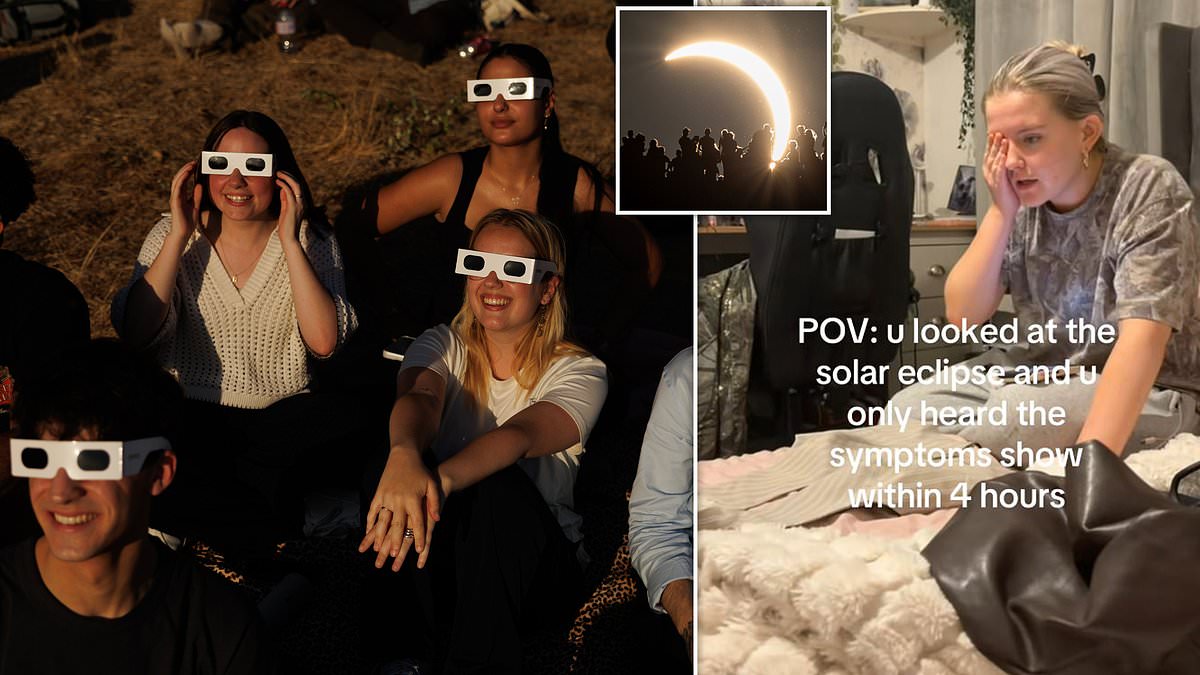
Last night, millions of Britons across the country watched in awe as the sun vanished during the best solar eclipse in a generation.However, with eclipse glasses in short supply, not everyone followed experts' advice to avoid looking at the sun without glasses.Britons have now taken to social media to complain of agonising eye pain after staring directly at the solar eclipse.And doctors warn that the damage could be permanent.Dozens of videos shared on TikTok show worried Britons reporting symptoms of eye damage after failing to watch the eclipse safely.In one clip, an anxious poster said: 'I stared at it. My eyes are killing me. It's a feeling I've not felt before and I think I'm going to go blind.'Another user said that they only 'took a quick peep thinking I'd be fine', but is now experiencing headaches and blurred vision.'While one commenter added: 'They weren't lying I looked directly at the eclipse and now there's a big reddish hue in my centre vision.'Britons have now taken to social media to complain of agonising eye pain after staring directly at the solar eclipse without glasses Last night, millions of Britons took to the streets to marvel at a once-in-a-generation eclipse. Pictured: The solar eclipse seen from Glastonbury, England Although no one wanted to miss out on the best solar event since 1999, the expert advice was clear: Do not look at the sun directly under any circumstances.Mohamed Elalfy, who is a consultant ophthalmologist and president of the Royal College of Ophthalmologists, told the Daily Mail: 'Looking directly at the Sun during a solar eclipse can cause damage to the retina, particularly the macula, which is responsible for sharp central vision. 'This occurs because the solar radiation is focused by the eye’s natural optics onto a very small area of the retina, causing photochemical reaction and, with prolonged exposure, thermal damage to retinal cells.'Hospital data regarding admissions for eye damage has not yet been released, but there is already evidence that some people thought a quick glimpse wouldn't hurt.The number of Google searches for the term 'eyes hurt' was 5,000 per cent higher on Wednesday evening than the same time last year.Likewise, searches for 'eye damage' were up 700 per cent week on week following the end of the eclipse.Meanwhile, social media has filled with worried Britons, uncertain whether they have permanently damaged their eyes.One X user complained: 'Looked at the eclipse for about 5 seconds and I'm now seeing spots maybe people weren't being dramatic about it damaging your eyes.' Experts advised that no one should look at the sun without proper eclipse glasses, but it now appears that many ignored that recommendation. Pictured: People gather to watch the eclipse in Greenwich Park, London, England Google searches for 'eye damage' were up 700 per cent week on week following the end of the eclipse'Looked at it for literally a sec and now my eyes hurt,' shared another.Even if your eyes didn't start to hurt right away, this doesn't mean that no damage was done.Mfazo Hove, consultant ophthalmic surgeon and founder of Blue Fin Vision, told the Daily Mail that there is no 'safe number of seconds' for looking at the sun. Mr Hove says: 'Symptoms often do not appear immediately. They can develop several hours after exposure.'They may include blurred or reduced central vision, a grey or dark spot in the centre of your vision, distortion where straight lines appear bent or wavy, altered colour vision and increased sensitivity to light.'If you have managed to damage your retinas, the expected recovery time varies widely.Some people with relatively mild cases of solar retinopathy will improve spontaneously over the coming weeks, with substantial recovery in three to six months.However, recovery from severe solar retinopathy is not guaranteed.Join the discussionDid you watch the eclipse? Tell us where you were and what you saw in the comments!What's your view?Social media was filled with people worried that their brief glimpse of the sun might have permanently damaged their vision Experts recommended that the safest way to watch the progress of the eclipse was indirectly, using a colander or something with holes in it to project an image of the sun (pictured) What are the signs of eye damage caused by looking at the eclipse? Blurred central visionA central blind or dark spotDistortion of visionReduced colour perceptionIncreased sensitivity to lightSource: Royal College of Ophthalmology 'More significant retinal damage can leave a permanent central blind spot, distortion or reduction in vision,' says Mr Hove.'Unfortunately, there is currently no treatment proven to reverse the retinal injury once it has occurred.'If you find that your vision has a blurred area or a dark spot in the central region, Mr Hove says the most important thing is not to look at the sun again to 'test your vision'.Instead, you should arrange a prompt eye examination with an optometrist or an ophthalmologist.Mr Hove says: 'There isn’t an emergency treatment that can undo solar retinopathy, but it is still important to establish the diagnosis and, crucially, rule out other causes of sudden visual loss.'Boots Opticians Director of Optical Practice, Kyla Black, said: 'Last night’s once-in-a-generation event brought millions together across the world for a breathtaking experience. However, this event was not without its risks. 'While most people recover over weeks or months, others can be left with permanent visual problems.'During Wednesday's eclipse, the moon moved across the face of the sun, blocking out more than 90 per cent of its light from London at its peak.Bizarre videos shared online show large flocks flying chaotically through the air as the sky began to darkenHowever, eye damage wasn't the only unfortunate or unusual side effect of last night's spectacle.Across Britain, the sudden change was accompanied by an eerie drop in light and, in some places, a noticeable chill. Videos shared online show large flocks flying chaotically through the air as the sky began to darken.Meanwhile, others appear to show the animals falling eerily quiet during the celestial event.The peculiar scenes prompted viewers to wonder whether the animals realised something extraordinary was taking place.‘The birds knew something was happening,’ one person said after sharing footage of birds flying in a random pattern in the sky above her.Another user asked: ‘Has anyone noticed the birds acting strangely?’ while another said there was suddenly a ‘massive flock of crows’ in the sky.While the birds’ reaction may appear strange, the animals are highly attuned to changes in light and use the rising and setting of the sun to regulate their daily routines. Birds across the country were thrown into a state of confusion as the sun disappeared behind the moon during last night’s solar eclipse Hundreds of Lime and Forest bikes were dumped on the roads outside London's Primrose Hill park as visitors flocked to see the eclipse Rental bikes completely blocked the pavements and roads in some parts of London as thousands made their way to prime spots to watch the sunset Why the ancient Mayans feared solar eclipsesIn Maya Culture, the sun god is Kinich Ahau, and the moon goddess is Ixchel. So, when solar eclipses occurred, the ancient Maya interpreted it as the sun god manifesting his wrath or demanding some kind of ritual. Additionally, they believed that the Xulab or Xibal (ants) wanted to eat the sun, so the Maya people had to come together to perform rituals and chants to ward them off from their god.Additionally, another belief in Maya Culture was that if people looked directly at eclipses, birds would be ready to peck out the eyes of anyone who looked at them, leaving them blind.Source: chichenitza.com ‘Some animals rely even more heavily on light cues; birds are one example,' explained Dr Kristina Paradowski, a clinical assistant professor at the Texas A&M School of Veterinary Medicine and Biomedical Sciences. Meanwhile, in a distinctly human migration, local residents near London's parks were blighted by massive piles of rental e-bikes left by budding astronomers.Coinciding with the start of this year's fifth heatwave, with temperatures up to 34°C (93°F), parks with good sunset views were flooded with visitors.Many of those arrived on rented Lime or Forest bikes, which were abandoned in precarious roadside heaps.Shocking photos taken outside London's popular Primrose Hill show hundreds of electric bikes entirely blocking the pavements and part of the road. Forest and Lime have been approached for comment. This came after researchers warned that the eclipse could lead to an increase in road traffic accidents. The AA has now revealed there was a major jump in the number of cars breaking down last night, coinciding with the event. During the 2017 solar eclipse over the US, scientists from the University of Toronto charted a spike in road traffic accidents‘Our data shows breakdown workload peaking at around 8pm, when it was approximately 30 per cent above expected levels,’ a spokesman told the Daily Mail.‘This increase might reflect that more drivers left urban areas to get a better view of the eclipse.’It is thought that – in a desperate bid to see the ‘once-in-a-generation’ event – people in cities jumped in their cars and headed to the countryside for unobstructed views as the moon passed in front of the sun.The increase in journeys – combined with another scorching day – means more cars were on the road than usual and may have struggled with overheating, cooling system faults or tyre issues.Previous data indicates that an eclipse can trigger a spike in traffic accidents.During the 2017 solar eclipse over the US, scientists from the University of Toronto charted a substantial increase in road traffic collisions.'We found a significant increase in traffic risk in the US around the time of the total eclipse, averaging to one extra vehicle crash every 25 minutes and one extra crash fatality every 95 minutes,' said lead investigator, Professor Donald Redelmeier.However, the AA said they saw no increase in the number of accidents or claims reported last night compared to normal levels.As Britain sweltered in the fifth heatwave of the year, an eerie yet welcome chill descended as the Moon blocked out the unrelenting 30C sunshine at Northala Fields in LondonDuring the 2017 solar eclipse over the US, scientists from the University of Toronto charted a spike in road traffic accidents. 'We found a significant increase in traffic risk in the US around the time of the total eclipse, averaging to one extra vehicle crash every 25 minutes and one extra crash fatality every 95 minutes,' said lead investigator Professor Donald Redelmeier. 'The total amounted to 46 extra deaths linked to the eclipse.'While the reason for this spike remains unclear, the researchers say it's probably not down to the change of light itself. Professor Redelmeier added: 'Instead, the findings likely derive from increased traffic, travel on unfamiliar routes, speeding to arrive on time, driver distraction by a celestial event, drug–or–alcohol–impairment from related celebrations, or eclipse viewing from unsafe roadside locations.' The eclipse began at 6.08pm in Edinburgh, 6.17pm in London and 6.18pm in Cornwall. The Moon gradually slid across the face of the Sun until it all but snuffed out the light around an hour later. The best place to witness the phenomenon was the Spanish city of Burgos, which enjoyed 100 per cent totality lasting nearly two minutes.Laura Stewart, a 35-year-old lawyer, was among 500 gathered on London's Primrose Hill. She told the Daily Mail: 'It feels utterly enchanting.' Aja Lilit, 24, of Uxbridge, west London, added: 'I can see the Moon and the Sun. I am nothing - but also a part of this. This is just so amazing.' A family gathers on the moor to watch the solar Eclipse through homemade welding glasses in Blackwood, Wales Arsenal fans are seen using cardboard and a colander to try and see the solar eclipse prior to the pre-season friendly match between Arsenal FC and Como Calcio at Emirates StadiumGasps of 'wow', 'oh my god' and 'this is so cool' rang out at Greenwich Park in south-east London.It was the first proper solar eclipse in Britain since August 1999. That was blighted by clouds, ruining the experience for many, but on Wednesday night, most of England enjoyed beautifully clear skies. The frenzy swept the UK from Inverness to Penzance and beyond. The best place to see it was Bishop Rock in the Isles of Scilly, where 96.5 per cent of the Sun was obscured.For those in Scotland and Northern Ireland, whose views were spoiled by clouds, the Royal Observatory Greenwich live-streamed the event online.
'I feel like I'm going to go blind': Britons complain of agonising eye pain after staring DIRECTLY at the solar eclipse without glasses
Full Article
Original Source
Read the full article at Dailymail →KhanList aggregates and links to publicly available news content. We do not host full articles from third-party sources. Always verify important information with original sources.