
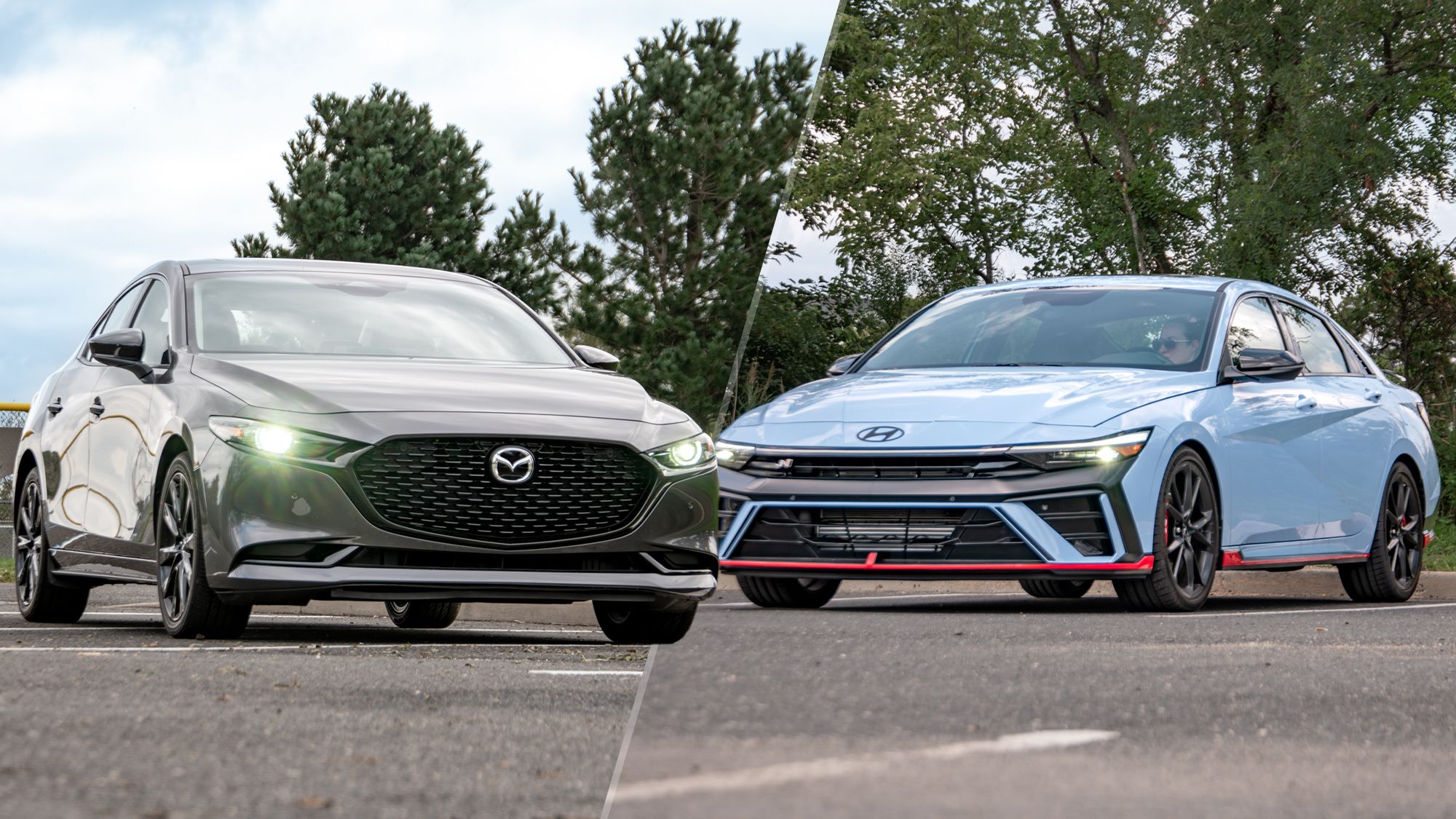
(Image credit: John Velasco / Tom's Guide) With sticker prices comfortably sitting under the $40,000 mark, the 2026 Hyundai Elantra N and 2026 Mazda 3 2.5 Turbo Premium Plus are practical compact sedans that remain well within reach for most buyers. Unlike their entry-level siblings, they’re engineered for drivers who refuse to settle for a boring daily commute — and who still crave serious curb appeal without draining their savings accounts.On the surface, both sedans lean heavily into a sharp aesthetic that commands attention on the road. The Elantra N has everything 20-year-old me would’ve wanted, from its aggressively angular lines to its aerodynamic side skirts and rear wing. Meanwhile, the Mazda 3 2.5 Turbo Premium Plus counters with a more refined, sculpted body, a prominent front grille, and an upscale silhouette that doesn’t shed its sporty heritage.After spending a week behind the wheel of each, only one gets my vote for where you should actually spend your hard-earned $40,000.Hyundai Elantra N vs. Mazda 3: Specifications Swipe to scroll horizontally Header Cell - Column 0 2026 Hyundai Elantra N 2026 Mazda 3 2.5 Turbo Premium Plus Price Tested $38,345 $39,145 Fuel Economy 20 mpg city / 27 mpg highway / 23 mpg combined 23 mpg city / 32 mpg highway / 27 mpg combined Engine 2.0L Turbocharged 4-Cylinder Engine SKYACTIV-G 2.5 DOHC 4-cylinder with VVT Fuel Tank Capacity 12.4 gallons 12.7 gallons Horsepower 276 hp 186 hp Wheels 19-inches 18-inches MSRP $36,600 $36,740 Hyundai Elantra N vs. Mazda 3: Pros and cons (Image credit: John Velasco / Tom's Guide)2026 Hyundai Elantra NProsSporty and fun driveSharp contrasting paint jobN Grin Shift speed boostBetter than expected fuel economyConsStiff bucket seatsBoring interior (Image credit: John Velasco / Tom's Guide)2026 Mazda 3 2.5 Turbo Premium PlusProsElegant meets sporty designFun to driveAffordable price pointSwaying headlightsHelpful head-up displayConsOutdated software experienceTighter rear legroomHyundai Elantra N vs. Mazda 3: Design Image 1 of 5 2026 Hyundai Elantra N. (Image credit: John Velasco / Tom's Guide) There’s a lot I love about the styling of both compact sedans, but they approach the concept of a “sporty” four-door from two entirely different angles.The 2026 Hyundai Elantra N undoubtedly has the bolder, more aggressive design, which is only amplified by its contrasting paint job that blends Hyundai’s signature Performance Blue with sharp black and red accents. With its razor-sharp creases, pronounced front grille, lowered stance, and prominent rear wing spoiler, it looks like a touring race car that wandered onto public roads.If I were handed the keys two decades ago, younger me would’ve fallen head over heels for its boy-racer energy — and even today, it still manages to bring out my youthful side. Image 1 of 5 2026 Mazda 3. (Image credit: John Velasco / Tom's Guide) But because my tastes have evolved, the 2026 Mazda 3 2.5 Turbo Premium Plus ultimately wins me over. While it’s nowhere close to matching that track-ready intensity, Mazda instead opts for an upscale, minimalist aesthetic that feels right at home in the entry-luxury segment. Its sleek sheet metal catches the light in a way that genuinely dazzles, complemented by its pronounced front grille and a subtle lip spoiler. It’s undeniably more mature, more refined, and handsome.Get instant access to breaking news, the hottest reviews, great deals and helpful tips.Don’t get me wrong: both cars turn heads. But the Mazda 3 delivers a timeless, sophisticated presence that I’d be much prouder to show off.Winner: Mazda 3Hyundai Elantra N vs. Mazda 3: Fuel economy Swipe to scroll horizontally Header Cell - Column 0 2026 Hyundai Elantra N 2026 Mazda 3 2.5 Turbo Premium Plus Total Miles Driven 144.9 miles 166.6 miles Average Fuel Economy 25.3 mpg 25.5 mpg Best short distance fuel economy 30 mpg 29.5 mpg Best long distance fuel economy 33.7 mpg 31.7 mpg Performance and efficiency rarely go hand in hand, but looking at my real-world testing numbers, this round ended up being practically neck-and-neck.Across my week-long test with each compact sedan, the Mazda 3 2.5 Turbo Premium Plus edged out the Elantra N with an overall average of 25.5 mpg over 166.6 miles — compared to the Elantra N’s 25.3 mpg across 144.9 miles. That 0.2 mpg gap is negligible in my book, but it's a win for the Mazda nonetheless.In fact, if you look strictly at the best recorded efficiency numbers above, the Elantra N actually overdelivered. I recorded a best short-distance run of 30 mpg (edging out the Mazda’s 29.5 mpg) and an impressive highway cruising average of 33.7 mpg on longer stretches (topping the Mazda’s 31.7 mpg).However, the Mazda 3 takes the overall win when you factor in long-term operating costs. While the Elantra N’s high-output turbo requires premium fuel to deliver peak performance without pulling timing, the 2.5-liter Skyactiv-G engine in the Mazda 3 happily sips regular unleaded. Paired with its slight overall efficiency advantage, the Mazda will cost noticeably less to keep fueled week in and week out.Winner: Mazda 3Hyundai Elantra N vs. Mazda 3: Driving performance Image 1 of 5 2026 Mazda 3. (Image credit: John Velasco / Tom's Guide) While both sedans deliver an engaging experience behind the wheel, there’s clearly one that’s way more fun to drive.Under the hood, the Mazda 3’s 2.5-liter Skyactiv-G four-cylinder engine produces 191 horsepower and 186 lb-ft of torque routed through a 6-speed automatic transmission. For a sedan bordering on entry-level luxury, it packs a surprisingly strong punch. Throttle response is immediate and caught me off guard for such a sophisticated-looking four-door. Merging onto highways and darting through traffic are effortless, offering more than enough muscle to keep everyday commuting engaging. Image 1 of 5 2026 Hyundai Elantra N. (Image credit: John Velasco / Tom's Guide) The Hyundai Elantra N, however, operates on an entirely different performance tier. Powered by a 2.0-liter turbocharged inline-four engine, it puts down a blistering 276 horsepower and 289 lb-ft of torque.Whenever I hit the steering wheel's bright red N Grin Shift (NGS) button, it triggers an overboost function that bumps output to 286 horsepower for 20 seconds. It legitimately pins me back into the seat every time, delivering a thrilling rush that remind me of six-figure performance cars like the BMW M2 CS and Cadillac CT5-V Blackwing.Straight-line speed and acceleration are only half the story, though. The Elantra N is far better at carving up corners without forcing me to lift off the throttle. While the Mazda 3 holds its own with composed steering and great chassis balance, it simply can’t match the razor-sharp agility and track grip that the Elantra N commands.Winner: Hyundai Elantra NHyundai Elantra N vs. Mazda 3: Comfort Image 1 of 8 2026 Hyundai Elantra N. (Image credit: John Velasco / Tom's Guide) The Hyundai Elantra N wins the numbers game with 38 inches of rear legroom and a 14.2-cubic-foot trunk, compared to the Mazda 3 sedan’s tighter 35.1 inches of rear legroom and 13.2 cubic feet of cargo volume. But the Elantra N comes with a major cargo compromise: a bright red rear chassis brace spans directly behind the rear seats, obstructing larger pass-through items. That means you can't fully maximize cargo capacity even when folding the rear seats flat.Their seating materials also differ greatly. While it makes sense for the Elantra N to feature aggressive sport bucket seats with illuminated N logos, they're strictly manually adjustable, and their rigid structure isn’t ideal for long-distance driving. Image 1 of 8 2026 Mazda 3. (Image credit: John Velasco / Tom's Guide) The Mazda 3's cabin is far more upscale, boasting leather-trimmed seats with power adjustability, power lumbar support, and a two-position memory system. They’re plush, supple, and far more forgiving on your lower back during extended trips. Paired with superior soundproofing and a suspension that absorbs pothole impacts without feeling jarring, the Mazda 3 is comfortably the sedan I’d choose for daily driving.It’s also worth mentioning that both cars' adaptive cruise control systems work smoothly to maintain a safe gap from traffic ahead while applying progressive braking when needed. However, I especially appreciate that Mazda includes an Active Driving Display (head-up display), keeping my speed and turn-by-turn navigation directly in my line of sight instead of forcing me to look down.Winner: Mazda 3Hyundai Elantra N vs. Mazda 3: Value Image 1 of 10 2026 Hyundai Elantra N. (Image credit: John Velasco / Tom's Guide) With both compact sedans coming in just under the $40,000 threshold, this round boils down to the extra features each package includes.The 2026 Hyundai Elantra N stickers at $38,345 as tested and certainly has the driving performance that appeals more to my inner enthusiast. Beyond its track hardware, it includes dual 10.25-inch displays, a Bose premium audio system, a wireless charging pad, a power tilt-and-slide sunroof, and heated front sport bucket seats. Image 1 of 10 2026 Mazda 3. (Image credit: John Velasco / Tom's Guide) Despite costing just $800 more with an as-tested price of $39,145, the 2026 Mazda 3 2.5 Turbo Premium Plus packs equipment that easily outclasses many entry-luxury sedans. It features that sharp Active Driving Display I've mentioned, a 360-degree view monitor, 12-speaker Bose audio system, moonroof, heated steering wheel, paddle shifters, and adaptive headlights that pivot with the steering wheel.For that minor price difference, the Mazda simply delivers far more everyday value for your dollar.Winner: 2026 Mazda 3Hyundai Elantra N vs. Mazda 3: Verdict Image 1 of 10 2026 Mazda 3. (Image credit: John Velasco / Tom's Guide) Let me be frank: I highly recommend both sedans, despite there being a definitive winner once all the scores are tallied up. Even though the Hyundai Elantra N comes up a smidge short in this matchup, it remains one of the most thrilling rides I’ve had all year — rivaling the rush of high-performance EVs I’ve tested like the Audi RS e-tron GT and Porsche Taycan, but at a far more attainable cost. Swipe to scroll horizontally Header Cell - Column 0 2026 Hyundai Elantra N 2026 Mazda 3 2.5 Turbo Premium Plus Design Row 0 - Cell 1 X Fuel Economy Row 1 - Cell 1 X Driving Performance X Row 2 - Cell 2 Comfort Row 3 - Cell 1 X Value X Row 4 - Cell 2 Total 2 3 Beyond just coming out on top, the Mazda 3 2.5 T Premium Plus is the car I would put my own money down on, especially since its robust package costs just $800 more than its rival. By delivering refined exterior styling, a whisper-quiet cabin, and all the high-end tech I love using without the inflated luxury-badge markup, it easily feels like it should cost far more than its $39,145 as-tested price.While younger me would have undoubtedly gravitated towards the Elantra N, today I’d gladly spend my own money on the Mazda 3. Follow Tom's Guide on Google News and add us as a preferred source to get our up-to-date news, analysis, and reviews in your feeds.More from Tom's GuideI'm not anxious that it's getting darker earlier with this thermal camera for my car — here's whyI just test drove the new Nissan Leaf — and it's irresistible at under $30,000CrabWalking with the GMC Sierra EV is the weirdest thing I’ve ever done with a car — and it’s actually pretty useful John’s a senior editor covering phones for Tom’s Guide. He’s no stranger in this area having covered mobile phones and gadgets since 2008 when he started his career. On top of his editor duties, he’s a seasoned videographer being in front and behind the camera producing YouTube videos. Previously, he held editor roles with PhoneArena, Android Authority, Digital Trends, and SPY. Outside of tech, he enjoys producing mini documentaries and fun social clips for small businesses, enjoying the beach life at the Jersey Shore, and recently becoming a first time homeowner.
I drove the Hyundai Elantra N and Mazda 3 for a week — here's the sub-$40K sedan I'd spend my own money on
Full Article
Original Source
Read the full article at Tomsguide →KhanList aggregates and links to publicly available news content. We do not host full articles from third-party sources. Always verify important information with original sources.