
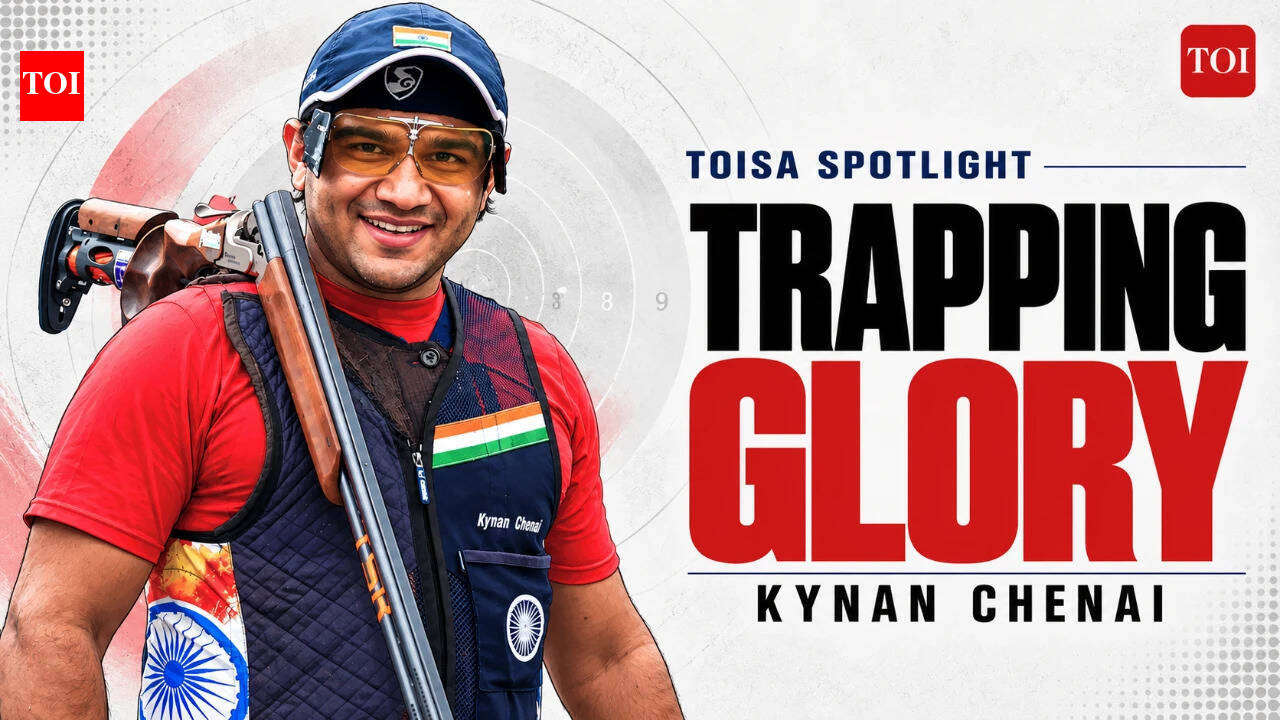
“Goosebumps!”That is the first word Kynan Chenai uses when asked what comes to mind when he thinks back to the Asian Games mixed-team trap final. He and Neeru Dhanda had won gold for India, but Chenai says there was little room to think about the medal while he was shooting.His attention was on the target, the gun mount, and the moment he needed to press the trigger. “At that point, nothing else mattered. It didn't matter if someone missed a target or if someone else broke theirs. All that mattered was hitting my target.” The emotion came later. “So, sitting here with you and thinking about it now, the one word that comes to mind is goosebumps.”Chenai had finished 16th in qualification in the individual event. In the mixed team, held a day later, he combined with Neeru Dhanda to qualify for the final and then shot 19 of 20 in the final. The change in performance was not lost on him.“At the Asian Games, I'm glad my experience and ability allowed me to flip the switch between the individual competition and the mixed-team event,” he says. “I was able to back myself and get that energy back after the individual event, which had taken place just a day earlier.”“I'm glad I was able to flip that switch. However, it comes down to my experience and my ability to grit my teeth and grind through difficult situations.”Gold medallist India's Neeru Dhanda, left, and Kynan Chenai pose for photographers during the medal ceremony after the trap mixed team shooting event at the 20th Asian Games, in Nagoya, Japan. (PTI Photo/Atul Yadav)The final also required Chenai to work alongside Dhanda, who had come off a demanding Asian Games campaign and was exhausted after shooting in the rain. He says the two had their own routines and that he trusted her to know what she was doing.He told her he would help if she needed anything; otherwise, they would focus on their targets and assess the result afterwards. Dhanda told him at one point, “My battery is down.” Chenai's reply was characteristically brief: “Then go and recharge it!” He laughs about their banter and says he was impressed by how she found the energy to keep going.“Eventually, I was very impressed by how she managed to gather some energy and hold everything together to a certain extent. I'm glad I was able to do the same, and it worked out very well for the country.”India's Neeru Dhanda, left, and Kynan Chenai celebrate after winning the gold medal (Photo by Atul Yadav)The 38-year-old barrel behind the goldThere was another detail behind the performance: the barrel on his gun belonged to his father, Darius Chenai, former national trap champion, who introduced Kynan to the sport when he was 10. The barrel was 38 years old.Chenai had been using a high-rib barrel for four or five years but was not getting the consistency he wanted. The decision to change it came after discussions with his team. His Perazzi gun allows different components to be fitted to the same action, so he could use another barrel without changing the entire gun. He did not have a regular barrel at home; his father's gun was the only one with one available.“I asked him, and he said, ‘Yeah, take it, use it.’ He wasn't using it at the time.”The older barrel worked well enough to be part of an Asian Games gold-medal performance.His father has since been teasing him about how many shells he is putting through it and warning him to be careful with something already so old. “But at the end of the day, it's all fun and jokes with him. He's quite proud that I've been able to use something of his and achieve some success with it.”The first person who taught him to shootKynan with father Darius (Photo from Instagram)Darius was also the person who first took Chenai to the range and put a gun in his hands. A two-time national champion in trap shooting, he taught his son the basics of shooting and, just as importantly, how to handle a firearm safely.Chenai says his father explained that a gun had to be respected, cleaned and put away properly. Some of the techniques he learnt then remain part of his shooting today.“I've had many different role models throughout my career. I could give you a list of names, but Dad is one of them. He's the first one, the OG.”He also names Manjir Singh, Manojit Singh Sandhu and Ranjan Sodhi as influences. More recently, David Kostelecki, his coach and a two-time Olympic medallist, has become an important source of advice. “I've been trying to learn from him how to win an Olympic medal. I keep picking his brain.”Chenai grew up in Hyderabad and spent 10 years at Hebron School in Ooty. He describes himself as a child more interested in sport than studies, keen to be involved in whatever was happening around him.Prithviraj Tondaiman, an accomplished Indian trap shooter who competed at the Paris 2024 Olympics and was part of India's gold-medal-winning men's trap team at the 2022 Asian Games in Hangzhou, was a young shooter at the range when Chenai was growing up. Tondaiman has often told him that he wanted to do everything: put the microphone on the range, load clay targets into the machine, check that it worked, shoot and then pick up the empty cartridges.“I was one of those kids who wanted to be involved in everything,” Chenai says. “I was into hockey, swimming, shooting and football. I loved everything.” Eventually, he had to settle on one sport. “But eventually, as life goes on, you realise that you don't have enough time to do everything. You have to pick one thing, and I'm glad I picked this one.”Kynan Chenai with Manvjit Singh Sandhu and Prithviraj Tondaiman (Photo from Instagram)Rio, the missed Olympics and the road to LAThe Olympics became the main target in his twenties. Chenai was 25 when he made his debut at Rio 2016, but he now looks back at that version of himself as a shooter who wanted to reach the Games without fully understanding what it took to win a medal there.“In my twenties, the one goal was to go to the Olympics. That was the main thing I wanted to achieve. However, I didn't know how to win an Olympic medal. I was a kid running on fumes. I was just shooting my way through whatever I could, relying on sheer grit and, as they say, sheer dumb luck.”Rio gave him the experience of competing at the Olympics and, in his words, a clearer sense of what he needed to do differently next time. Chenai finished 19th in the men's trap qualification with a score of 114. “That was a great experience for me because I learnt what to do and what not to do for my next Olympics. It was as simple as that.”He missed Tokyo and then Paris, both disappointments for a shooter who still wants another Olympic opportunity. But Chenai says he has learnt to move on rather than let the absence consume the next phase of his career.“I still have the goal of going to the Olympics. Yes, as you said, I missed the last two, which was disappointing, but it wasn't earth-shattering. I had already been to the Olympics in Rio.”However, the disappointment does not vanish while the Games are under way. He watches other athletes compete and thinks about being there himself.“When the Olympic fever is at its peak, you're watching the Games on TV and seeing people do great things. You want to be part of it too, right? When you're not there, it hurts.” His own measure of time is the closing ceremony. “But after the closing ceremony, you move on and carry on.”Kynan at Rio Olympics (Instagram Photo)Getting to Los Angeles, one competition at a timeLos Angeles 2028 is the next Olympic target, but Chenai is not looking to plan every step two years in advance. He wants to win another World Cup medal, too, and says his focus has shifted towards the competition immediately in front of him.Asked how he is approaching the final stretch towards LA, he answers without dressing it up: “There's no thinking behind it. There's just winning.” The first task is to win a quota place for India. He says that can be done at a World Cup, World Championship or Asian Championship, after which an athlete must qualify through trials in India under the federation's selection policy.“Without a quota place, we can't go. So, it comes back to what I was telling you earlier: give 100 per cent in one competition and see what happens. After that, we move on to the next one.”For Chenai, preparation means knowing when not to keep shooting. He says athletes can exhaust themselves mentally if they train hard right up to the competition. A shooter might put in 200 shells a day for 10 days, only to arrive at the event tired of repeating the same routine.“You're going to make a mistake, almost certainly, because you've been training with 200 shells a day for the last 10 days. You'll come back the next day, and your mind will say, ‘Oh man, we've got to do this again?’”His team follows a regimented tapering process to make sure he is mentally fresh when it counts. The rest of life has to be kept under control, too.Kynan at Asian Games 2026 Podium (Photo by Instagram)“You also work very hard to make sure everything in your life settles down around the time of your competition. After the competition, things can become hectic again. But during that period, your life has to be very mellow. There should be no drama, nothing.” He describes it as work that happens away from the trigger.Balancing life beyond the shooting rangeHe has also had to make room for life outside the range. Chenai got married seven months before and his businesses take up time as well.“I'm 35 now, so, as my family says, it's high time!” he says. “Shooting is my one love, of course, it takes up a lot of our time and effort.”“However, life has changed between my twenties and my thirties. I have to give time to other things in life as well. I have to make time for my family, my businesses and whatever else there is outside shooting.”Kynan is married to Ria Rajeshwari Kumari, Indian Olympian trap shooter and silver medallist at 2022 Asian Games (Photo from Instagram)He says the balance has changed his appreciation for the hours he gets at the range: “When I'm on the range, my appreciation for the game is greater because I love it so much and value the time I get to do what I need to do.”Chenai has been part of Indian shooting long enough to see changes in the support available to athletes. He credits National Rifle Association of India president Raninder Singh with helping put systems in place through which shooters can train at NCOEs, receive support under the Target Olympic Podium Scheme and access ammunition regularly.“He's put standard operating procedures in place that allow athletes to be part of NCOE and TOPS, receive ammunition and practise their targets every day. Not every month, but every day.” In his view, the ability to train consistently for around 250 days a year helps shooters develop the muscle memory needed to compete internationally.He says India's shotgun shooters have made progress, while rifle and pistol shooters remain capable of competing with the best despite a disappointing Asian Games. “Okay, they didn't have a good Asian Games. So what? In my opinion, they are still the best in the world. Indian rifle and pistol shooters are among the top performers. Shotgun is coming along, and you've seen that here.”Raninder Singh, Former NRAI President (Photo from agencies)He is also quick to point out that each discipline comes with different demands. Shotgun takes place outdoors, where rain and sun can affect competition; indoor shooters deal with conditions such as temperature and lighting. “I don't know all the logistics involved, but I can tell you that every sport has its own difficulties, and we are genuine contenders at the world level.”Still searching for perfectionChenai does not claim to have worked everything out. He says the years since Hangzhou have made him more mature in how he responds to competition, and that handling pressure remains a learning process.“I'm not saying I'm perfect or that I've figured everything out, because that's not possible. Nobody does that. I say this all the time: I don't think perfection exists, but I'm searching for it.”Asked what success means to him now, he does not reduce it to a medal count or an Olympic appearance. “It's about being the best version of myself, yes. And I can also tell you that if I'm consistent, I'm successful.”
‘I don’t think perfection exists’: Asiad medallist Kynan's unfinished Olympic pursuit
Full Article
Original Source
Read the full article at Timesofindia →KhanList aggregates and links to publicly available news content. We do not host full articles from third-party sources. Always verify important information with original sources.