
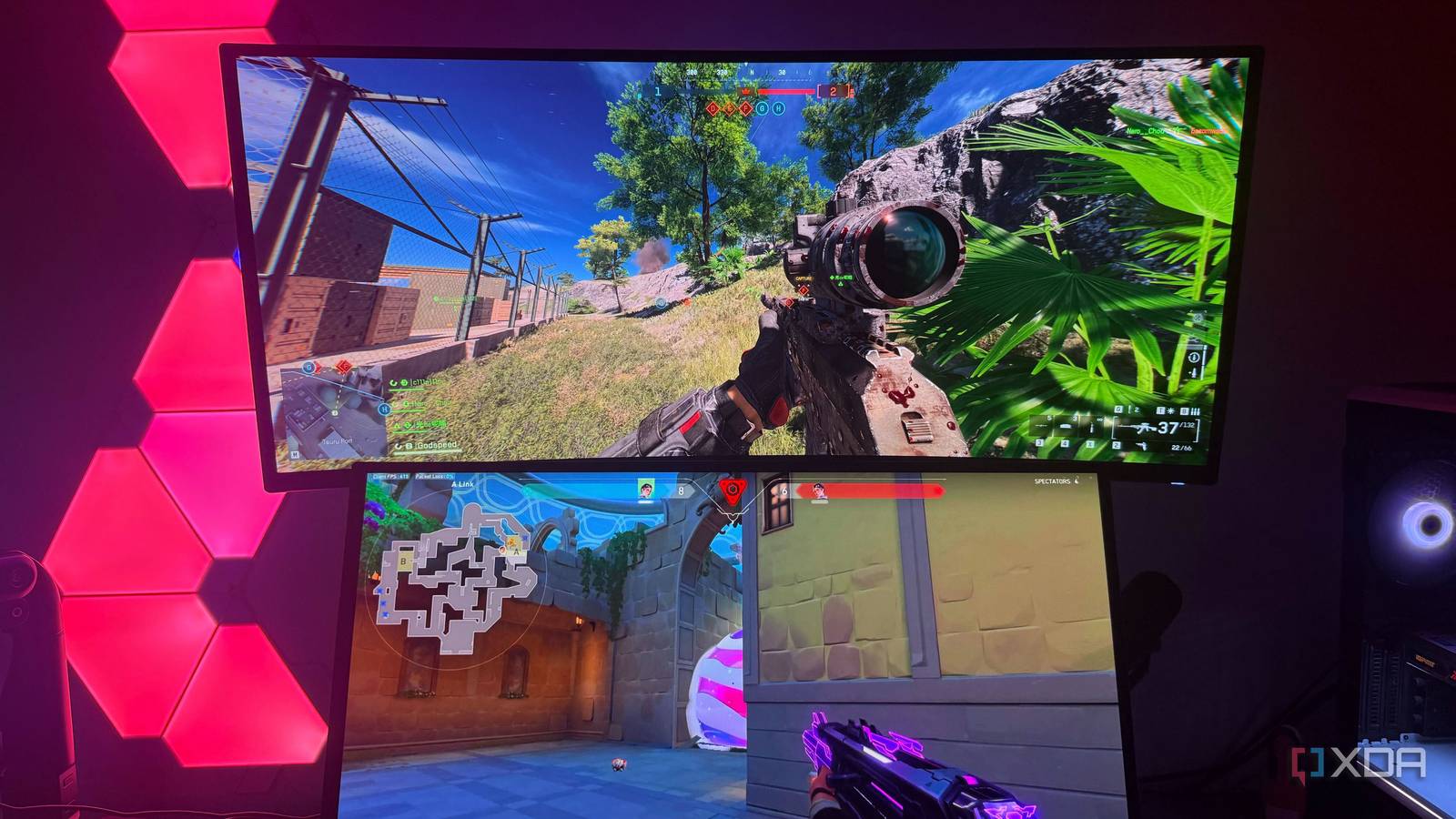
Published Jul 27, 2026, 12:00 PM EDT Hamlin has been in the tech field for over nine years. Since 2017, his work has appeared on MakeUseOf, Android Police, OSXDaily, Beebom, and more. He served as the Senior Editor at Valnet's MakeUseOf for over two years before joining XDA. He uses a high-end gaming rig for desktop use and a MacBook for traveling, but dislikes some of the quirks of macOS. You're more likely to catch him at the gym or on a flight than anywhere else. About two years ago, I bought the Alienware AW2725DF for the sole purpose of playing competitive games at a high level. Back then, it was one of the fastest OLED monitors on the market with a 360Hz refresh rate, so it seemed perfect for the esports titles I used to play every day, like Valorant and Counter-Strike 2. Even for AAA games, I'd still use it over my 4K/160Hz IPS monitor despite the resolution downgrade because the OLED panel looked that good. But after about a year and a half, I got the itch to try something different. That's when I started looking at ultrawide monitors and decided to get the AW3425DW. This time, it wasn't about the resolution or refresh rate. I simply wanted a more immersive gaming experience. Yes, dropping from 360Hz to 240Hz was a step backward on paper, but the extra horizontal screen real estate more than made up for it. The 360Hz OLED still sits next to my ultrawide as my secondary monitor, but I rarely game on it anymore. It made every AAA game feel larger than life For me, it was a completely new way to experience my favorite games Excuse the cliché, but "larger than life" is honestly the best way I can describe the experience. Up until this point, I've only gamed on traditional 16:9 displays, whether on my TV with the PS5 or one of the many monitors I've owned over the years. I knew an ultrawide monitor would give me more horizontal screen space from all the reviews I'd seen, but I didn't expect it to completely change how I experienced AAA games. In fact, it made me revisit some older games that I hadn't touched in years just to see how they'd look in 21:9. For starters, the wider aspect ratio just filled more of my peripheral vision, especially with the subtle curve of the AW3425DW. Open-world environments, in particular, looked much more expansive. Whether I was driving through Night City in Cyberpunk 2077 or riding horses in Red Dead Redemption 2, the immersion was nothing like what I was used to on either my 4K IPS or 360Hz OLED monitor. At this point, I'm convinced that 21:9 is the best aspect ratio for enjoying AAA titles. The downgrade to 240Hz didn't matter for most games Even with an RTX 4090, I wasn't getting anywhere close to 360FPS The RTX 4090 is clearly intended for 4K gaming, but that doesn't mean it's overkill for 1440p. Unless you're playing lightweight esports titles, you're not going to max out a 240Hz monitor, let alone a 360Hz one. Sure, you can use frame generation to get close, but that's not a true FPS boost because the responsiveness is still mostly tied to your base frame rate. And in newer AAA releases like Assassin's Creed: Shadows and Black Myth: Wukong, I'm still looking at double-digit frame rates on my AW3423DW. While that's partly because 3440×1440 has around 34% more pixels to render than a standard 16:9 1440p display, I had already come to the same conclusion before switching to this ultrawide. Even on my 360Hz OLED, I wasn't getting more than 150FPS in Battlefield 6 at maxed-out settings, and the game doesn't even support ray tracing. So it's not really a "downgrade" if I can't even tell the difference in refresh rate 90% of the time. The remaining 10% is all about competitive gaming, and that's a trade-off I'm willing to make. Faster is better, at least for competitive games But the benefits of a 21:9 screen go beyond gaming There's a reason why I still keep the 360Hz around even though I barely use it anymore. If I ever want to grind competitive shooters like Valorant or Counter-Strike 2 and actually rank up, I don't want to feel like my hardware is limiting me. In these games, I do get 300-500FPS, so a 360Hz panel can easily prove its worth. In fact, I even switched between the two monitors, and I could immediately tell the difference in refresh rate. Another downside of using an ultrawide for competitive gaming is that you'll have to deal with black bars, since these games force 16:9 to keep everyone on a level playing field. So, you're not taking advantage of that extra width either. But outside of that use case, it's hard to defend my AW2725DF or any faster OLED on the market. The ultrawide, on the other hand, is fantastic for regular use too. For instance, splitting two windows side by side doesn't make either one feel cramped. You can keep an app open in a standard 16:9-sized window and still have enough space to browse the web on the side. Watching movies shot in a cinematic ratio is also better because you don't have to deal with huge black bars at the top and bottom. And while editing videos in Premiere Pro, I can see more of my timeline, which is a nice bonus. When you put all that together, it's easy to see why I don't regret making the switch. I don't think I'll ever get tired of ultrawide Upgrading from a 160Hz to a 360Hz monitor makes a great first impression, but the novelty wears off quickly. Once your eyes get used to the higher refresh rate, it simply becomes your new normal. But ultrawide is different because every other monitor or TV I use is 16:9. Whenever I switch back to a standard display, it just doesn't feel nearly as exciting. That's why I'm sticking with this form factor in the long run. And when I eventually upgrade my GPU, I'll probably end up buying one of those new 5K ultrawide OLEDs.
I ditched my 360Hz monitor for an ultrawide, and it's the best downgrade I've ever made
Full Article
Original Source
Read the full article at Xda-developers →KhanList aggregates and links to publicly available news content. We do not host full articles from third-party sources. Always verify important information with original sources.