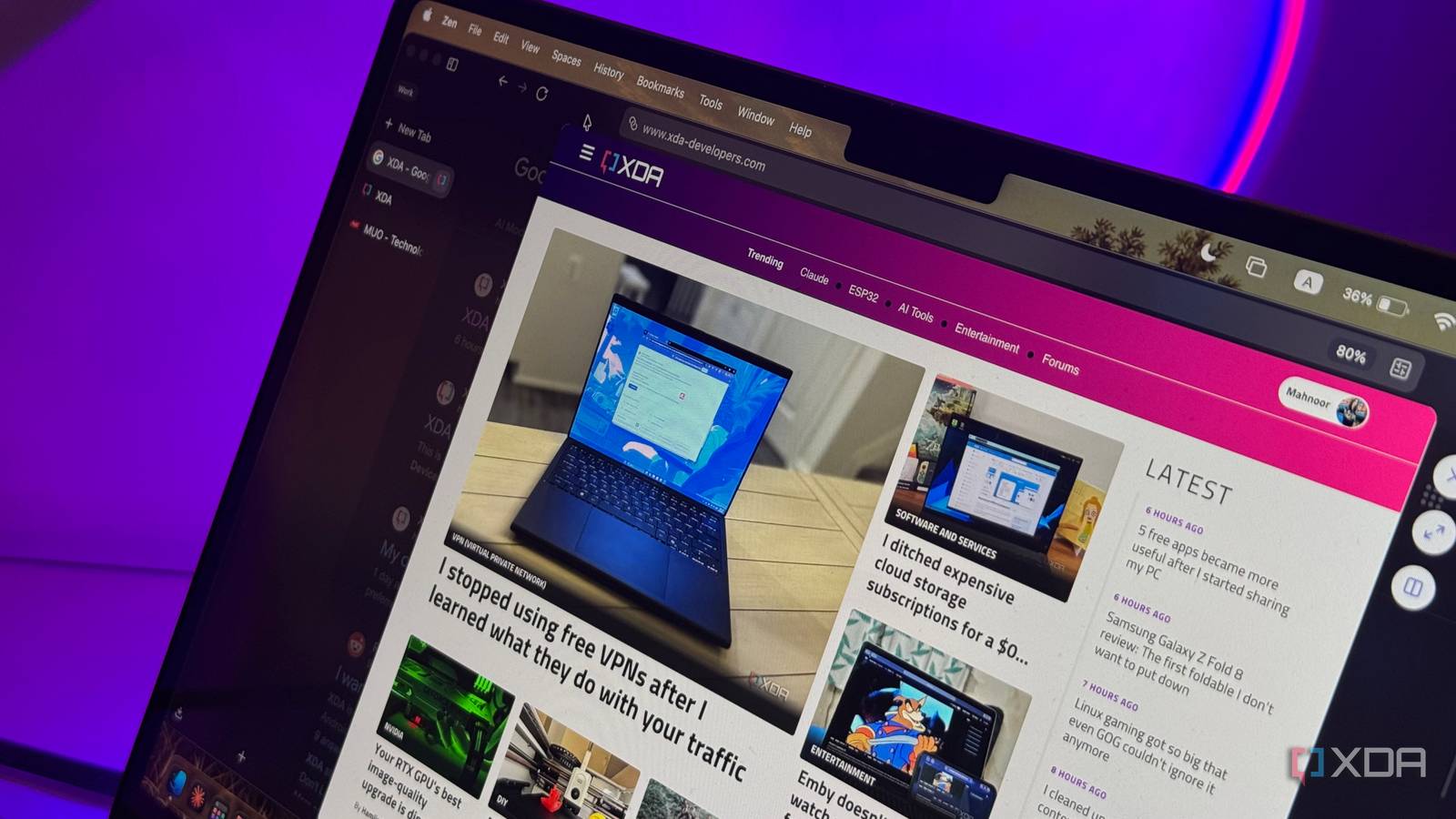
Published Aug 8, 2026, 3:30 PM EDT Mahnoor Faisal is a tech journalist covering AI and productivity tools with bylines at XDA, SlashGear, MakeUseOf, Laptop Mag, and Android Police. She's been writing professionally since she was sixteen, and has since penned hundreds of articles. This includes in-depth coverage of AI tools like NotebookLM to breaking news across the AI space. Her passion for technology started when she received her first iPod Touch (4th generation) on her 8th birthday, and she's been deep in the tech world ever since. Currently pursuing a degree in computer science, Mahnoor brings both a journalist's eye and a technical foundation to her coverage of how AI is reshaping the way we work and learn. I don't speak for everyone, but most people's very first laptop was a Windows laptop. It would barely turn on, would need to be plugged in 24/7 because the battery gave out years ago, and would wheeze its way through more than three open tabs. The reason I'm mentioning this is because that clunky old machine is where most of us met our very first browser. For the majority of us, it was Chrome. If it wasn't Chrome, it was typically Edge, and the very first thing the average person would do is use it to download Chrome. Despite having been a tech maniac from the very beginning, I was no exception. Chrome was my default for years, and when I moved on from it, I'd jump between Opera and Firefox. I've now ditched all three for Zen, and my only regret is not doing it sooner. Zen keeps Firefox's best parts and drops the rest All the Gecko, none of the Google I've tried tons of browsers in the past few months, and the majority of them have admittedly been agentic browsers. All the browsers I'd turned to, including the ones I mentioned above, had one thing in common: they were incredibly loud. Cluttered toolbars, sidebars stuffed with features no one really asked for, and a general sense that the browser wanted my attention as much as the websites inside it did. I installed Zen simply because it was marketed as a calm and minimalist browser, and that's exactly what I was looking for. I ended up sticking with the browser for reasons far beyond that, though. Zen Browser is an open-source Mozilla Firefox fork that was released on July 11, 2024, and it's compatible with macOS, Windows, and Linux. Unlike nearly every "alternative" browser that's just Chrome wearing a different skin, Zen runs on Firefox's Gecko engine. This means there's absolutely no Chromium in sight, and that's a big part of the appeal, since it's independent of Google's grip on the web. Firefox's been long-praised for its privacy, and Zen inherits that foundation. It gets the same Enhanced Tracking Protection, end-to-end encrypted syncing, and also strips out Mozilla's own telementry by default (whereas Firefox requires you to manually opt out in settings). Zen's real strength is in how it works The features that ruined every other browser for me The real reason I've stuck around with Zen for so many months is because it borrows the ideas that made Arc so great in the first place. For instance, while I was never one for vertical tabs, a few months in Zen has convinced me that horizontal tabs were holding me back the whole time. When you've got a dozen tabs open along the top of the screen, each one shrinks down to a sliver until you can't read the titles, and you're squinting at tiny favicons trying to remember which is which. Zen stacks them vertically in a sidebar instead, so the titles stay legible no matter how many you've got open, and scanning the list feels natural in a way that a cramped horizontal row never did. Better yet, you can tuck the whole sidebar away with Compact Mode when you want the page to itself, then summon it back with a hover or a keyboard shortcut! Then there are Workspaces. My life is divided between work, personal, and college. Given I don't have a separate laptop for work, and I'm a massive multitasker, everything used to pile into a single window. I'd have research tabs for an article sitting right next to my college's portal, college and work emails fighting for space in the same cramped row, and a dozen half-read tabs I kept meaning to get back to. Workspaces let me carve that chaos into separate spaces. I have separate workspaces for work, personal, and college. Each workspace holds its own sets of tabs and can even carry its own theme! As a journalist, the reason you'll find so many tabs open in my browser at any given time is because I do a lot of browsing. I open a link to check one fact, then another, then a third, and before I know it I've got fifteen tabs I'll never return to, each one opened for a single sentence I needed to verify. Zen's Glance feature is the fix I didn't know I needed. Instead of committing every link to a full tab, I hold Alt and click, and the page opens in a floating window layered right on top of the one I'm already reading. I skim what I need, dismiss it with a click, and I'm back where I started. For someone who opens links by the dozen just to confirm a detail, it's quietly become the feature I'd miss the most if I switched away. Zen is also very customizable as a whole. Beyond the workspace themes and layout tweaks, there's a whole Mods registry. You also have the option to write your own custom CSS, meaning you can reshape almost any part of the interface down to the pixel. I might just never switch back While I'm still always testing out new browsers, Zen's overall experience has made it the one I keep coming back to. The AI-native browsers are flashier, and the Chromium crowd will always have broader compatibility, but none of them have made me want to abandon the setup I've built here!
I ditched Chrome, Opera, and Firefox for this browser, and I wish I did it sooner
Full Article
Original Source
Read the full article at Xda-developers →KhanList aggregates and links to publicly available news content. We do not host full articles from third-party sources. Always verify important information with original sources.