
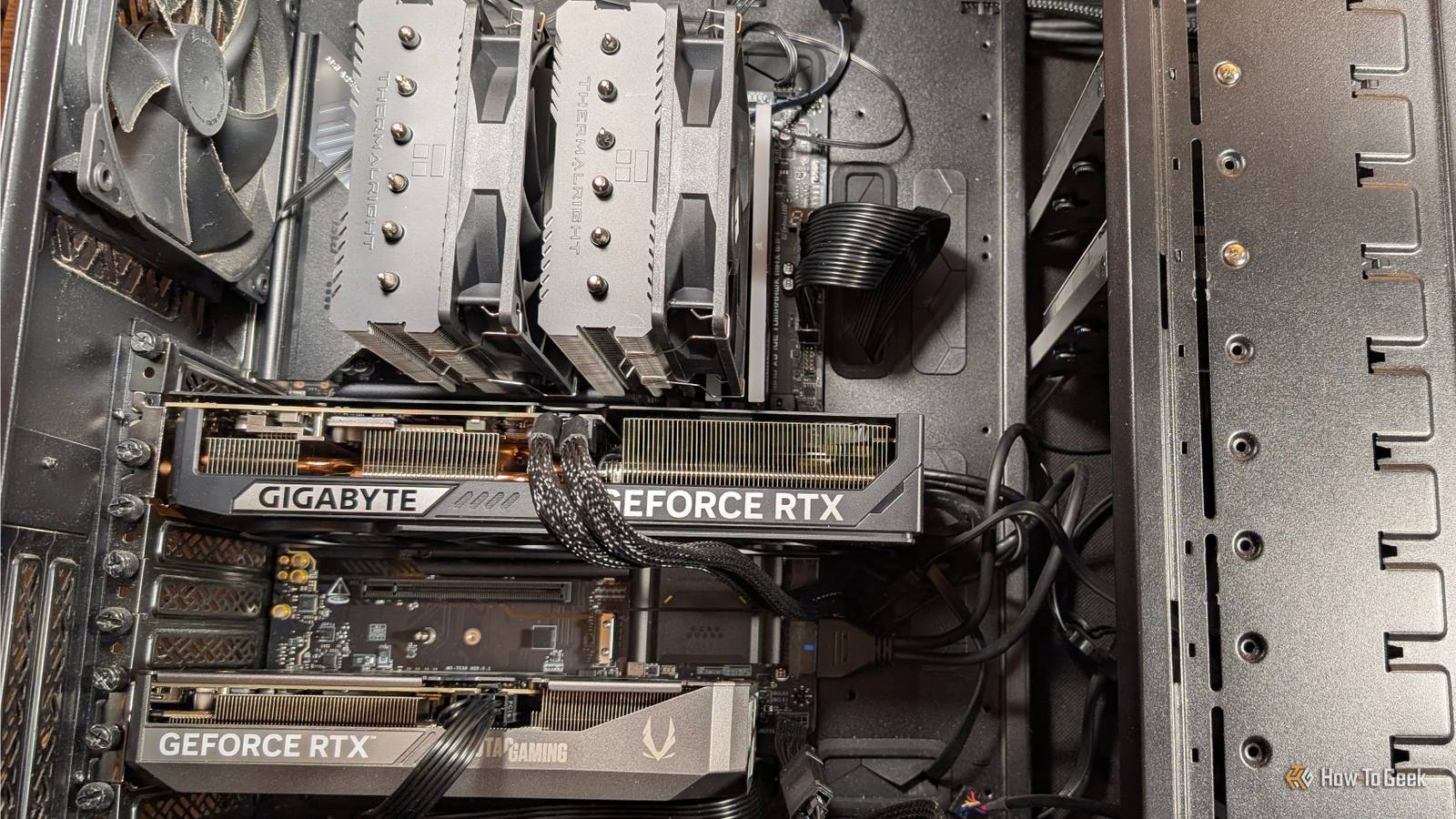
Published Oct 7, 2026, 7:30 AM EDT Monica J. White is a journalist with over a decade of experience in covering technology. She built her first PC nearly 20 years ago, and she has since built and tested dozens of PCs. PC hardware is her main beat, and graphics cards and the GPU market at large are her main area of interest, but she has written thousands of articles covering everything related to PCs, laptops, handhelds, and peripherals. From GPUs and CPUs to headsets and software, Monica's always willing to geek out over all things related to computing. Outside of her work with How-To Geek, Monica contributes to TechRadar, PC Gamer, Tom's Guide, Laptop Mag, SlashGear, Whop, and Digital Trends, among others. Her ultimate goal is to make PC gaming and computing approachable and fun to any audience. Monica spends a lot of time elbow-deep in her PC case, as she's always making upgrades, testing something, or plotting out her next build. She's the go-to tech support person in her immediate circle, so she's never out of things to do. Whenever she has spare time, you'll find her gaming until the early hours and hanging out with her dog. I built a brand new PC in 2024, and it cost me around $3,000. I built it with the expectation that I'll be able to play all of the latest games at max settings for the next few years. And yes, I obviously knew that DLSS would play a part in that. I just didn't realize how quickly I'd end up in unplayable territory if I ever tried to disable the whole thing. Turns out that even a high-end GPU won't protect you from the heavy compute cost of ray tracing and path tracing. The Witcher 3 remaster gave me another reality check Old game but still new I couldn't be more excited to check out The Witcher 3: Wild Hunt - Remastered. I'm a huge fan of the game, so to see it looking even better than before plus get some nice updates was a real treat. But when I jumped in on release day, the frame rates floored me, and not in a good way. The game may be a decade old, but all the new bells and whistles made it a lot more difficult to handle for my PC, even though my rig is not at all bad: I have an RTX 4080 Super and a Ryzen 7 7800X3D paired with 32GB of RAM (thankfully bought prior to the RAM-pocalypse). My settings were all the way at max, most likely because that's what I played at prior to the remaster being a thing, but DLSS was toggled off. I wasn't aware of that fact, so I initially thought that I was dealing with some patch day issues—a common thing for PC games, unfortunately. Why? Because my frames per second sat at a measly 40 fps. It was playable, but it felt so sluggish, I couldn't handle it. A quick dive into the settings told me why my PC was begging for mercy. Ray tracing, path tracing, all of that stuff was on, and cranked up. But DLSS was off. Which meant that my $1,000 GPU from 2024 couldn't offer solid raster performance in a game remastered in 2026. A part of me wanted to feel defiant at that point, although I've all but accepted that DLSS is the future of GPUs. So I decided to keep it off for a while and see if I could handle the subpar performance. I lasted less than five minutes. No wonder: CDPR's official guidance for 4K, 60 FPS with path tracing on calls for an RTX 5080, so it's not a surprise that my last-gen card wasn't happy about my attempts. Neither was I. We really can't play modern games without DLSS now, huh? Turning off DLSS isn't one simple switch Super Resolution and Frame Generation do two completely different jobs No matter which version of DLSS, be it DLSS 4.5 or DLSS 5, it's important to note that it's such a suite of tools at this point that you might be rocking one and ignoring the other. Super Resolution renders the game internally at a lower res, then reconstructs the final image at your target resolution. Frame Generation, meanwhile, creates additional frames and sticks them between the ones your GPU actually renders. Turning both off at once asks the GPU to render every pixel at full resolution and give up the extra frames, which, apparently, is a lot to ask these days. In my case, Super Resolution didn't make much of a dent in my fps, but Frame Generation, obviously, did. Enabling DLSS frame gen worked like a charm. I still wasn't able to max out my 165Hz monitor, but my frames sat at a comfortable 140-ish fps even during fast-paced shots. The game felt smooth and looked every bit as gorgeous as I hoped. We have to embrace the fake frames Focus on whether the game feels good or not It's funny, because when friends ask me for tips on picking a GPU in 2026, I've almost stopped asking them whether they were worried about rasterization or not. These days, frame generation and tool suites like DLSS 5 are inseparable from rasterization, because many GPUs will fail to deliver smooth performance in the latest games. Sure, you could get by with a much worse GPU if you'd just lower your settings, but for those who don't want to do that, DLSS isn't an option anymore, it's a necessity. Should modern games be optimized for no frame generation? I want to say yes, but ... The more game devs optimize for frame generation, the more likely it is that you'll end up using it, whether you like it or not. Some people hate that. Others love it. I tried to hate it, but I've learned to embrace it. I'll just do whatever it takes to make my games look and feel good at this point. If anything, the reliance on DLSS and similar tech will only grow more pronounced with every GPU generation, and game studios will account for that when optimizing their new titles. If the option is there, use it I tried to play without DLSS, but I didn't last long, and I don't suggest you try that, either. If the option is there and your GPU supports it, go for it. There used to be downsides, such as artifacts or latency, but those have mostly been dealt with (Reflex exists for a reason). Once I enabled DLSS, I had a lovely few hours in The Witcher 3 remaster, and I didn't regret it one bit.
I disabled DLSS to see if I could live without it and I lasted about five minutes
Full Article
Original Source
Read the full article at Howtogeek →KhanList aggregates and links to publicly available news content. We do not host full articles from third-party sources. Always verify important information with original sources.