
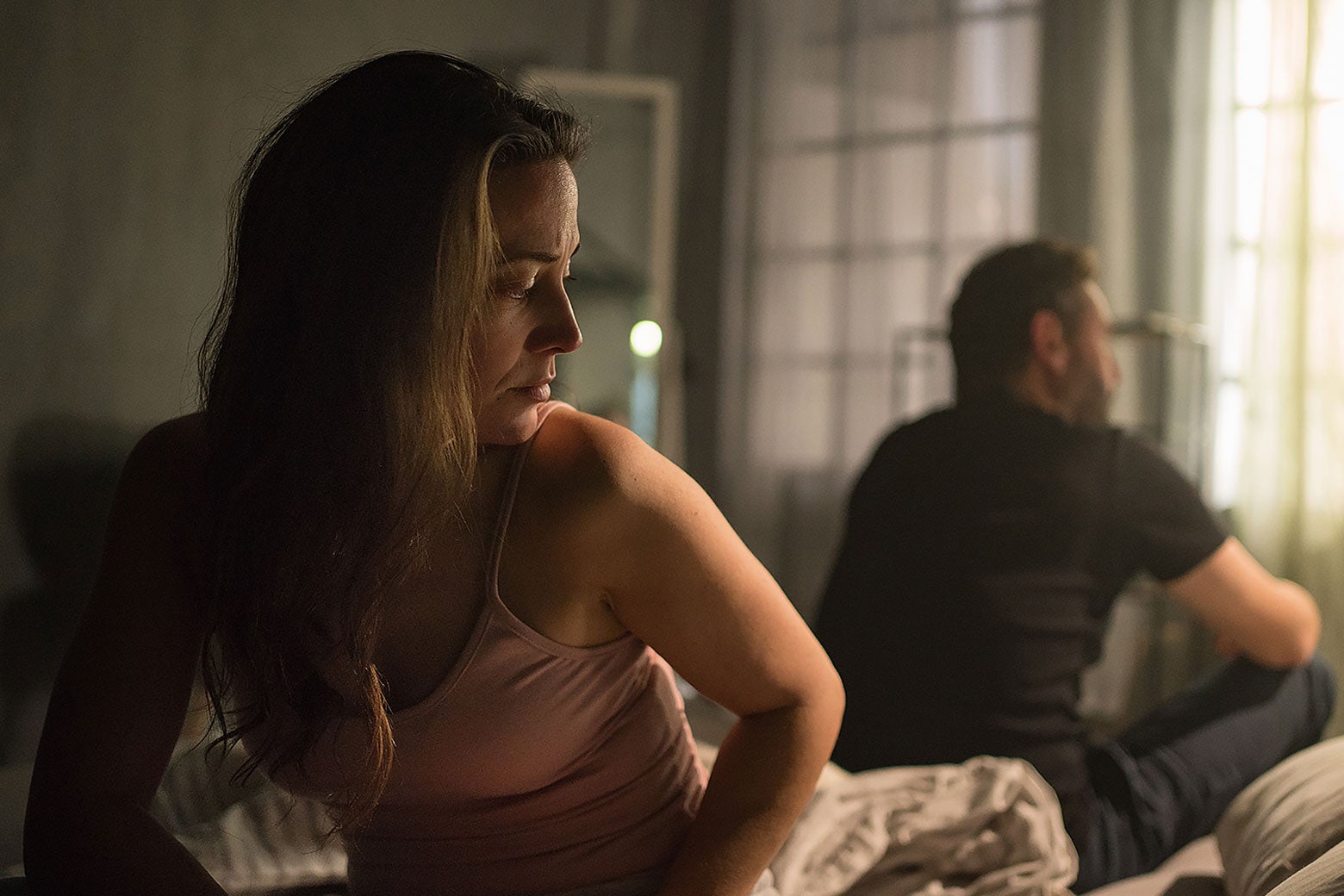
Medical Examiner For survivors of sexual assault, conception sex can carry extra emotional weight. Halfpoint/iStock/Getty Images Plus Sign up for the Slatest to get the most insightful analysis, criticism, and advice out there, delivered to your inbox daily. A year into trying for Baby No. 2, I sat on the couch, bloated, at the end of my follicular phase. My husband stepped into the glow of the television, a gentle, almost apologetic look on his face. I shut off the TV and followed him upstairs for yet another night of sex. I consented to it, of course. But I barely wanted it. For many couples, the goal of conception can transform sex from a passionate act, dictated only by desire, to a duty. In our case, it felt like a task we had to complete urgently and diligently. It had taken three years for us to conceive our first child. This time around, I was already in geriatric pregnancy territory, and I wasn’t getting any younger. Also, I’d recently had a miscarriage. According to our doctor, the next few months would present our best chance at a pregnancy. There was another factor in my case, one that is all too common: I’m a survivor of sexual assault. I adore my partner. When we met as freshmen in college, I immediately felt safe with him. Through years of typical relationship ups and downs, our attraction to each other has hardly wavered. But when a sense of obligation rather than romance is the driver behind sex, I occasionally find myself slipping into survival motions I thought I had long ago escaped. I desperately want another child. The process of trying to conceive, coupled with a history of sexual trauma, can sometimes leave me feeling disturbingly disconnected from my own body. When I feel threatened, I dissociate. When I was younger, and trapped in a nonconsensual situation, I focused on small details: a car radio, a crooked curtain rod, the carpet beneath my face. Now, sometimes during trying-to-conceive sex, especially when ovulation amplifies the discomfort of my endometriosis, I find myself engaging in the act with the same distance. “There is a parallel between having something done to your body that you did not want to happen and having to have sex when you do not want to be having sex for a goal outside of yourself,” says Laura Federico, a psychotherapist and sex therapist. It’s not that conception sex resembles assault. It doesn’t. It’s that my body sometimes performs similar, involuntarily reactions in both cases. It’s that I thought I had long since worked through these feelings. And here I am, in the most secure relationship of my life, with the person whose love and support helped me heal, still struggling. Most of the time, even if an encounter begins because of obligation, it quickly becomes enjoyable and we move beyond it. But other times we have to stop because of discomfort or panic, a reality that affects us for the worse. Not being pregnant when you want to be is difficult. Having to endure the reenactment of trauma with your most trusted sexual partner, over and over, in pursuit of having a child is another layer. Federico identifies these moments as trauma triggers (a concept that is often broadened beyond usefulness but can genuinely occur for survivors). “A trigger really turns on a system in the body that has learned a lot through trauma,” she says. “It’s so real for people trying to conceive. I do see this a lot in my work. When something is similarly uncomfortable, the ways in which our bodies have learned to respond to get through a painful situation are automatically instigated.” Infertility physician Ido Feferkorn, an expert in trauma-informed care in a clinical setting, reminded me in an interview that trauma is a problem of lost control, communication, and agency. Through a survey of fertility patients with a history of sexual assault, Feferkorn and his colleagues found that, for many patients, fertility treatments completed in an office—and that barely resemble sex of any kind—can be retraumatizing. But they also found practical accommodations that could make clinical care feel safer and more empowered. “It comes down to a desire to regain the control,” says Feferkorn. “Because the point where [the survivor] had no control was very traumatizing.” Some solutions that can reduce discomfort include allowing the patient to choose the music playing during a scan or procedure, and determining the pace at which a procedure takes place. Patients can even insert their own vaginal ultrasound probes, which are frequently used to peer inside the uterus during in vitro fertilization. “You can still be in control through this process if we communicate properly,” says Feferkorn. Researchers and clinicians are increasingly discussing trauma-informed approaches to fertility treatment, pregnancy, and birth. But trauma triggers can be an issue when conception happens outside a clinic, in the context of a loving relationship—and they can be scary to deal with. Even naming a trigger, and connecting it to our lovemaking, felt as if it would break that sacred bond of protection first felt 18 years ago. But Federico suggests that avoidance may actually do the most harm in exacerbating trauma symptoms. The longer dissociative patterns are ignored and repeated, the more ingrained they become in your mind and body’s understanding of intercourse. Ultimately, talking about what was going on was our first step back to enjoying the intimate part of the baby process. During my fertile windows, we started putting measures in place that were very similar to the ones used in trauma-informed fertility care. I would choose the music, the position, and the pace, my partner relinquishing even surprisingly subtle gestures of control. Then, there’s awareness that this won’t last forever. I can remind myself that conception sex is not the new normal but a temporary recurrence. That understanding relieves a lot of the dissonance trying-to-conceive sex brings into my home. Best of all, open communication has given me the ability to name it when conception pressure begins to feel a little too similar to the coercion of assault, giving us an opportunity to pause and reorient. This shift in perspective worked, then was followed by devastating news. In June, as I was drafting this essay, we experienced another pregnancy loss, this time a rare and dangerous type of ectopic pregnancy. I’m lucky to have not lost any of my reproductive parts, let alone my life, though I was given medications that could complicate another pregnancy, and trying to conceive again has been advised against for several months. The road to healing from this loss has been rocky and nonlinear, but the relief of the return of our sex life unburdened from a timeline and a goal has been profound. Even with all the tools we’ve gathered for having conception sex that feels safe and loving, the compounding pressure of being a sexual assault survivor and someone who struggles to get and stay pregnant looms over the baby-making process. For now, in the bedroom, I can just be myself. Get the best of news and politics Sign up for Slate's evening newsletter. Children Sex Sexual Assault Women
I Desperately Want a Baby. What I Need to Do to Get One Can Take Me to a Dark Place.
Full Article
Original Source
Read the full article at Slate →KhanList aggregates and links to publicly available news content. We do not host full articles from third-party sources. Always verify important information with original sources.