
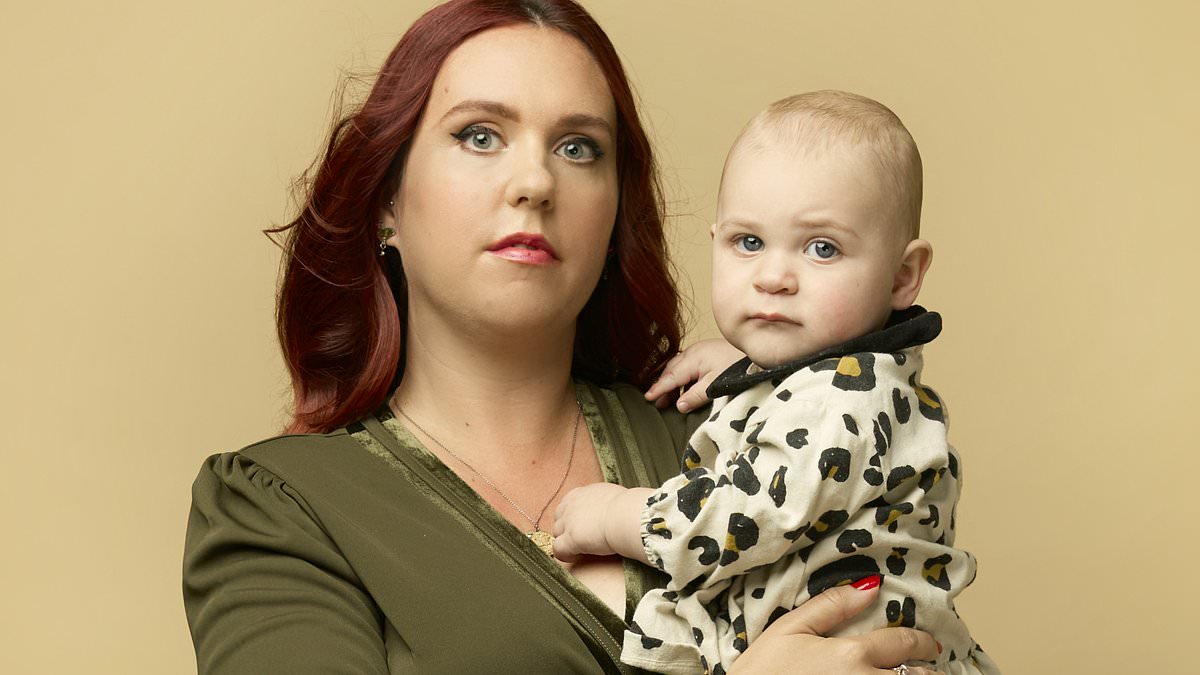
My heart was pounding in terror as I stared at the reflection in the mirror. My teeth were dotted with chunks of flesh – blood-red, fresh and oozing.Oh my god, my baby. Had I actually eaten my baby?It took a few minutes for me to calm down and realise that, of course, I hadn’t. There was a plum stone in my trembling hand, and my two-month-old daughter, Rosalie, was fast asleep in her cot. While undoubtedly extreme – and even a little darkly comical – many would put this incident down to one too many sleepless nights for me as the mother of a newborn baby.After all, lack of sleep can do horrible things to even the strongest mind. But this went beyond that.Which is how, in February this year, I found myself a patient at the Thumbswood Mother and Baby Unit in Radlett, Hertfordshire – a specialist psychiatric hospital for new mothers experiencing serious mental health crises. I had recently suffered a terrifying bout of postpartum psychosis, tormented by delusions that saw me nearly sectioned and placed on suicide watch after two attempts to take my own life.This was no cry for help; I truly wanted to die. Death had seemed the only way out of the nightmare I was trapped in.I’m sharing my story now to try to make sense of my still-fresh experience; I was released from hospital at the end of March and only started to feel normal again in August.I also want to raise awareness of this condition, which affects one in 1,000 women – usually in the first six to eight weeks after giving birth – and which couldn’t be further from the ‘baby blues’ that most people associate with those difficult early days of motherhood.Prompt detection and intervention mean that most mothers go on to lead healthy lives but, sadly, most women don’t have any idea what is happening to them when they find themselves immersed in this hell.Certainly, there was no indication of what would happen to me. I’ve no history of mental illness and hadn’t really heard of postpartum psychosis before I experienced it. I had recently suffered a terrifying bout of postpartum psychosis, tormented by delusions that saw me nearly sectioned and placed on suicide watch after two attempts to take my own lifeI was living a perfectly normal life before Rosalie’s birth. My husband Alex and I had been together ten years, meeting when we both worked in the music industry, before I took up a role as media and PR manager for the domestic abuse charity Refuge.We had conceived with relative ease when I had just turned 33 and I was classified as a low-risk pregnancy.I was all set for a chilled-out water birth, complete with Neom essential oils and my own playlist.But, as they so often do, things took a drastic turn when I was 40 weeks and six days pregnant in December 2024.Uncomfortably overdue, I went in for a general check-up with the midwife at the children’s centre, expecting perhaps a suggested intervention to get things moving.Instead, I was sent straight to hospital with protein in my urine and sky-high blood pressure.On the maternity ward at the Lister Hospital in Stevenage, Hertfordshire, I was quickly diagnosed with ‘severe pre-eclampsia’. Things were no longer going to plan. Panic set in.I’d heard about pre-eclampsia in my antenatal classes, a serious condition that can cause seizures and be fatal to both mother and baby.We’d been told to look out for headaches, swelling and stomach pain – but I suffer from chronic migraines, so how was I supposed to know the difference?Plus, I was 40 weeks pregnant and the size of a small whale, so it was easy to miss any swelling.People say all births are traumatic and painful, and maybe this is true, but it wasn’t the pain of childbirth that left me reeling. It was the confusion, the feeling I wasn’t being listened to, that will forever haunt me.I went from ‘everything as expected’ to being hooked up to a drip surrounded by doctors discussing the risk of organ failure and seizures within a matter of hours. Looking back, it’s no wonder my brain lost its equilibrium. The treatment for pre-eclampsia is to get the baby and placenta out as quickly as possible, usually via an emergency C-section.The operating team was fantastic and, with Alex by my side, dressed in scrubs and trying to reassure me, despite being terrified himself, 30 minutes later little Rosalie, weighing a healthy 7lb 13oz, took her first lusty cry.And that’s where the drama should have ended – that first awe-struck cuddle with my newborn, a few days’ recuperation, then to our home in Bedfordshire for our new life as a family of three. But various infections and post-birth complications meant I stayed on that recovery ward for a fortnight.Despite being a place of healing, a hospital can feel like the very worst place to be when you’re an exhausted, bewildered new mother: staff changeovers, the constant bleep of machines and bright lights both night and day meant I got no sleep at all. Despite being a place of healing, a hospital can feel like the very worst place to be when you’re an exhausted, bewildered new mother: staff changeovers, the constant bleep of machines and bright lights both night and day meant I got no sleep at allOnce, I got so teary and distressed that – despite being surrounded by medical professionals – I was given a number for the mental health support line.‘I don’t have post-natal depression,’ I pleaded. ‘I just need to go home.’ A few days later I finally did go home, laden with an A4-sized bag of blood pressure medication and a healthy baby girl.New motherhood is a maddening time for everyone. The endless cycle of nappy changes, feeds and laundry makes most women feel like a shell of their former selves. Yet normally, with time and growing confidence, things settle down.Except for me, they never did. It just got worse and worse.I have often wondered what it was that triggered my psychosis. Was it fluctuating hormones? Lack of sleep? The trauma of a chaotic birth? Or was it a potent cocktail of all three?While it’s true that postpartum psychosis is more common in women who have had a difficult birth, like many illnesses specifically affecting women the exact causes are unknown.It’s often overlooked, too, as the first signs are so often confused with exhaustion. Certainly, my health visitor and GP saw no red flags.I was exclusively breastfeeding, and as such wasn’t getting much sleep. I was snappy, raging constantly at Alex, who bit his tongue and nobly assumed this was part and parcel of new family life.He urged me to consider bottle-feeding at night, desperate to do anything to help, but I was determined to do everything by the book.But before long, my symptoms went beyond that of tired new mum.One day, three weeks after giving birth, I woke up utterly convinced that Roz was dead in the bed with me.It was terrifying, and took a few minutes for me realise that what I was looking at was the pattern on our floral bedspread – not my baby’s dead face. It felt so real, and my heart was racing. This was the first hallucination of many, each one more bizarre than the next.I saw Rosalie’s face in the chandelier, and then – the oddest of them all – I literally watched her face morphing into that of the actor Jason Watkins, who played Prime Minister Harold Wilson in The Crown. Then, a week later, came a line from a 1990s pop song that kept playing on a loop in my head. It was from Brimful of Asha by Cornershop and went: ‘Everybody needs a bosom for a pillow, everybody needs a bosom.’On and on, round and round in my brain.You might be laughing now, and I don’t blame you – even I can see the funny side, months on. But when you’re living it, all day, it’s utterly petrifying. I began to think Rosalie wasn’t there at all, and Alex had replaced her with a pillow or an animatronic doll – before becoming convinced Alex actually was Rozzy, all grown up.Clearly the ‘doesn’t she look like her dad?’ comments from well-wishers had triggered something in my scrambled brain.Initially Alex thought my confusion was funny; then he started to get scared. One morning, after I’d sat up talking gibberish all night, he told me: ‘I can’t do this any more, this is so much harder than I thought it would be.’At first in between my delusions I was lucid and scared, knowing at any point my mind could trick me again. But by two weeks after my initial hallucination, I’d completely lost touch with reality, my delusions spreading beyond my baby.I thought the house was on fire. The television was talking to me, telling me I had to ‘figure it out’. I treated the house like an escape room, thinking if I did certain rituals I would win the prize of getting my sanity back.Alex was back at work by this point. Normally, I would have relied on my mum – who is my best friend – but in a cruel twist of irony in my delusional state we had a huge argument, culminating in my telling her that I didn’t want to see or speak to her.She’s told me since that she knew something was wrong, but again just thought it was hormones, and I would calm down in a few weeks. But towards the end of February I’d started asking where I was, and what the date was, over and over again.Alex took time off work to look after me and wanted me to go to hospital, but even the mention of it made me agitated, reminding me of the trauma of giving birth.Unbelievably, I had a general check up with the GP for my blood pressure during this time, who didn’t seem the slightest bit concerned about anything.In fact the GP – a mother of two – tried to reassure me my behaviour was normal. ‘Just focus on the breastfeeding and you will feel better soon,’ she told me.That is the other insidious thing about this scariest type of mental illness: it stops you being able to communicate your distress adequately, so you don’t get the help you need. Only now do I realise how deadly delaying getting the right help can be.Look at the recent case of Alice Mackey, who was jailed earlier this month for drowning her two-year-old daughter Annabel while in the grip of postpartum depression. She had stopped taking her anti-psychotic medication when she killed her little girl, thinking she would be better off dead than with a mother like her.Luckily, I was never assessed as a threat to my daughter, but who knows what might have happened had my family not intervened when they did.The flashpoint came when we had ordered a Thai takeaway as a treat the evening after that GP appointment. When it arrived, I was convinced it was covered in flies and couldn’t be persuaded otherwise. Once I started shouting at the television, Alex overruled me and called an ambulance.In A&E I was told I most likely had postpartum psychosis and sent home with ‘community support’ in place, with Alex put in charge of my medication while they arranged for an assessment.After my official diagnosis, doctors made moves to section me under the Mental Health Act but Alex – my absolute rock – was determined I shouldn’t be separated from my daughter and pushed for me to get a place at a specialist mother and baby unit, which I did.But I needed the nightmare to end, and so I decided, the morning I was meant to go to the unit, to drown myself in a scalding hot bath. Alex, of course, was constantly checking on me and intervened. I arrived at Thumbswood still wet and wrapped in a towel that I refused to remove.It’s hard to recall this period clearly, or describe what I was feeling other than utter confusion and fear. Psychosis completely alters your perception of reality.As they showed me around the hospital I cried hysterically; nothing was making any sense.That night, I tried to kill myself again, attempting to suffocate myself with a pillow to make the noise both inside and outside my head stop. Staff intervened, but I tried again the next day; this time Mum stopped me. The staff looked after Rosalie overnight, feeding her formula in a bottle – and me drugs to help me sleep.I was still experiencing delusions – like my conviction that I had eaten my baby when I had actually eaten a plum – but the anti-psychotic medication mercifully took effect quickly.As my mind cleared, the floodgates opened and in poured shame and embarrassment – but most of all relief.Roz wasn’t dead. I wasn’t a bad mother. Those thoughts were just tricks made up by my brain.After a month, I was deemed well enough to go home. I was so relieved, but terrified of being left alone with my baby and suffering hallucinations and delusions again. Everything felt very loud, and I felt very fragile, so Alex had to work from home indefinitely.What followed was – somehow – the part that hurt the most. Postnatal depression crept up on me slowly. However, within a month of being sent home from the psychiatric unit it was all-encompassing.I would wake up distraught that I hadn’t died in my sleep, not knowing how to get through the day. Then, like clockwork, the mum guilt would kick in as I’d hear Alex feeding Roz breakfast while I was unable to get out of bed. I was meant to be well now, I was meant to be in control – how could I still be this ill?To add insult to injury, the anti-psychotic medication that was solving one issue was making me feel like a zombie, making my depressive symptoms worse.It took me months to recover from the depression, but with the help of antidepressants, my family and community workers I’ve started to feel more like myself again and enjoy motherhood.It’s still early days. Rosalie and Alex have been my rocks throughout and, now nine months old, she has been unfazed by her mother’s brush with madness.Friends and family have been sympathetic and understanding and I know I’m lucky to have such a close support networkLooking back, it feels like something that happened to someone else. I’m still making sense of what happened – that I had a baby and literally went mad.But if I could give one message to everyone reading this, it would be to continue checking in on new mothers after the excitement of the initial visits wears off.It’s during these baffling months of sleeplessness and isolation that mental illness can creep in – and, untreated, potentially prove fatal. Keep watching, keep vigilant and never be afraid to step in. I’m so thankful someone loved me enough to do that for me.For more information and support visit Action On Postpartum Psychosis (app-network.org) and the Pandas Foundation (pandasfoundation.org.uk) for perinatal mental illnessFor free confidential support, call Samaritans on 116 123 or visit samaritans.org
I decided to drown myself in a scalding hot bath and was convinced I'd eaten my baby. This is the horrifying reality of living with postpartum psychosis... and the outrageous thing my female GP said to me about my condition
Full Article
Original Source
Read the full article at Dailymail →KhanList aggregates and links to publicly available news content. We do not host full articles from third-party sources. Always verify important information with original sources.