
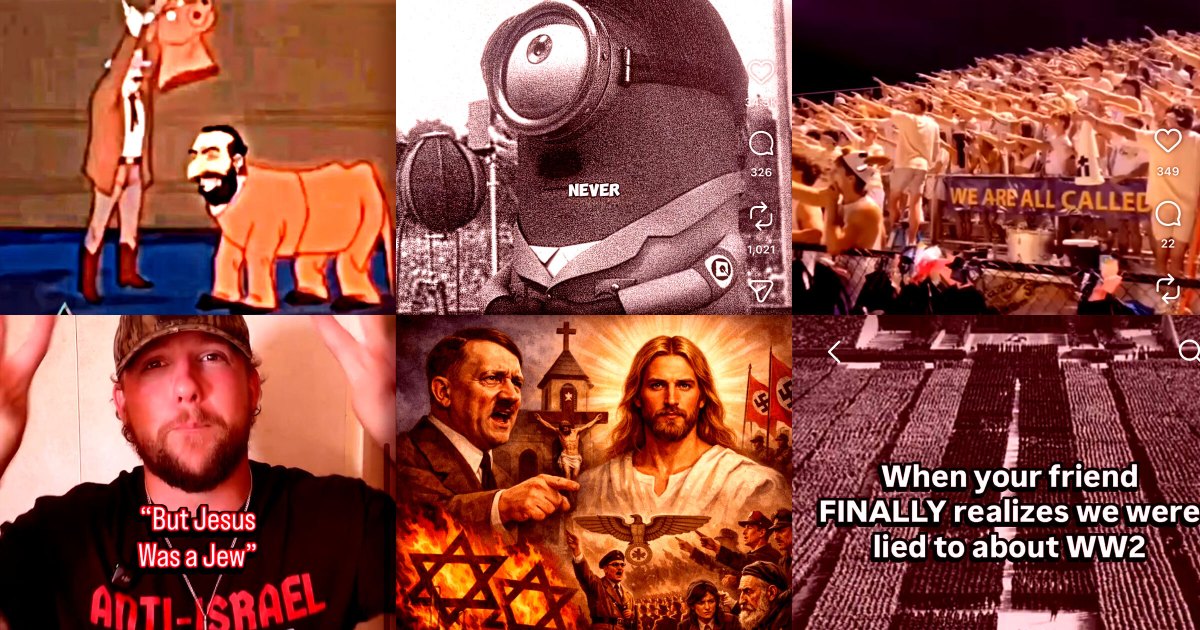
I open Instagram on my phone, and the flood of hatred is immediate. The first video on my home feed is a conspiracy theory claiming that the Titanic was intentionally sunk by Jewish elites in a plot to kill opponents and take control over the Federal Reserve. There are endless flattering edits of Nazi soldiers and speeches by Adolf Hitler, videos claiming the Third Reich was “defending western values,” declarations that “Jews started LBGTQ,” warnings against “Jewish propaganda,” antisemitic depictions of Jewish people, and clips of Nick Fuentes, the incel leader of the Groypers hate group. Commenters praise the “Austrian artist,” referring to Hitler, and use emojis to draw swastikas. Peppered throughout the feed is content disparaging Black and Muslim people, along with calls to repeal the 19th amendment, which granted women the right to vote. I refresh. Now the first post is a video about race science. Further down, Meta’s AI recommends that I ask about “antisemitic gym motivation.” This geyser of overt Nazism and bigotry is on a brand-new Instagram account I’d registered the day prior. Since creating it, I hadn’t liked or shared any posts, nor followed any accounts. Instead, all I did was search for a few neutral terms related to Judaism — and Meta’s algorithm did the rest, transforming my feed into a bottomless pit of hate speech and misinformation. I was inspired to try the experiment last week, when the watchdog Nexus Project published a report exploring how Instagram’s algorithm promotes blatantly antisemitic content. In response, Meta disparaged the group’s work, telling Futurism that it contained “both factual inaccuracies and misrepresentations” and that “this type of violent and hateful material has no place on our platforms.” To test what was really going on, I registered a fresh Instagram account and used it to search for innocuous terms like “synagogue,” “Jewish people,” “rabbi,” and “Judaism.” At first, the results were mixed. Some posts celebrated Jewish heritage and culture, like a travel video about the world’s most beautiful synagogues. But immediately interspersed with top results were hateful memes, conspiracy theories about Jewish people secretly controlling world politics, and quotes from infamous antisemites like Henry Ford. I tapped around on some of these posts and scrolled through a handful of accounts that were sharing antisemitic content, but I didn’t like or follow any of them. Within 20 minutes, my Home feed was infected with antisemitic conspiracies and dehumanizing language about Jewish people. And that wasn’t all: soon, Instagram’s algorithm started serving me other types of extremist content, like self-avowed America First creators claiming the public has been “lied to” about the American Civil War, wild-eyed conspiracies about “NASA and the Mark of the Beast,” and Christian nationalist posts fixated on calls for mass deportation. After spending some time scrolling, I returned to my search tab and inputted the same Judaism-related searches I’d run before. The same queries now almost exclusively returned bigoted and conspiratorial content, like posts claiming that World War II was pushed “on both sides” by Jewish people and an AI-generated image of Jesus hovering over Hitler while Stars of David burn in the background. Some posts were soundtracked by “Erika,” a Nazi-era German marching song that’s used as a dog whistle by far-right propagandists. Within an hour of creating the account, its feed was completely filled with conspiracies accusing Jewish people — often referred to with dog whistles such as “tiny hats,” “the bankers,” or a juice box emoji — of causing the downfall of Western civilization. In one video, a creator with more than 500,000 followers insisted that “nukes are fake” and that Americans stole uranium from peaceful pre-1940s Germans who were working to create energy that could liberate them from the “Rothschild-Rockefeller oil system.” In another, a creator urging followers to stop believing “Jewish myths” ominously contends that “there is a reason why they didn’t translate the Munich speech of 1939 in US history.” By the end of the day, Instagram was serving me content about how Nazi book burning was a good thing and videos questioning whether Hitler was really evil. The Instagram algorithm further encouraged me to branch out from antisemitism into other types of hate, recommending videos about racial pseudoscience, Islamophobic conspiracies, and misogyny. Beneath many posts, Instagram’s Meta AI-powered search tool also started to recommend that I dive deeper into clearly conspiratorial and bigoted topics, including “Jewish influence politics” and “goyim destruction prophecy.” (Meta AI searches for “Erika” and neutral terms like “women” and “Black history also returned a flood of hateful material.) In a statement, Meta said that it was committed to keeping hateful content off its platforms. “There is no place for antisemitism or any other form of hateful conduct on Meta’s platforms, and we continue to take action against any violating content we identify,” Meta told Futurism in a statement. “While creating a new account to specifically engage with certain content is not representative of any genuine, legitimate use case, we take this very seriously and continue to strengthen our detection methods for identifying and removing antisemitic content. This includes improving our systems for recognizing coded antisemitic language and harmful stereotypes and sending content that requires a closer look for expert review.” Meta’s Community Standards forbid what it defines as “hateful conduct,” which includes “Holocaust denial,” “slurs,” “dehumanizing speech,” and “claims that Jewish people control financial, political, or media institutions.” However, there are signs that the company has significantly retreated from enforcing those rules. At the outset of Trump’s second term, it announced that it was ending its third-party fact checking program and allowing “more speech by lifting restrictions on some topics that are part of mainstream discourse and focusing our enforcement on illegal and high-severity violations.” As we’ve found in prior reporting, the company often fails to remove videos of physical child abuse and even sexual abuse when reported by users. “On platforms where billions of people can have a voice, all the good, bad and ugly is on display,” it wrote at the time. “But that’s free expression.” It’s no secret that destructive white supremacist ideals and revisionist histories have found an audience in American politics, particularly among young conservatives. What was extraordinary to experience, however, was how quickly Instagram absorbed benign queries and pushed me toward the most horrifying interpretations of them possible — and how those interactions so heavily impacted searches for other topics. Instagram’s algorithm saw my searches about a minority group and, when I showed even a passing interest in conspiracy posts, propelled me into a personalized echo chamber of full-blown Nazism. And the deeper you go, the harder it is to look away. More on Meta: Meta Is Refusing to Remove AI-Generated Videos of Coaches Inappropriately Touching Young Athletes When Users Report Them
I Created a Completely Fresh Instagram Account, Searched for Some Innocuous Terms Related to Judaism, and My Feed Almost Instantly Became a Cesspool of Overt Nazism
Full Article
Original Source
Read the full article at Futurism →KhanList aggregates and links to publicly available news content. We do not host full articles from third-party sources. Always verify important information with original sources.