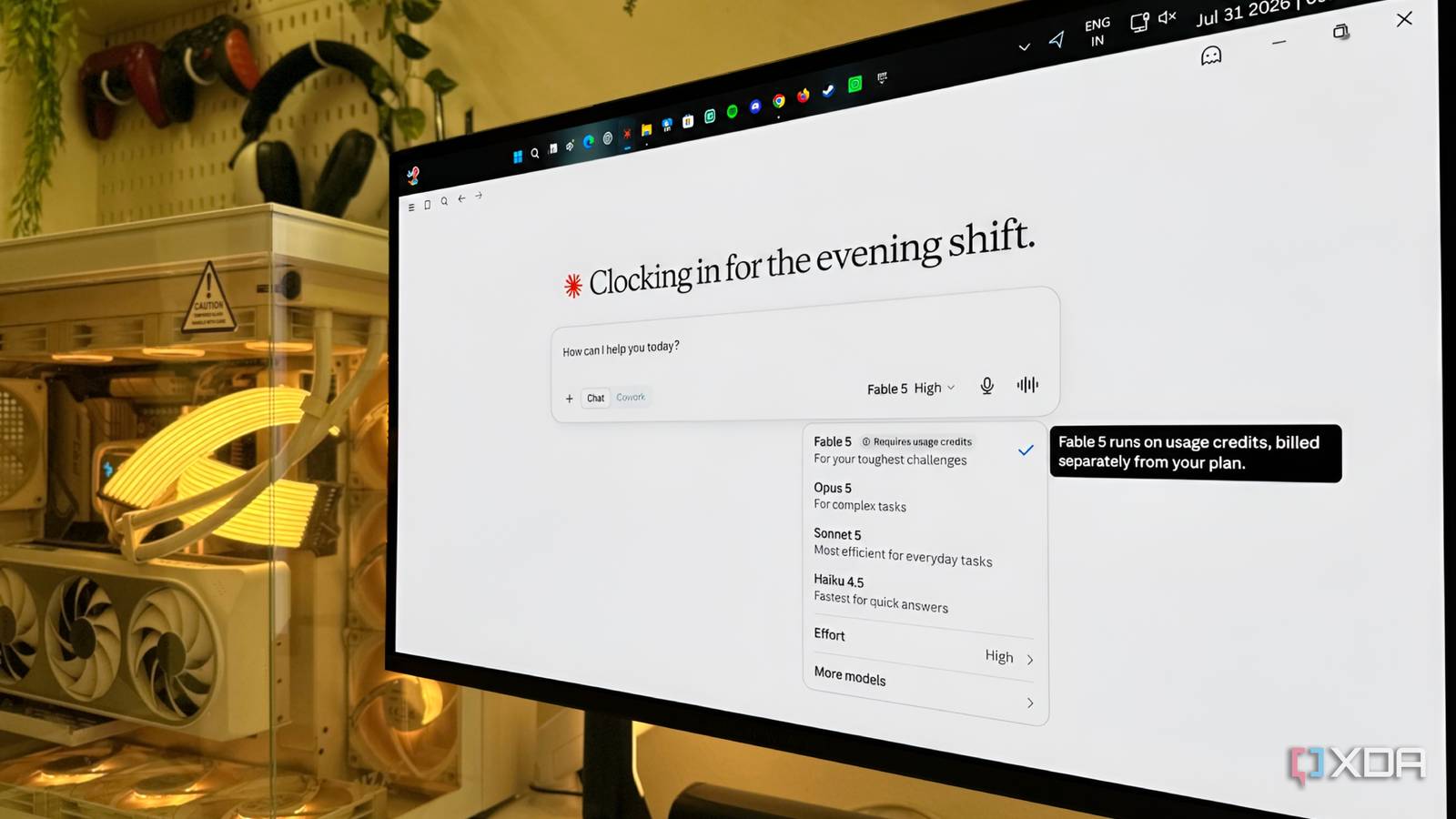
Published Aug 8, 2026, 6:17 PM EDT Mahnoor Faisal is a tech journalist covering AI and productivity tools with bylines at XDA, SlashGear, MakeUseOf, Laptop Mag, and Android Police. She's been writing professionally since she was sixteen, and has since penned hundreds of articles. This includes in-depth coverage of AI tools like NotebookLM to breaking news across the AI space. Her passion for technology started when she received her first iPod Touch (4th generation) on her 8th birthday, and she's been deep in the tech world ever since. Currently pursuing a degree in computer science, Mahnoor brings both a journalist's eye and a technical foundation to her coverage of how AI is reshaping the way we work and learn. By now, you've likely had the realization that AI tools are expensive. You might've realized that by looking at the price of your growing pile of monthly subscriptions. Or the thought might've hit you when you got the polite "you've hit the limit! please come back later" message after using your favorite AI tool for what felt like five minutes. I've experienced both, but Claude Code has made me particularly conscious of the latter. Coding agents can burn through an almost comical number of tokens while they're poking around a codebase, reasoning through a problem, calling tools, and occasionally doing far more thinking than the task seems to warrant. So naturally, I've started looking for ways to get the most out of Claude Code subscription. Turns out, changing one setting is all it took to make a surprisingly big difference. Claude Code lets you decide how hard it should think More thinking isn't always better When you ask an LLM a question, it doesn't instantly spit out an answer. Instead, it works through the problem internally before generating the response you actually see. The more complex the task, the more reasoning it may need to do. Of course, extra thinking means more tokens being consumed along the way. This translates to both more waiting on your end and more of your usage allowance being burned through in the background. That tradeoff can be worth it for genuinely difficult tasks, but it makes a lot less sense when the job is relatively straightforward. Claude Code already has a system designed around that exact tradeoff. Its newer models use what Anthropic calls adaptive reasoning, which means Claude can decide whether a particular step needs deeper reasoning and how much thinking is actually worthwhile. In theory, that lets routine tasks move along quickly while more complicated problems get the extra attention they need. Claude handles some of that automatically, but you still get a say in how much room it has to think. The main way to do that is through Claude Code's effort setting. Each effort level trades token usage against capability, so lowering it encourages Claude to be more economical with its reasoning, while raising it gives the model more room to work through difficult problems. There are five actual effort levels on the newest supported models. Low is intended for short, tightly scoped tasks where speed matters more than maximum intelligence. Medium reduces token usage for cost-sensitive work, with the possibility of sacrificing some capability in return. High is designed to balance token usage and intelligence, and is the default on most supported models. Xhigh gives Claude more room for deeper reasoning at a higher token cost, while Max pushes that even further. Anthropic even warns that Max can hit diminishing returns and become prone to overthinking. Claude Code also offers Ultracode in the same /effort menu, though technically it isn't another model effort level. Instead, it combines Xhigh reasoning with Claude Code's dynamic workflow orchestration for more substantial tasks. All it took was dropping Claude Code to Medium Claude doesn't need to overthink everything For my testing, I didn't do anything particularly dramatic. I left Claude Code on High, its default effort level for Sonnet 5, gave it five different coding tasks, and recorded the usage report after each one. Then I reset the codebase, switched Claude Code to Medium, and gave it the exact same prompts again. The tasks ranged from fixing a bug and adding a search feature to refactoring code, improving test coverage, and tracking down a performance bottleneck. I also made sure both effort levels started from the same untouched version of the project each time, so the only meaningful variable I was changing was the effort setting. The difference showed up almost immediately. On the simple bug-fixing task, Medium generated around 1,500 output tokens compared with 2,000 on High, a 25% reduction. The gap became much larger when I asked Claude Code to build a search feature: High burned through roughly 14,400 output tokens, while Medium finished the same task with around 7,500 — nearly 48% fewer. The pattern continued across the rest of my tests. Medium used about 54% fewer output tokens on the refactoring task, 40% fewer while improving test coverage, and 39% fewer while finding and fixing a genuine performance problem. Add everything together, and High generated roughly 26,000 output tokens across my five tests. Medium used around 14,300. That's a 45% drop in output token usage from changing a single setting. More importantly, Medium didn't suddenly start falling apart. It successfully completed all five tasks, and on some of the more open-ended tests, it reached almost exactly the same conclusions as High. When I asked both to find an under-tested piece of logic, for example, both independently chose the same task-completion function, discovered the same bug, applied the same one-line fix, and finished with all 12 tests passing. When I asked them to hunt for a performance issue, both spotted the same exact problem! The key is picking the right effort for the job Ultimately, I'm not suggesting you should permanently abandon High effort and force Claude Code to do everything on Medium. There are still going to be complicated debugging sessions, architectural decisions, and genuinely difficult problems where giving Claude more room to reason makes sense. But for the kind of everyday coding tasks I tested, High felt increasingly difficult to justify. Medium completed the same five jobs while generating 45% fewer output tokens, spending less time processing them, and showing no obvious drop in the quality of the results. At this point, I'd rather start on Medium and only turn the effort up when a task actually gives me a reason to.
I changed one setting in Claude Code, and my token burn dropped by 45%
Full Article
Original Source
Read the full article at Xda-developers →KhanList aggregates and links to publicly available news content. We do not host full articles from third-party sources. Always verify important information with original sources.