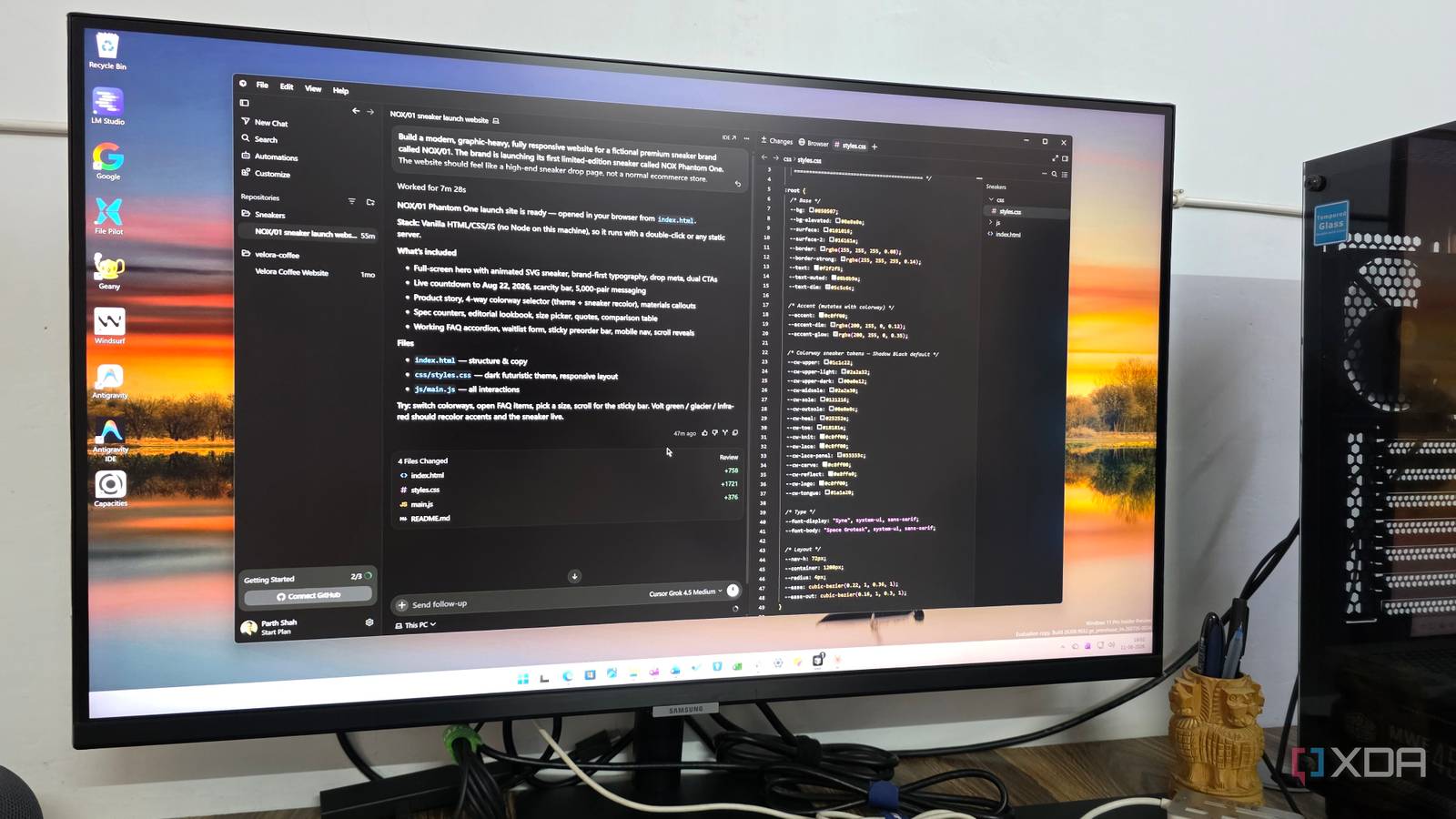
Published Aug 12, 2026, 7:30 AM EDT Parth, a seasoned tech writer, wields the keyboard (or pen) with finesse to unravel the intricacies of both Windows and Mac operating systems. He has covered evergreen content on mobile devices and computers for multiple publications over the last six years. You can find his work on AndroidPolice, GuidingTech and TechWiser. Whether it’s demystifying system updates, deciphering error codes, or exploring hidden features, Parth’s prose guides readers through the binary maze. When not immersed in tech jargon, you’ll find him sipping chai, pondering the next software review, and occasionally indulging in a friendly debate about mechanical keyboards. I thought I already knew what the best AI coding experience looked like. OpenAI and Anthropic have dominated the market to the point that I had almost stopped expecting anyone else to surprise me. Then I loaded a different model into Cursor and gave it the same kind of messy, real-world coding work I normally throw at my usual favorites. The results caught me off guard almost immediately. I expected another benchmark-chasing model Composer 2.5 lowered my expectations I did not go into Grok 4.5 expecting it to become one of my favorite models in Cursor. I had already spent plenty of time with Cursor’s Composer 2.5, and while it was fast and perfectly capable of handling smaller coding tasks, it never really impressed me when I pushed it harder. That experience changed the way I judge new coding models. I am no longer interested in benchmark scores or claims about being faster than the competition. A model can look fantastic on a leaderboard and still become frustrating when I have it in an actual project with dozens of files, existing design choices, and instructions that require some judgment. Composer 2.5 was useful, but it never made me want to abandon the Claude Code models I already trusted. So, when I started experimenting with Grok 4.5 in Cursor, my expectations were fairly modest. Grok 4.5 gets to the point quickly Its token efficiency is the real surprise Grok 4.5 impressed me when I used it to build a premium speakers website from scratch. I did not make things easy for it either. I gave Cursor a detailed prompt covering the overall look, page structure, product description, navigation, and the kind of polished visual experience I wanted. This was exactly the type of project where an AI coding model can easily spend ages planning, jumping between files, and burning through context before anything useful appears on the screen. Grok 4.5 behaved differently. It understood the direction quickly, started putting the site together, and moved through the project at a pace that stood out to me. Also, the website actually looked like something I could continue working with rather than a generic AI-generated storefront that needed to be rebuilt immediately. The bigger shock came when I looked at the token usage. It consumed only around 40k tokens for the entire website. This is where Grok 4.5 changed my perception of it. It was fast and economical. That is also why I don’t need Grok 4.5 to beat every OpenAI or Anthropic model in raw coding ability. If it can give me a result that is close enough or sometimes just as useful, while consuming fewer tokens and getting there faster, that is a trade-off I am willing to live by. Grok doesn’t overthink simple changes It works especially well for rapid iteration Another thing I noticed with Grok 4.5 is that it does not turn every small request into a major coding task. Once the sneakers website was up and running, I started making the usual round of tweaks: adjusting spacing, changing text, refining sections, fixing smaller UI issues, and asking it to rework several elements. Grok 4.5 was direct with these requests. I did not have to sit through long explanations or watch it inspect half the codebase for a change that only affected one component. It usually identified the relevant file, made the adjustment, and moved on. That sounds like a small thing, but it makes a huge difference when I am deep into a project and making dozens of minor changes. That also helps with the token usage. After all, if I ask for a minor visual tweak, I don’t want the model to reread unrelated files, generate a lengthy plan, and consume thousands of tokens before changing a few lines of code. It still isn’t my answer to everything Maybe Grok 4.6 can change that As impressed as I am with Grok 4.5, I am not ready to make it my default model for every coding task. There are still situations where I switch to Fable 5, especially when I am dealing with a complicated feature, a messy codebase, or a problem that needs deeper reasoning before touching the code. I trust Claude Code when a task involves several moving parts or when a single wrong decision could cause problems elsewhere in the project. That being said, I am looking forward to what Grok 4.6 brings to the table. It is expected to be released soon, and I am hoping it preserves that efficiency while improving its handling of complex tasks. Strong coding without the token bloat Grok 4.5 has not convinced me that OpenAI and Anthropic suddenly have nothing to worry about. That is not really the point. What impressed me is how effectively it works inside Cursor without constantly demanding a massive token budget to get there. For me, Grok’s efficiency matters just as much as raw intelligence. I will still reach for other models when a project demands them, but Grok 4.5 has earned a permanent spot in my Cursor setup. Cursor Cursor is a Grok-powered IDE that rivals Claude Code and VS Code.
I can't believe how good this AI coding model is, and it isn't from OpenAI or Anthropic
Full Article
Original Source
Read the full article at Xda-developers →KhanList aggregates and links to publicly available news content. We do not host full articles from third-party sources. Always verify important information with original sources.