
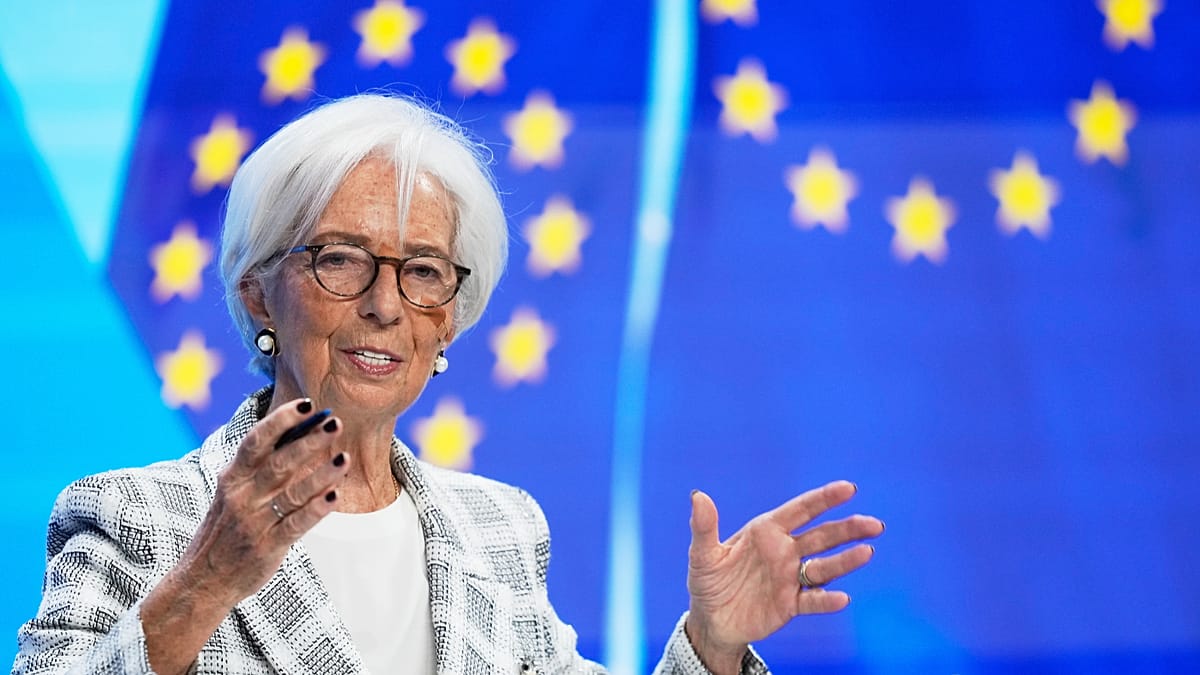
Christine Lagarde is leaving the European Central Bank (ECB) early because she no longer wants to stay silent. ADVERTISEMENT ADVERTISEMENT The ECB president, who will step down on 7 February 2027, around nine months before her term ends, said on Thursday that the neutrality expected of central bankers, which she described as "the price of their independence," was no longer something she could accept. “I don’t think that I can remain neutral,” she told reporters in Frankfurt. “I’m interested in the truth, and I see the truth being very often damaged, contradicted by misrepresentation,” she added. It was not the only surprise of the afternoon. Moments after the ECB left its key interest rates unchanged, with the deposit rate at 2.5%, Lagarde revealed that policymakers had seriously debated raising them instead. The decision to hold was unanimous, she said. But her message to markets was that the pause may only last until December. Why did the ECB come close to a hike? Two things have changed since the ECB’s last forecasts in September, Lagarde explained. The first is energy. Petrol, diesel and gas prices have kept climbing, and refining margins remain high. Eurozone inflation rose to 3.8% in September, with energy prices up 18.9% from a year earlier. The second is the cost of long-term borrowing. Lagarde said the average 10-year government bond yield in the eurozone had risen by around 35 basis points since the cut-off date for the September projections. That rise matters because it does part of the central bank’s job for it. When governments and companies pay more to borrow over ten years, mortgages and business loans get more expensive too, and spending slows. Mortgage rates already climbed to 3.8% in August from 3.5% in July, while banks tightened lending standards for companies in the third quarter. “If you combine these two factors, actually, the Governing Council debated whether a hike was appropriate,” Lagarde said. In the end, the council judged it was “well positioned enough at this stage to hold”, and that a “measured approach” remained appropriate. Is a December hike now on the cards? Lagarde repeated the ECB’s usual line that it decides “meeting by meeting” and is not pre-committing to any path. But she went further than usual. She listed the data the bank will receive before its December meeting, from two more inflation readings to third-quarter growth and wage figures, and said those numbers would be checked against today’s assessment. “Unless there were major developments, the direction of travel is quite clear for all of us,” she said. She added that underlying inflation, which strips out volatile items such as energy and food, would carry particular weight. What did Lagarde say about rising French bond yields? France was the elephant in the room. The country's 10-year borrowing costs rose above 5% last week for the first time since 2002, and the gap over German Bund yields has widened sharply. On Thursday afternoon, the French 10-year yield eased to about 4.88%, down around 3.5 basis points on the day. That still left it roughly 154 basis points above Germany’s, and about 40 basis points above Italy’s, a country long seen as the eurozone’s weakest link on public debt. Yet, Lagarde avoided explicitly naming France. She said the rise in long-term yields was global, driven by inflation expectations, the expected path of interest rates and the wave of bonds issued by large technology companies borrowing to build data centres. But she was clear that countries with high debt face a particular challenge. They must plan for interest rates that “will probably remain higher for a period of time”, she said, and keep their budgets within Europe’s fiscal rules. Asked whether the ECB was watching for the risk of contagion to other countries, Lagarde struck a firmer tone. “Should market developments threaten the smooth transmission of our monetary policy, including through unwarranted and disorderly market movements, we have instruments available to respond,” she said. In other words, the ECB is prepared to step in if turmoil in government bond markets becomes severe enough to stop its interest rate decisions from reaching households and businesses as intended. When another journalist raised the prospect of a new euro crisis, she did not engage with the comparison. “There will be developments, obviously, but this is not going to deter us,” she said. The ECB has stepped in before, buying the bonds of struggling eurozone countries during the debt crisis that began in 2010 and again during the pandemic, while its 2022 Transmission Protection Instrument has never been used. Oxford Economics does not expect it to be activated soon. Its baseline sees the French-German spread approaching 200 basis points by the time of next spring’s presidential election. Leo Barincou, a senior economist at the research firm, said in a note that there is “likely some room” between that scenario “and an actual debt crisis”. What's next? Lagarde said her mandate would have ended in October 2027 in any case. Leaving in February, she explained, gives her back the freedom to speak and act on issues beyond monetary policy. After more than 20 years at the IMF and the ECB, she added, there were things she felt she should say. “Whether people will listen or not is another story.” She declined to say whether she would back a candidate in France’s presidential election next spring, or what job she will take next. On the succession, she insisted there would be “perfect continuity of business”. “The institution is solid, strong like a rock,” she said. Not everyone is so relaxed about the timing. “The timing for the ECB is far from ideal,” Matthew Ryan, head of market strategy at financial services firm Ebury, told in an emailed comment, pointing to inflation well above target and a French-German spread at its widest since 2011. Ryan sees former Dutch central bank chief Klaas Knot and Bank for International Settlements head Pablo Hernández de Cos as the frontrunners. “The Bank has decided to kick the can down the road for now, but a quarter-point rise looks increasingly likely at December’s meeting,” Joe Nellis, head of economic research at accountancy and advisory firm MHA. Lagarde will chair two more ECB meetings, in December and February. The first may well bring the hike the bank debated this week. What happens after that is far less clear, because nobody yet knows who will take over once she leaves. Until a name emerges, that uncertainty will weigh on markets too. Investors “will now trade partly on rumours about the ECB’s new leadership next year, alongside the economic data”, Claus Vistesen of Pantheon Macroeconomics said in a note.
‘I cannot remain neutral’: Lagarde finally explains her early ECB exit
Full Article
Original Source
Read the full article at Euronews →KhanList aggregates and links to publicly available news content. We do not host full articles from third-party sources. Always verify important information with original sources.