
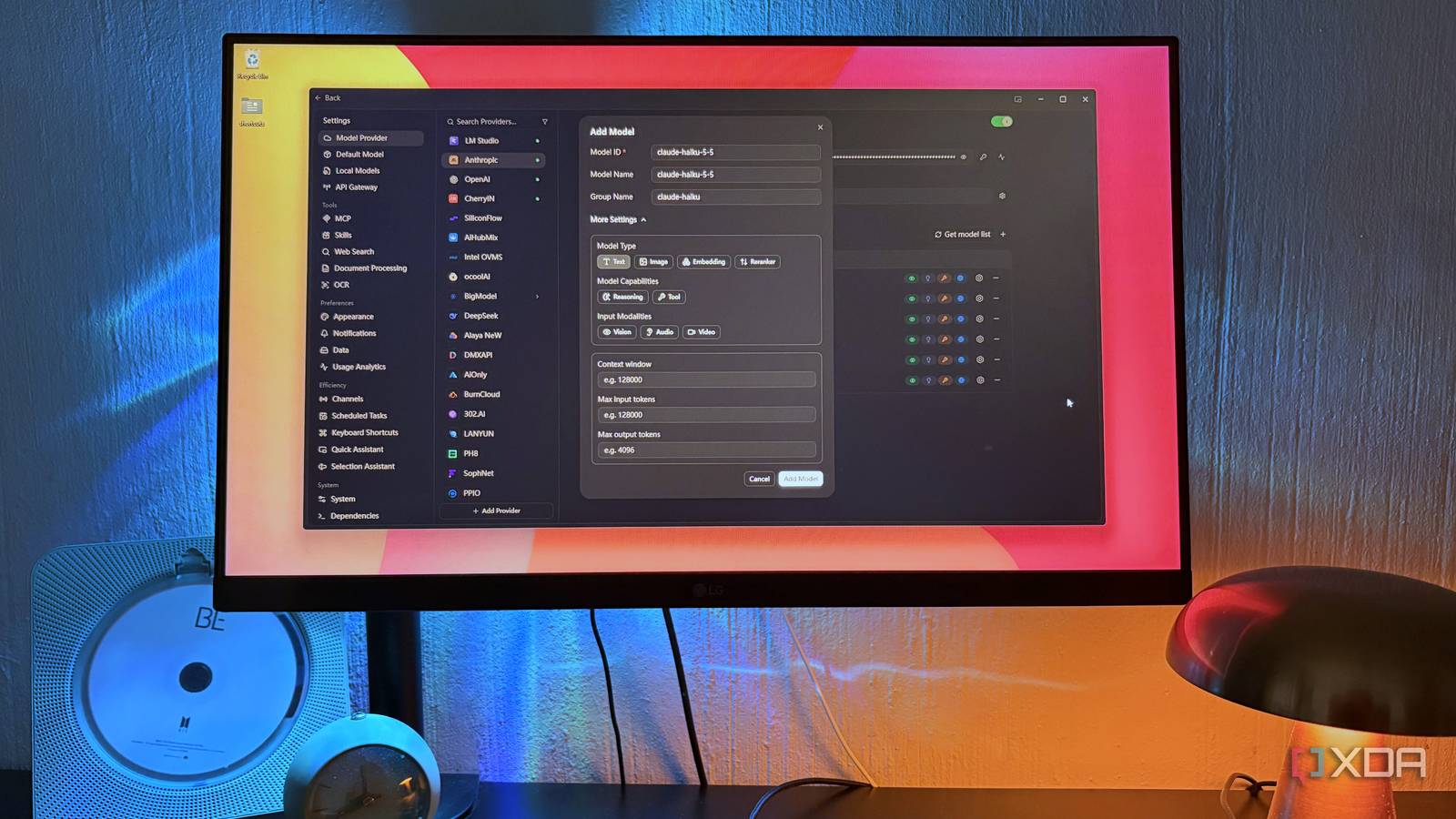
Published Oct 26, 2026, 7:30 AM EDT Nolen began their writing career in 2019, with three years dedicated to editing the Creative section at MakeUseOf. Their expertise lies at the crossroads of technology and creativity, covering areas like photography, video editing, and graphic design. Outside of work, you'll often find Nolen diving into a good book, writing their own stories, or playing video games. Twenty dollars a month for Claude Pro doesn't really feel like that much when you consider how much you're getting out of it, and it's also a price point you simply get used to. Pro gets you Anthropic's bigger models plus a stack of app features, which is great if you're leaning on Opus all day. But a lot of everyday AI use is smaller, and getting a concept explained here and there doesn't need a flagship model, and probably not a $20 bill either. Anthropic's cheapest model, Haiku 5.5, got a big price cut on the API recently, where you pay for what you use instead of a flat fee. Per-token pricing always looks good on a rate card, but this one in particular is quite impressive. What it means for an actual workday is harder to picture until you try it, so I left my subscription behind for a minute and plugged Haiku into a free desktop app to see if it could actually replace a Claude desktop setup. Haiku 5.5 is cheap, but it's not dumb A tenth of the price per token, with a couple of asterisks Haiku is the smallest of Anthropic's model lines, and Haiku 5.5 dropped in October this year as the replacement for Haiku 4.5. Anthropic built it for fast, high-volume work, like pulling details out of a pile of text or rapid-fire explainers for example, which truly covers a lot of what a regular day of AI use looks like for the average person. It's also a much smarter model than the old Haiku. It's the first Haiku with adaptive thinking and an adjustable effort setting, meaning it works out on its own how much to reason before it answers. Then there's the price: the input is $0.10 per million tokens and output is $0.50. Haiku 4.5 is listed at $1 and $5 respectively, so 5.5 is a tenth of the cost of its predecessor. This also happens to match what OpenAI charges for GPT-6 Luna, which is OpenAI's version of its cheapest advanced model. And I don't think this is a coincidence. That tenth doesn't fully hold up in practice, though, since Haiku 5.5 splits the same text into about 30% more tokens (the chunks API pricing counts) than Haiku 4.5 did. Anthropic's own estimate for the real saving is closer to 75%. Next to the $20 a month Pro plan I was paying for, it still works out to very little, though. Effort plays into this too, probably more than the tokenizer does, since thinking gets billed as output and higher effort means more thinking. Medium is the default, which is where I left it at. What I can do with Haiku 5.5, and what I had to give up The model is there, but the rest is your job now Using Haiku at API rates, first and foremost, means no Claude app. You grab your API key from Anthropic's Console and add it to whatever other workspace you want to pull the model into, and it will then send your messages to the model while Anthropic bills you per token. Pretty standard. My top pick for accessing both local and cloud models via API is Cherry Studio, mainly because I love the UI, it's so simple but also comprehensive. There are options that can do a similar job, like Jan, AnythingLLM, Msty, or even LibreChat and Open WebUI. For my setup in Cherry Studio, it took a couple of tries at first because Haiku 5.5 wasn't listed in Cherry Studio's model options yet so I had to add it manually. But once it was loaded, it handled all my usual stuff without a fuss. Explainers came back comprehensive but concise and readable, and when I asked for a tiny HTML timer it built one and previewed it right in the chat. I also dropped seven design docs into a single message and asked for every claim that needed a source, which it laid out in a table. Something really cool is that it admitted when it wasn't sure of something, flagging its own info as possibly being out of date. The trade-off is everything Claude Pro bundles around the models. Stuff like Projects, Memory, Claude Code, Artifacts, Claude Design, and the bigger models are all accessible from the Claude app. When you use other AI workspace apps, you have to build that setup yourself, and all the tools for it might not be at your disposal, so you'll probably have to give something up. This is exactly why I went with Cherry Studio, because it gives you things like Web and a filesystem MCP, making it pretty easy to replicate a similar workspace environment as Claude. On paper, Haiku is decent for local file work. It scored 72.4% on OSWorld, a test where models operate a computer, against 15.7% for Haiku 4.5. But it does tend to struggle a bit with complex reasoning and multi-step tasks, so I'd stick to the simple stuff like batch-renaming files. Also keep in mind that every file it reads counts towards your token count. Overall, it handles the basics like a champ, but it doesn't touch Opus for the complex reasoning and building work. The bill is small... but there's a catch Pennies a day, until a chat gets too long On my Console, the busiest minutes peak around 3,000 input tokens and under 800 output tokens. Even if every minute of an eight-hour workday ran at that pace, which it absolutely doesn't, that works out to roughly $0.33 a day. Over 22 working days that's about $7.30. Using it every single day of the month would still come in around $9.90, under half of Pro's $20. This is just a rough estimate since my use fluctuates a lot, but you get the picture. The catch is a pricing rule only Haiku 5.5 has. Once a request's prompt goes past 100,000 tokens, the whole request bills at $0.50 input and $2.50 output, five times the normal rate. Anthropic's pricing page counts cache reads and writes toward that limit as well, so caching doesn't get you out of it. Chat apps make it easy to creep up on, because every new message resends the conversation so far, attachments included. One way to circumvent this issue is starting new chats more often where you can, and Cherry Studio's own context settings can also stop it from resending the entire history every time. I don't miss the subscription as much as I thought Ditching my Pro setup for an API actually turned out perfectly fine, I managed to replicate most of my everyday AI use with Haiku 5.5 in a free app. Turns out, the thing I miss most about Claude isn't really the models, but the workspace around the models that let me do things like iterate on designs, use the in-app browser, or do complex tasks on my local files.
I cancelled my $20 Claude subscription for Anthropic's cheapest model at API rates, and it cost me less than half
Full Article
Original Source
Read the full article at Xda-developers →KhanList aggregates and links to publicly available news content. We do not host full articles from third-party sources. Always verify important information with original sources.